
Booz Allen Hamilton Advances Amid Government Contract Complexity and Rising Expenses
Robust government relations and compliance underpin Booz Allen's consulting model, though margin pressures emerge from rising costs.
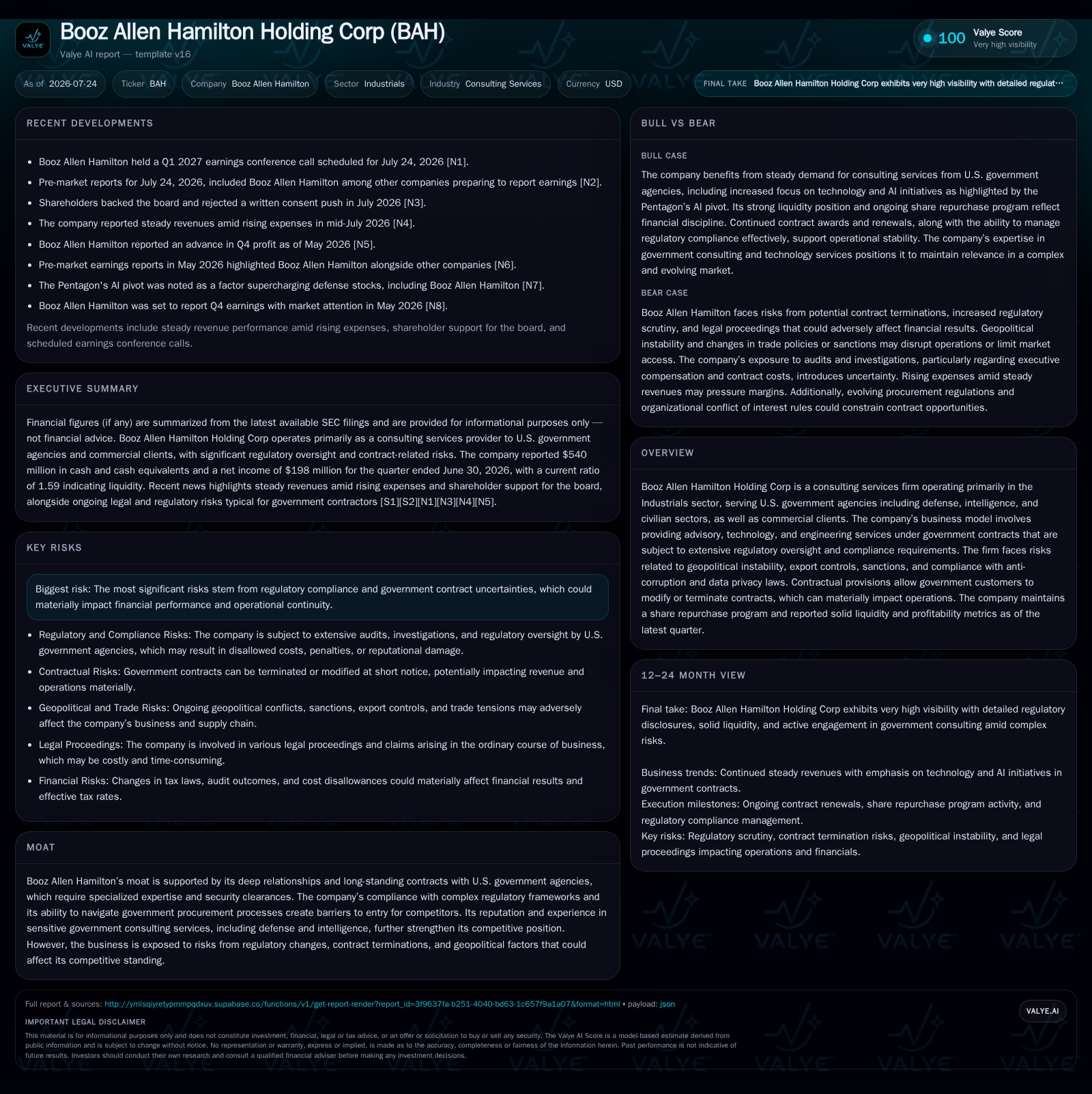
Booz Allen Hamilton Holding Corp reported its latest quarterly results reflecting steady government consulting revenues supported by a sizable contract backlog and strong delivery capabilities. The company’s specialized services in defense, intelligence, and civilian sectors benefit from industry barriers such as security clearances and regulatory expertise, underpinning competitive advantage. However, rising labor and technology-related expenses have compressed margins in the short term, marking a key operating challenge. Continued execution on AI-enabled offerings and cybersecurity services drives growth potential within a business tightly linked to evolving U.S. government spending and regulatory landscapes.
Recent Operating Update
Booz Allen Hamilton's most recent quarterly filing for the period ending June 30, 2026 reflects a continuation of its government-facing consulting operations with stable revenue streams derived from long-term contracts primarily with U.S. defense, intelligence, and civilian agencies [S2]. Despite macroeconomic uncertainties impacting budgets generally, Booz Allen's performance remains anchored by a sizeable contract backlog which provides meaningful near- to mid-term revenue visibility — a critical KPI given the complexity of government procurement processes and inherent contract variability [S1]. However, the quarter saw net income pressure attributable to rising labor costs and heightened investment in emerging technologies like artificial intelligence (AI) used to augment service delivery capabilities as well as sustain cybersecurity defenses, consistent with commentary from the earnings call [N1][N7]. This mix of steady top-line fundamentals combined with margin headwinds frames the current operating environment.
Business Model
Booz Allen operates within a specialized segment of the consulting services industry focused on professional advisory, technology integration, management consulting, and engineering support sold under diverse contract structures — primarily time-and-materials, cost-reimbursable-plus-fee, and fixed-price engagements with U.S. federal customers. Revenue recognition is closely tied to contract milestones or invoicing rights reflecting progress on obligations [S1]. The firm's ability to access classified projects depends on maintaining extensive security clearance infrastructure for its consultant workforce — a significant competitive barrier that limits entrants.
These contracts often embed variable fee provisions where incentive or award fees are contingent on performance metrics or client discretion; management employs conservative estimates recognizing only amounts probable not subject to reversal to estimate transaction prices [S1]. Contract profitability critically depends on the firm’s cost estimation accuracy at completion plus effective risk management around regulatory compliance demands including procurement integrity rules under continuous government audit. Adverse contract modifications or termination rights held by federal agencies introduce revenue risk despite backlog visibility.
Booz Allen also invests heavily in AI-driven analytics platforms deployed within national security frameworks alongside cybersecurity solutions designed to counter increasingly sophisticated threats amplified by advanced adversarial AI techniques. These technology capabilities both differentiate Booz Allen from broader management consulting peers such as Accenture while aligning it more closely with specialist government contractors like Leidos Holdings or CACI International known for defense-focused technology integration services.
Industry Structure and Competitive Position
The U.S. government consulting market is characterized by entrenched relationships between providers possessing requisite security clearances and demonstrated compliance disciplines. Booz Allen’s longstanding contracts with intelligence agencies underscore a durable moat founded on trust and past performance records — essential in an environment where procurement integrity is paramount and reputational damage can curtail future work considerably [S1]. Competition is fierce but structurally limited due to these barriers.
Peers such as Leidos Holdings emphasize large-scale system integration in defense while CACI International focuses heavily on intelligence community needs; Deloitte Consulting offers broader commercial advisory services but comparatively less classified project exposure. Booz Allen fits in this niche intersecting government consulting with advanced technology-enabled solutions—an intersection increasingly valuable given accelerated digital transformation mandates in government sectors.
Growth Drivers
Two primary themes propel Booz Allen’s growth outlook: first, sustained or rising U.S. federal discretionary spending emphasizing defense modernization, intelligence capabilities enhancement, cybersecurity hardening, and AI adoption. These areas are priorities amidst global geopolitical tensions spurring investments to counter emerging threats [S1]. Second, Booz Allen’s strategic pivot toward integrating AI technologies into core service offerings supports differentiated value propositions while addressing clients’ evolving operational challenges. Additionally, longer-term contract renewals underpin recurring revenue streams even if new wins fluctuate due to procurement timing.
Government-wide initiatives demanding enhanced data analytics capabilities alongside tightening regulatory requirements around data privacy provide incremental service opportunities for Booz Allen’s consultancy teams seasoned in navigating complex legal frameworks. Moreover, expansion into some commercial cybersecurity offerings complements predominantly federal work allowing modest client diversification [S1][N7].
Risks and Watchpoints
Operational risks prominently arise from regulatory compliance failures — any lapse could lead to suspended work eligibility or costly litigation given continuous audits by entities like the Defense Contract Audit Agency (DCAA) [S1]. The company explicitly flags cybersecurity breaches as a material threat capable of damaging reputation severely given the sensitivity of handled information spanning national security contexts.
Contracts inherently allow government clients rights to modify or terminate agreements unilaterally which injects revenue volatility beyond macro budget trends [S1][S2]. Geopolitical instability abroad remains a wildcard influencing U.S. spending patterns unpredictably especially if foreign conflicts de-escalate or accelerate rapidly.
Furthermore, wage inflation among specialized consultant ranks combined with need for continual technological investments impinges on profitability margins despite strategic price positioning; staying ahead technologically while managing cost structures will be critical going forward. Management turnover among key personnel holding security clearances can also disrupt service continuity.
What to Watch Next
Monitoring upcoming quarterly results for margin progression will be crucial given reported expense pressures [N7]. Tracking backlog composition changes offers insights into revenue sustainability amid contract renewals or new awards announcements. Additionally, assessing variable fee achievement rates embedded in many contracts will help gauge final profitability outcomes relative to guidance disclosures when available.
Further developments around adoption of AI tools internally versus those sold externally may inform scalability prospects. Finally, shareholder responses to ongoing capital allocation plans including share repurchases could reflect market confidence levels in financial health balanced against reinvestment needs [S2].
Financial Profile Discussion
As of June 30, 2026, Booz Allen reported cash and equivalents of $540 million alongside current assets totaling approximately $3.04 billion supporting liquidity needs [F1]
The share repurchase program remains active; during Q4 FY26 nearly 760 thousand shares were repurchased indicating management’s willingness to return capital while balancing investment allocations for growth initiatives [S2]. No defaults or material changes in internal controls were noted during the quarter highlighting continued governance stability.
This analysis synthesizes filing data through July 24, 2026 combined with recent news disclosures without projecting or guiding future financial performance beyond publicly stated facts and should not be construed as investment advice.
Disclaimer: This is research-only, informational analysis and not investment advice. It may include AI-generated interpretation and general industry context. Always verify important details using primary sources.

Comments