
Lamb Weston’s Volume Growth and Cost Initiatives Offset Pricing Pressure in Frozen Potato Market
Despite pricing and margin challenges, Lamb Weston advances through volume gains, joint ventures, and operational efficiencies across North America and international markets.
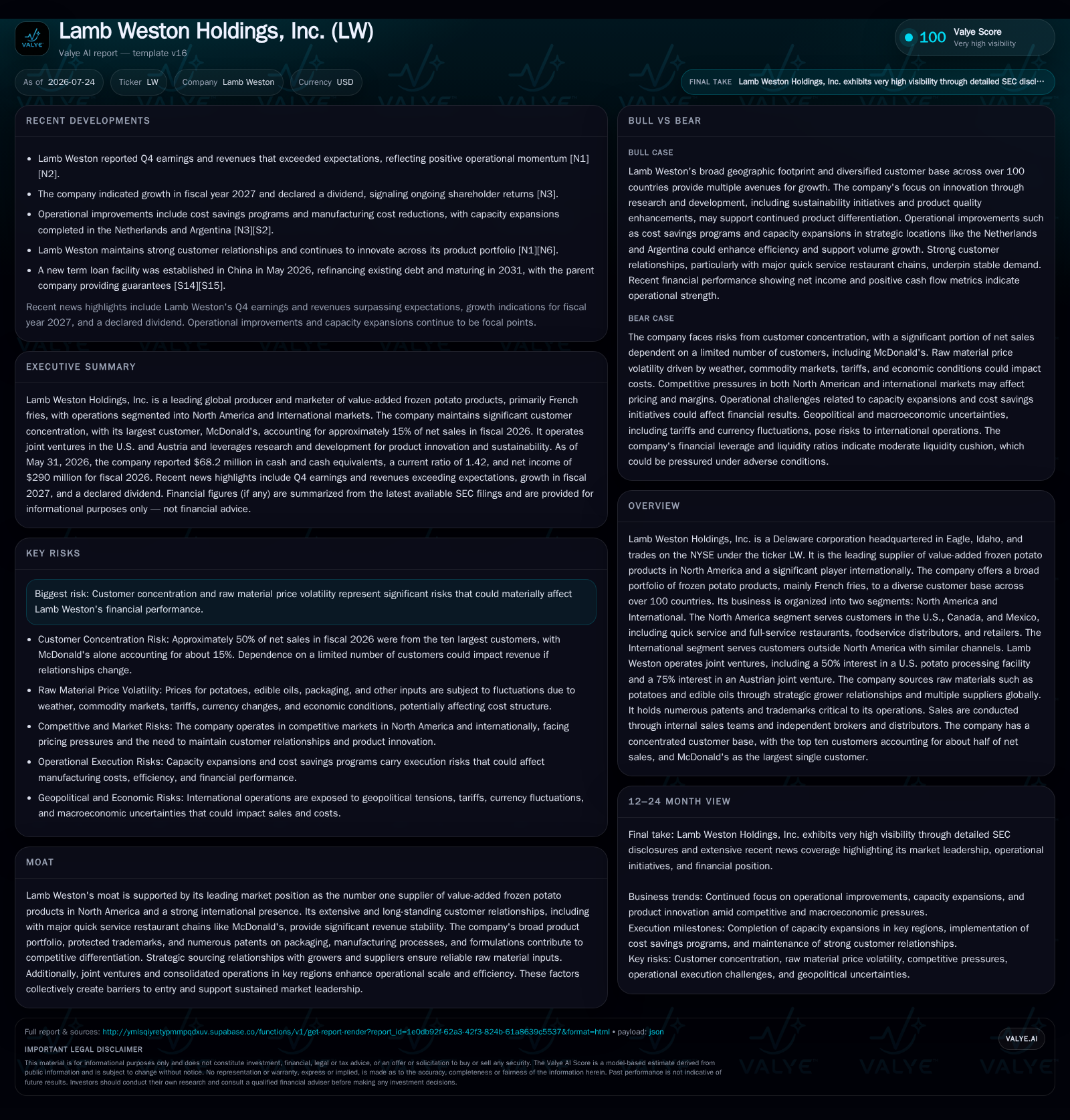
In its latest quarter ending February 2026, Lamb Weston Holdings, Inc. saw a modest sales increase driven primarily by volume growth—especially in North America and Asia—that offset ongoing pressure on price and mix. The company maintains its leadership as the largest North American supplier of value-added frozen potato products, leveraging a broad product portfolio and significant joint ventures to expand capacity and geographic reach. Raw material cost volatility and customer concentration risks persist as critical factors shaping financial performance. Cost savings programs and facility expansions in Argentina and the Netherlands underpin long-term volume growth despite near-term earnings pressure from input costs and pricing support initiatives.
Recent Operating Update
Within the North America segment—the company's largest market—revenue decreased by 2%, reflecting a price/mix decline of 7% driven by prior year pricing investments plus channel mix effects [S28]. However, this was more than offset by a strong volume gain of 5%, fueled by recent customer wins, contract retention across quick service restaurant (QSR), foodservice distributors, and retail channels, highlighting resilient demand dynamics despite competitive pressures
Internationally, sales improved by 4%, buoyed wholly by foreign exchange factors; underlying volumes rose by 6%, largely attributable to growth in Asian markets and multinational foodservice chains [S28]. Price/mix under constant currency declined by approximately 6%, reflecting ongoing promotional support to sustain customer relationships amid competitive environments
Gross profit contracted $13.6 million compared with the prior year period due principally to unfavorable price/mix headwinds but was cushioned by enhanced production volumes, reduced manufacturing unit costs enabled through ongoing cost reductions, and absence of a prior-year $39 million voluntary product withdrawal charge [S22]. Selling, General & Administrative (SG&A) expenses increased nominally by $9.7 million on a GAAP basis; however, adjusted SG&A fell $24 million thanks to cost efficiency programs that have lowered daily operating expenses over recent quarters [S22].
Business Model Overview
Lamb Weston operates predominantly as a manufacturer and distributor of value-added frozen potato products with French fries representing the majority share of its extensive product portfolio. It serves multiple customer segments including large QSR chains (notably McDonald's), full-service restaurants, foodservice distributors, retailers (grocery chains, mass merchants), non-commercial entities (like educational institutions), and private label customers across over 100 countries [S1,S24].
The company monetizes through direct sales agreements structured across these channels with varying contract lengths—often anchored with major QSR players requiring consistent quality standards backed by patented formulations, proprietary manufacturing know-how, innovative packaging solutions, and rigorous food safety compliance. Revenue drivers include unit sales volume influenced by menu penetration or retail shelf presence as well as net realized prices adjusted for promotional discounts or trade investments.
Operationally, Lamb Weston’s business includes owning or holding interests in strategic joint ventures: notably a 50% equity interest in Lamb Weston/RDO Frozen Co., which operates a U.S.-based potato processing facility accounted for under the equity method; alongside consolidation of a 75%-owned Austrian JV focused on European market penetration. These alliances expand manufacturing capacity without wholly assuming capital costs yet amplify geographical coverage while enabling shared expertise in sourcing raw potatoes [S1,S24]
Industry Structure & Competitive Position
The frozen food manufacturing industry revolves around capital-intensive processing facilities that require optimal capacity utilization to manage fixed costs effectively. Market segmentation is dictated by product specialization—Lamb Weston's mastery resides in frozen potato products targeting QSRs who demand large-scale consistent supply.
Key peers include Conagra Brands’ frozen division and Canada’s McCain Foods which compete on innovation cycles (new product formats), scale efficiencies, geographic diversification, pricing leverage with major chain customers, and supply chain robustness.
Lamb Weston’s moat stems from its number one North American market share position augmented by patents protecting key proprietary processes and packaging technologies, long-standing relationships with marquee customers like McDonald’s representing ~15% of overall sales—a relationship reinforcing recurring revenue stability—and joint ventures supporting scaled production footprint internationally easing entry barriers [S1,S24]. However, customer concentration remains one risk factor given reliance on few large buyers accounting for roughly half the revenue base.
Growth Drivers
Volume expansion remains central with Lamb Weston capitalizing on rising global preference for convenience foods amid evolving consumer habits favoring frozen ready-to-cook products in QSRs and retail grocery alike.
Capacity investments at recently commissioned Argentina facilities (completed Q1 fiscal 2026) along with modernization efforts in the Netherlands furnish incremental output designed to capture expanding emerging-market demands alongside saturating mature markets. This geographic diversification mitigates regional macro uncertainties while tapping high-growth areas where frozen food consumption penetration is still nascent relative to North America.
Innovation via research & development supports both organic growth—through new product offerings tailored for health trends or menu diversification—and operational excellence programs aimed at reducing water usage, minimizing waste streams during processing thus lowering variable costs per unit shipped [S26].
Cost savings derived from restructuring plans directly affect gross margin resilience against raw material inflationary pressures—fluctuations in potato prices being an inherent challenge for the sector with impacts rippling directly into input cost per unit sold.
Lastly, collaborative joint ventures serve dual roles: operational scale augmenting capacity without full capital burden; plus local market expertise funneling distribution efficiencies vital for maintaining order fulfillment rates across complex international supply chains.
Risks & Watchpoints
Raw material price volatility remains paramount as potato crop yields and prices fluctuate due to weather variability or geopolitical trade effects impacting agricultural commodities globally.
Customer concentration—with top ten clients accounting for half revenues—particularly McDonald’s at ~15%, introduces dependency risk should contract terms evolve unfavorably or if there’s loss of volume from any significant player impacting revenue predictability.
Competitive pressures from private label manufacturers pose threats especially within retail grocery channels where margin sensitivities heighten competition possibly forcing additional price concessions.
Supply chain disruptions including logistics bottlenecks or manufacturing downtime could impair capacity utilization rates damaging delivery schedules critical for foodservice clients reliant on menu consistency.
Macroeconomic factors such as inflation affecting labor costs or energy inputs further compress margins despite underlying volume strength.
Currency fluctuations represent an international risk translating into reported results given multi-currency operations across Europe and Asia.
Current assets of $2.01 billion and current liabilities of $1.42 billion imply a current ratio of approximately 1.42x, indicating a moderate liquidity cushion suitable for ongoing operations [F1]
Capital expenditures decreased recently reflecting completion of major growth projects though monitored closely given ongoing modernization needs.
Effective tax rates fluctuated influenced partly by discrete adjustments related to international deferred tax assets suggesting an area sensitive to jurisdictional profitability shifts [S13,S22]
In sum, Lamb Weston's financial profile reflects typical sector traits blending cyclicality of agricultural inputs with steady consumer demand support amplified through strategic facility expansions and operational rationalization programs aimed at sustaining profitability over time.
This analysis synthesizes recent SEC filings alongside sector fundamentals appropriate to frozen food manufacturers emphasizing Lamb Weston's leadership in frozen potato products across key global geographies supported extensively by durable customer relationships and operational scale noted through joint ventures and strategic investments. It excludes investment advice but focuses clearly on firm positioning within industry dynamics relevant for informed stakeholder appraisal.
Disclaimer: This is research-only, informational analysis and not investment advice. It may include AI-generated interpretation and general industry context. Always verify important details using primary sources.

Comments