
American Express Reports Strong Second-Quarter Card Member Spending Boosting Growth Outlook
Robust card member spending underpinned American Express's Q2 revenue gains despite heightened credit loss provisions and regulatory scrutiny.
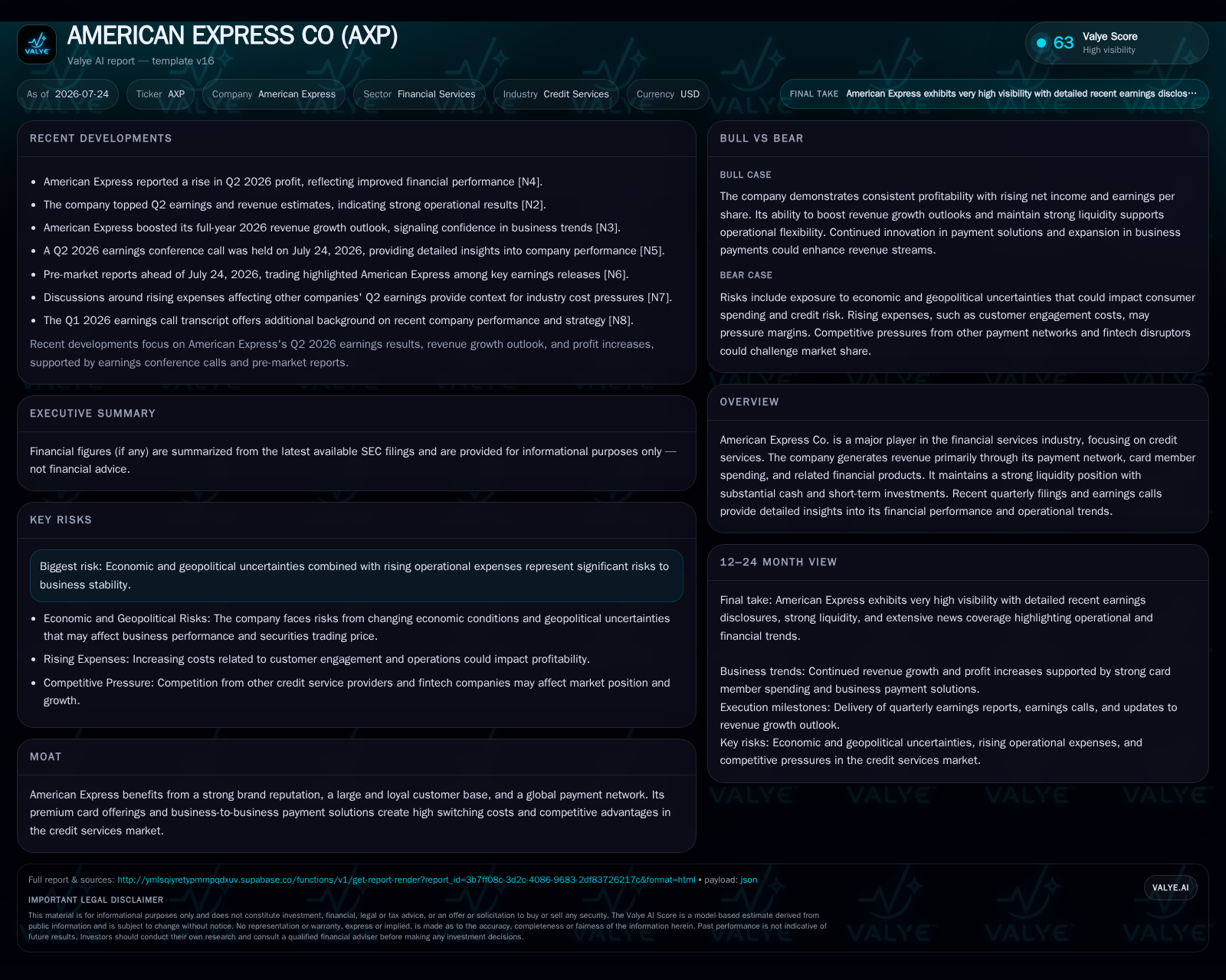
American Express’s Q2 2026 results reveal accelerated card member spending growth fueling revenue momentum and prompting an upward revision to full-year revenue expectations. The company’s integrated issuer and payment network model sustains premium merchant discount fees supported by strong loyalty programs. However, rising delinquency rates amid macroeconomic uncertainty have driven increased provisions for credit losses, emphasizing the need for vigilant credit risk management. Competitive pressures from fintech players and regulatory developments underscore ongoing challenges even as digital payment expansions and strategic partnerships offer growth potential.
Q2 Results Reveal Accelerated Card Member Spending Driving Revenue Momentum
American Express's second-quarter 2026 financial disclosures reveal a notable acceleration in card member spending that propelled top-line performance beyond consensus estimates [S2][N1][N3]. This surge in total transaction volume expanded revenue streams from both merchant discount fees—reflecting the premium pricing Amex commands from merchants for card acceptance—and net interest income generated from revolving credit balances carried by cardholders. The company reported broad-based spending growth across consumer and business segments, with particular strength in travel and entertainment categories, which typically involve higher average transaction sizes and contribute disproportionately to fee income [S2].
This increase in card member spending directly impacts key operating KPIs such as total transaction volume and average cardholder spend, critical drivers of Amex’s non-interest revenue. These fee-based revenues, derived from merchant discount fees and cardholder fees, complement interest income from revolving credit balances, underscoring the dual revenue streams inherent in Amex’s integrated business model. The robust spending trends helped offset headwinds from rising provisions for credit losses driven by macroeconomic volatility, including elevated delinquency rates [S3]. The sustained momentum highlights resilience in consumer engagement with Amex’s premium card offerings, though it also increases exposure to credit risk through higher outstanding balances and revolving credit utilization.
The significance of these trends lies in the validated demand elasticity within Amex's premium cardholder base, reinforcing its ability to generate differentiated non-interest fee income distinct from pure payment network operators such as Visa or Mastercard, which primarily monetize interchange fees without direct lending exposure [S2][N5]. Monitoring whether this elevated spending trend persists amid evolving economic conditions will be a key directional indicator for revenue durability and credit risk management
American Express’s Integrated Payment Network and Issuer Model Supports Premium Pricing Power
American Express operates a vertically integrated business model combining both card issuer and payment network roles, enabling it to capture value across multiple points in the transaction lifecycle [S1]. Unlike Visa or Mastercard, which function solely as network facilitators collecting interchange fees passed through issuing banks, Amex issues cards directly to consumers and businesses while simultaneously managing its proprietary global payment network. This integration allows Amex to command higher merchant discount fees, reflecting the enhanced value delivered by its premium card programs and differentiated merchant services.
The company’s portfolio emphasizes affluent consumer cohorts attracted by exclusive rewards and services embedded within its premium card offerings. Loyalty programs play a central role in sustaining high customer retention and wallet share by fostering stickiness through benefits such as airport lounge access, travel protections, dining experiences, and concierge services. This Membership Model creates meaningful switching costs, supporting pricing power and limiting commoditization risks in a competitive payments landscape.
Amex’s ability to cultivate such a comprehensive ecosystem supports sustained non-interest revenues that complement net interest income derived from revolving credit balances [S1][S2]. By securing engagement from both spending-oriented customers and those carrying balances, Amex optimizes profitability while maintaining alignment between product experience quality and rewards expense efficiency
Emerging Credit Risk Trends Reflect Macroeconomic Uncertainty Heightening Loss Reserves
Despite strong transactional growth, American Express’s latest filings indicate rising delinquency rates and increased provisioning for credit losses, reflecting heightened macroeconomic uncertainty [S3][S20]. Factors such as fluctuating employment levels, consumer confidence variability, and geopolitical tensions contribute to greater uncertainty regarding card members’ repayment capabilities.
The company has adjusted its loan loss reserves upward to anticipate higher charge-off rates consistent with peer industry trends during economic stress periods [S3]. Amex’s credit risk management framework incorporates dynamic monitoring of key indicators including delinquency rates, net charge-offs, paydown and revolve behaviors, and vintage loan performance. These metrics inform reserve builds that absorb expected impairments on the loan portfolio
While Amex maintains stringent credit underwriting standards and robust fraud detection systems, the increased provisions represent a prudent response to potential cyclical pressures impacting even its loyal premium customer base. This uptick in credit loss reserves introduces a near-term earnings quality variable sensitive to macroeconomic developments and consumer credit behavior shifts [S3][S20]
Competitive Dynamics: Balancing Market Challenges with Brand Strength and Innovation
American Express operates in a highly competitive environment alongside traditional payment networks like Visa and Mastercard, large credit card issuers such as Capital One and JPMorgan Chase, and fintech disruptors including PayPal and Square. Each competitor varies in business model focus, with Amex’s vertically integrated issuer-network model distinguishing it from network-only operators and fintech platforms [S1].
Amex’s strong brand equity and premium positioning provide a defensive moat against competitive encroachments, but continuous innovation remains essential. The company invests in technology enhancements such as AI-driven personalization, mobile wallet integration, and seamless digital interfaces to boost user engagement and deepen customer relationships [S19]. These innovations also enhance fraud detection and credit risk analytics, critical in managing portfolio quality amid rising credit loss provisions.
Sponsorships of premium lifestyle events and ongoing investments in upgrading authorization and merchant acquiring platforms sustain Amex’s relevance amid marketplace shifts favoring convenience and real-time payment capabilities. However, regulatory pressures on interchange and merchant discount fee structures, as well as merchant negotiating power, remain persistent challenges that could constrain margin expansion [S3][S20]
Growth Catalysts Rooted in Loyalty Programs, Digital Payments Expansion, and Strategic Partnerships
American Express is advancing growth initiatives focused on expanding its premium and co-branded card portfolio, targeting younger demographics such as Millennials and Gen Z who demonstrate increasing preference for cashless and digital payment methods [S1][N4]. Enhanced loyalty programs aim to improve customer retention and increase wallet share by offering more personalized and flexible reward redemption options linked to travel, dining, and entertainment.
The acceleration of e-commerce globally drives higher card usage volumes, while strategic partnerships with merchants and fintech platforms broaden Amex’s market access beyond traditional channels [S8]. In the B2B payments segment, which benefits from structural tailwinds, Amex leverages tailored expense management and payment solutions to enhance client stickiness and capture incremental revenue streams.
The company is also investing in emerging technologies such as agentic commerce platforms that integrate AI tools to anticipate future transaction paradigms and unlock new revenue pools [S18]. The success of these initiatives depends on effective scaling from pilot programs to broad deployments with positive unit economics
Risks Highlighted by Rising Operational Costs, Regulatory Scrutiny, and Macroeconomic Factors
Operating expenses increased in the quarter, driven by investments in technology infrastructure upgrades—including AI automation—and compliance functions necessitated by intensifying regulatory scrutiny [S3][S9]. These cost pressures affect the cost-to-income ratio despite revenue growth, highlighting the challenge of balancing innovation investments with operational efficiency.
Regulatory risks include potential caps on card acceptance fees, interest rate ceilings, or changes to credit underwriting practices that could materially compress margins or restrict business flexibility. Additionally, reputational risks arising from litigation, fines, or customer remediation require rigorous governance and risk management to preserve brand integrity [S20][S23].
Macroeconomic uncertainties, including geopolitical conflicts and inflationary pressures, may impact international card usage patterns and consumer spending behavior. These factors could alter transaction volumes and credit performance, necessitating vigilant monitoring and adaptive risk management strategies.
What To Monitor — Indicators That Will Confirm Execution Trajectory or Signal Headwinds Ahead
Key indicators to watch in upcoming quarters include the trajectory of card member spending growth segmented by consumer demographics and business verticals, particularly in travel and entertainment categories [S2][N5]. Stabilization or improvement in delinquency rates following recent reserve builds would signal a more favorable credit cycle outlook.
Execution of the share repurchase program will provide insight into management’s confidence in capital allocation amid evolving regulatory capital requirements. Progress in launching new commercial payment products and expanding digital payment ecosystems will be critical to validating growth investments and increasing wallet share [S12][S18].
Regulatory developments affecting merchant acceptance economics and fee structures will be pivotal in projecting sustainable non-interest revenue growth. Additionally, metrics on technology adoption and user engagement intensity will offer predictive insight into customer loyalty and revenue durability.
Financial Profile Discussion — Liquidity Strength Amid Elevated Credit Loss Provisions
American Express reported cash and cash equivalents of $43.4 billion and total debt of approximately $56.6 billion as of year-end 2025, resulting in a moderate net debt position near $13.2 billion [F1]. This liquidity position supports operational flexibility, enabling continued investment in growth initiatives despite increased provisions for credit losses tied to recent portfolio risk assessments [S2][S3].
Net interest margin remains supported by favorable lending spreads, although it is sensitive to benchmark interest rate fluctuations that affect asset-liability repricing dynamics. Operating margins reflect a balance between revenue gains from transaction volume growth and expense increases related to technology modernization and compliance investments.
Capital allocation priorities appear focused on maintaining capital ratios above regulatory minima while preserving capacity for strategic acquisitions or share repurchases, contingent on market conditions and earnings visibility. This financial robustness underpins Amex’s premium franchise as it navigates evolving credit risk and regulatory environments.
This analysis synthesizes American Express’s recent SEC filings and market disclosures, interpreting key operational developments within its integrated issuer-network business model against prevailing industry dynamics. It provides a sector-specific perspective on revenue drivers, credit risk trends, competitive positioning, and financial resilience without offering investment advice or market research views.
Disclaimer: This is research-only, informational analysis and not investment advice. It may include AI-generated interpretation and general industry context. Always verify important details using primary sources.

Comments