
Texas Instruments Leverages Broad Analog Strength Despite Macroeconomic Challenges
Texas Instruments’ Q2 results reveal a broad-based demand rebound in analog semiconductors amid ongoing geopolitical and supply chain uncertainties.
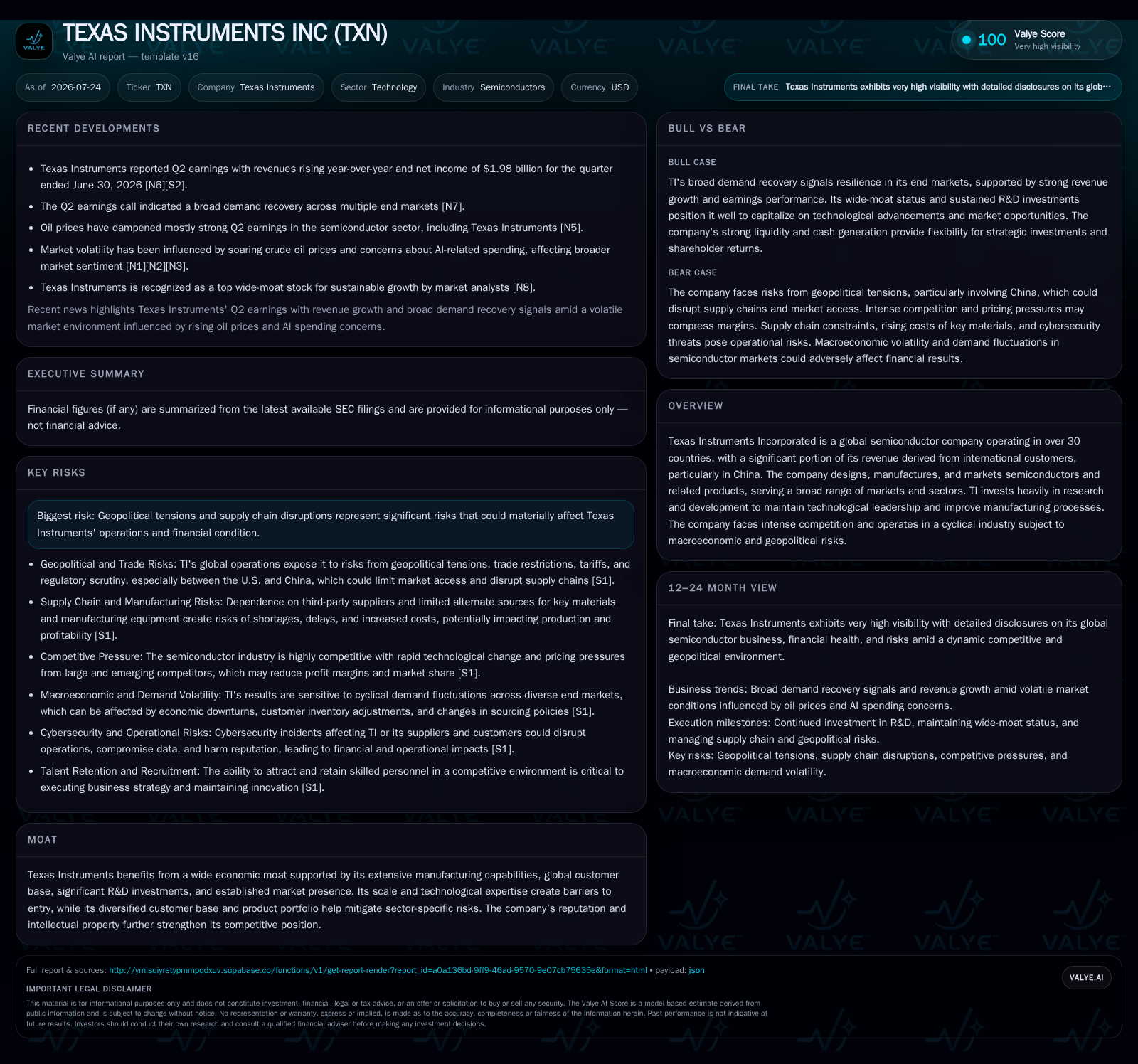
In its latest quarterly filing, Texas Instruments (TI) demonstrated improving unit shipments and average selling prices (ASPs), signaling robust demand recovery across diverse end markets. The company’s integrated device manufacturing model provides control over capacity utilization and manufacturing yield, a critical advantage amid industry cyclicality. However, persistent geopolitical tensions, especially related to China’s substantial revenue exposure, and intensifying competition pose notable risks. Sustained R&D investment anchors TI’s competitive moat, supporting innovation in analog and embedded processing products aligned with strong growth drivers in automotive, IoT, and industrial segments.
Q2 Operating Momentum Reflects Broad-Based Analog Demand Rebound
Texas Instruments' Q2 2026 report presents clear evidence of recovery after prior cyclical softness. The company reported increases in unit shipments coupled with upward trends in average selling prices (ASPs). This dual improvement signals not only volume demand gains but also stable pricing power within their analog and embedded processing product portfolio. These dynamics suggest that major end markets — spanning industrial, automotive, and consumer electronics sectors — are broadly re-accelerating purchases of TI’s integrated circuits (ICs), which predominantly consist of analog semiconductor wafers and embedded processing chips designed internally [S2], [S3]. The Q2 commentary also highlighted gradual improvements in manufacturing capacity utilization rates as fabs increased output to meet replenishing orders. Such signs collectively point to an inflection point in the semiconductor cycle for TI.
TI's IDM Model: Manufacturing Control as Competitive Advantage Amid Cyclical Upswing
Texas Instruments operates as an Integrated Device Manufacturer (IDM), controlling both semiconductor design and its own fabrication plants (fabs). This vertically integrated model contrasts with fabless peers reliant on third-party foundries. It allows TI to directly manage capacity utilization—a crucial lever given the capital-intensity of semiconductor fabs where costs are largely fixed due to depreciation and maintenance regardless of output levels [S1]. As industry demand fluctuates cyclically, TI can optimize fab loading to balance inventory build versus obsolescence risks and margin preservation. Management’s ability to modulate wafer production aligns capacity with recovering unit shipment trends while preserving yield rates critical for profitability. This operational control enhances resilience versus fabless competitors dependent on foundry lead times and availability when chip shortages occur. Moreover, TI's investment in maintaining its own mask sets for custom analog IC designs bolsters time-to-market responsiveness, crucial during volatile ordering cycles.
Global Market Exposure: Balancing China Revenue Contribution Versus Geopolitical Challenges
Approximately 50% of TI's revenue derives from products shipped into China, with around 20% sourced from end customers headquartered there [S1]. This geographic concentration exposes the company to substantive geopolitical risks amid ongoing US-China tensions impacting trade policies, export controls, tariffs, and supply chain stability. Restrictions or disruptions could impede TI's ability to deliver products or access critical manufacturing equipment sourced globally. Additionally, Chinese government incentives promoting domestic semiconductor champions intensify competitive pressures within this strategically important market. TI’s broad customer diversification mitigates concentration risk somewhat; however, escalation in geopolitical frictions remains a significant watchpoint given its potential impact on sales volume and pricing dynamics within the largest regional segment.
Sustaining Innovation: Elevated R&D Intensity Anchoring TI's Narrow Moat
TI consistently allocates a substantial portion of revenue towards research and development efforts aimed at advancing analog semiconductor technology and embedded processor platforms [S1]. This investment underpins its competitive moat by enabling differentiation through proprietary designs optimized for power efficiency, integration density, and application-specific features that customers value highly. Benchmarking indicates TI’s R&D spend as a percentage of revenue is roughly on par or slightly higher than analog-focused peers such as Analog Devices—indicative of commitment to sustaining technological leadership in a rapidly evolving market. Robust R&D fuels pipeline progression necessary to maintain pricing power against emerging low-cost alternatives and supports rapid time-to-market essential for capturing innovation-driven end markets like automotive electrification and industrial automation.
Risks Highlight: Supply Chain Resilience and Pricing Pressure from Intensifying Competition
Despite positive momentum, TI faces multiple headwinds articulated explicitly in recent risk disclosures [S1], notably supply chain fragility manifested through prolonged chip shortages influencing raw materials availability and manufacturing equipment lead times. Additionally, aggressive competition is growing from Asian incumbents backed by substantial government subsidies as part of strategic efforts by countries such as China to cultivate self-sufficiency in semiconductor production. Such players may compete vehemently on price or accelerate product development cycles aided by state support—threatening margin erosion for established global suppliers like TI. Compounding these challenges are tariff uncertainties which add cost volatility for cross-border shipments critical to TI's complex multi-tiered supply network.
Growth Vectors in Automotive, IoT, and Industrial Electronics Demand
TI's product portfolio is well-positioned to capitalize on secular growth tailwinds transforming end markets. Increased semiconductor content per vehicle driven by electrification, autonomy features, and advanced driver-assistance systems creates substantial analog IC demand within automotive electronics—a segment growing faster than traditional computing chips. Furthermore, the explosive expansion of Internet-of-Things (IoT) devices worldwide drives need for low-power analog sensors and embedded processors that TI produces extensively. Industrial automation growth tied to smart factories also propels mixed-signal chip consumption supporting motor controls, power management, connectivity interfaces, and safety systems [S1]. These diversified secular drivers partially insulate TI from consumer electronics cycles while prioritizing segments requiring increasingly sophisticated chip performance.
Financial Footing: Solid Liquidity and Capital Allocation Support Strategic Flexibility
From a financial standpoint, Texas Instruments maintains a robust liquidity profile with cash & equivalents totaling approximately $3.7 billion at quarter-end June 30, 2026 [F1]. Coupled with reported total debt near $14.15 billion resulting in net debt around $10.5 billion after cash offsets [F1], the firm's balance sheet exhibits manageable leverage levels consistent with capital-intensive industry norms. A current ratio close to 4.86 indicates strong short-term asset coverage over liabilities providing flexibility to fund ongoing capital expenditures necessary for fab maintenance or expansion without constraining operational agility [F1]. Free cash flow generation remains strong as highlighted during recent earnings commentary supporting shareholder return programs alongside reinvestment into technology development projects that sustain long-term growth prospects.
What Investors Should Monitor Next: Capacity Utilization, ASP Trends, and Demand Signals
Forward-looking indicators critical to assessing sustained recovery include fabrications plant (fab) utilization rates which reflect how efficiently fixed costs are absorbed amid fluctuating order volumes—higher utilization typically translates into improved manufacturing margins when combined with stable yields. Tracking average selling price movements will reveal whether improving mix toward higher-value analog/embedded products continues offsetting price competition pressures or discounts driven by inventory correction cycles [S2]. Additionally, observing order backlogs or replenishment rates informs on downstream OEM inventory health serving as early signals of softening or firming demand trajectories across key verticals such as automotive or industrial sectors monitoring macroeconomic sensitivities remains essential given current global uncertainties affecting capex plans by customers worldwide.
This analysis integrates insights from Texas Instruments’ latest SEC filings including Q2 2026 10-Q [S2] emphasizing operational metrics alongside annual context from its 2025 10-K providing structural business model framing [S1], supplemented by company event disclosures [S3]. It situates TI within an IDM peer landscape balancing capital-intensive fabs against fabless models prevalent among many semiconductor firms while highlighting specific analog semiconductor focuses comparable with Analog Devices or NXP Semiconductors within automotive/mixed-signal subsegments.
Disclaimer: This article does not constitute investment advice or research views regarding securities of Texas Instruments Incorporated or any other entity.
Disclaimer: This is research-only, informational analysis and not investment advice. It may include AI-generated interpretation and general industry context. Always verify important details using primary sources.

Comments