
Nathan's Famous Faces Margin Pressure Amid Inflation and Pending Merger Uncertainty
Inflationary pressures weigh on margins as Nathan's leverages a multi-channel model amid Smithfield Foods acquisition risks.
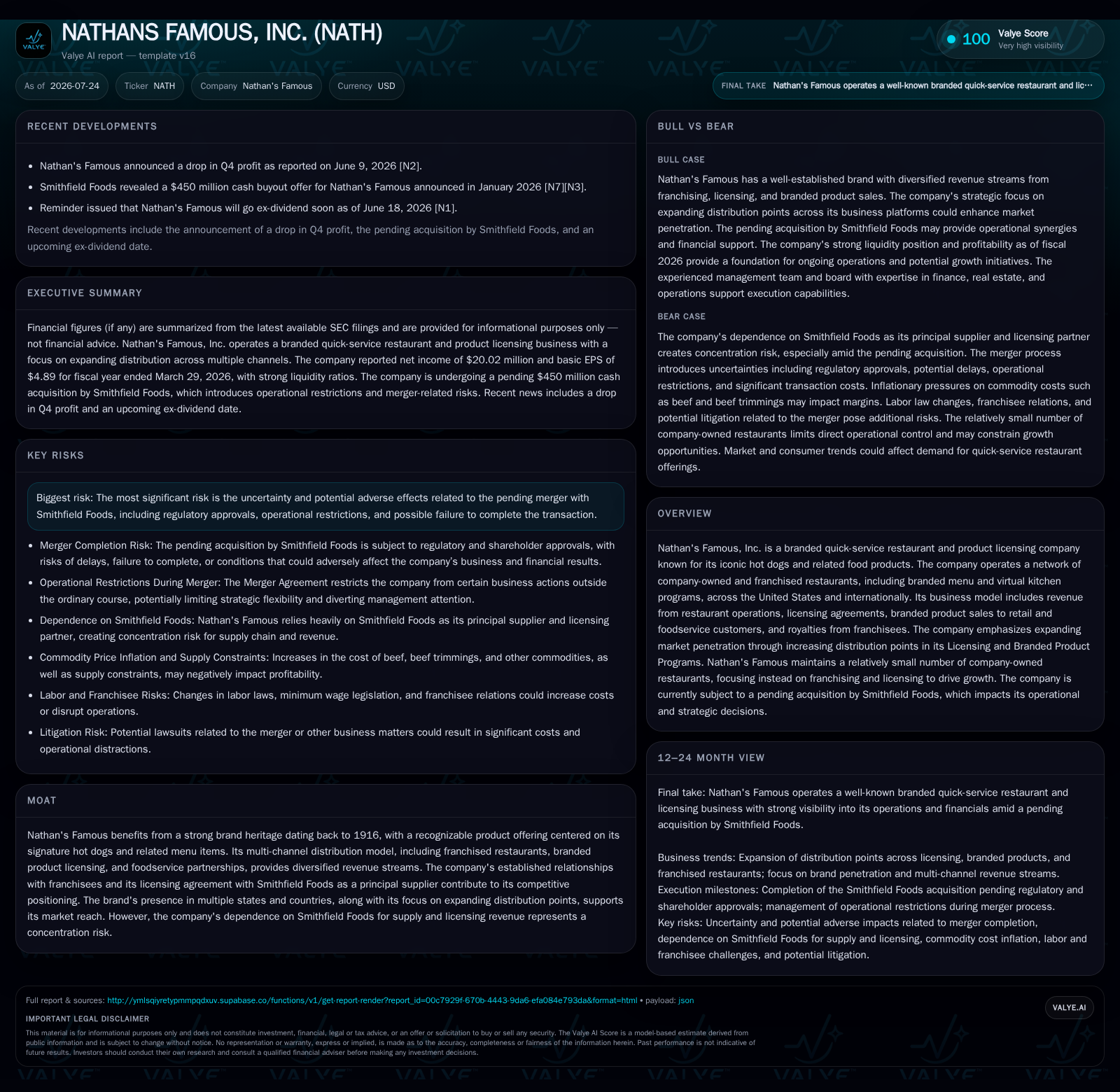
Nathan’s Famous operates a diversified quick-service restaurant and branded food licensing business centered around its iconic hot dogs. Recent quarterly results highlight rising commodity and labor costs compressing margins, especially in its Branded Product segment. The company’s strategic reliance on franchising and licensing supports steady revenue diversification but exposes it to supply dependencies and complexity amid a pending acquisition by Smithfield Foods. Execution of franchise expansion, pricing power amidst inflation, and merger completion risks remain key factors shaping near-term outlook.
Recent Operating Update
Nathan's Famous reported in its February 2026 10-Q that inflationary pressures materially affected profitability during the first thirty-nine weeks of fiscal year 2026 [S2]. The company highlighted significant cost increases in beef and beef trimmings—core inputs for both its Branded Product offerings and quick-service restaurants—with hot dog costs rising roughly 19% year-over-year during this period. Concurrently, labor cost pressure intensified due to increased minimum wages in key New York markets ($16.50 to $17.00 per hour effective January 1, 2026) and broader labor shortages impacting staffing retention across company-owned, franchised, and branded menu locations. These inflationary dynamics are expected to persist through fiscal year 2026’s remainder, weighing on operating margins
On June 9, 2026, Nathan’s issued its fiscal year-end financial results confirming these trends without altering prior guidance or announcing material new strategic initiatives [S3][N1]. The company's narrative confirmed ongoing management focus on mitigating cost inflation via pricing actions and operational efficiencies but acknowledged margin compression risks inherent to commodity volatility and labor cost inflation
Business Model Overview
Nathan's Famous operates a multi-channel business combining quick-service restaurant operations with branded product licensing and franchise royalties. Its revenue streams derive from:
- Company-Owned Restaurants: Direct sales from a limited number of self-operated outlets predominantly in legacy markets.
- Franchising: Royalties and fees from an expansive network of domestic and international franchisees managing Nathan’s branded restaurants and virtual kitchen operations.
- Branded Product Licensing: Sales of packaged hot dogs and related items primarily distributed through retail grocery chains and foodservice channels.
- Supply Agreements: Notably with Smithfield Foods (pending acquirer), serving as the principal supplier of raw beef products under exclusive licensing arrangements.
This structure allows Nathan's to leverage its century-plus brand heritage while maintaining asset-light growth predominantly through franchising and licensing partnerships rather than capital-intensive company stores. The branded product segment benefits from increasing distribution points across retail chains—a key driver for volume gains despite current commodity headwinds—offering more stable revenue buffers compared to the QSR unit-level variability [S1][S2]
Industry Structure & Competitive Position
Operating within the quick-service restaurant (QSR) sector enhanced by branded food licensing, Nathan’s sits at the intersection of fast-food franchising incumbents like McDonald's or Shake Shack and specialty branded product licensors such as Hormel or Tyson Foods. However, Nathan's smaller scale in both company-owned units and franchisees limits operational leverage relative to larger multi-brand QSR platforms.
Competition hinges on brand recognition, menu innovation (primarily around hot dogs), pricing strategy amid commodity cost cycles, labor cost management, and supply chain efficiency. Nathan's benefits from strong brand heritage dating back to 1916, creating consumer loyalty that underpins both restaurant visits and packaged product demand. The partnership with Smithfield Foods enriches the supply chain but heightens concentration risk concerning sourcing terms and licensing fees.
Peer companies increasingly deploy virtual kitchens and delivery-first models; Nathan’s own initiative to grow branded menu programs through franchised outlets including digital-only kitchens reflects adaptation to this trend but execution remains early-stage compared to sector leaders like Yum! Brands or Papa John’s franchise penetration strategies.
Growth Drivers
Several factors underpin potential growth post-merger:
Franchise Network Expansion: While Q3 FY26 showed a slight retreat (225 units vs. 236 prior year), targeted openings suggest continued emphasis on strengthening core domestic markets alongside international licensing opportunities [S26]. Retention rates among franchisees will be critical given labor cost escalations.
Licensed Product Penetration: Volume growth in branded product sales (+1–3%) combined with price increases (+10–12%) indicates positive traction expanding retail distribution amid inflation adjustments [S25] [S26]. Enhanced shelf presence supports brand awareness complementary to on-premise sales.
Digital & Virtual Kitchens: Leveraging franchised partnerships for branded menu expansions at non-traditional venues could accelerate reach without substantial capital expenditure akin to traditional restaurants.
Brand Heritage Marketing: Maintaining promotional campaigns anchored on heritage narratives differentiates Nathan’s within the premium fast-food niche versus generic QSR competitors.
Risks & Operational Constraints
Significant uncertainties cloud near-term prospects:
- Merger Approval & Integration Risks: The pending acquisition by Smithfield Foods carries regulatory approval uncertainties which could delay or jeopardize deal closure [S1][S2]. The current ratio stood at about 2.49x, supporting short-term obligations comfortably [S2][F1].
Operating cash flow generation remains positive albeit somewhat compressed relative to prior periods due to elevated input costs; capital expenditures focus largely on maintenance capex with occasional opportunistic investments aligned to brand expansion initiatives [S7] [S20]. Effective working capital management combined with negotiated supplier terms preserves financial flexibility amid macroeconomic volatility.
Overall, Nathan’s maintains a conservative financial posture suitable for navigating current industry headwinds while positioned for potential transformation upon successful merger integration.
This analysis synthesizes publicly disclosed information without offering investment research views or forward-looking assurances about company performance beyond available evidence as of mid-2026.
Disclaimer: This is research-only, informational analysis and not investment advice. It may include AI-generated interpretation and general industry context. Always verify important details using primary sources.

Comments