
Atlantis Glory Inc. at the Crossroads: Challenges and Opportunities in SPAC Execution
Recent quarterly filings reveal Atlantis Glory remains a development-stage SPAC with acute capital constraints and no acquisition agreements, underscoring execution risks amid intense market competition.
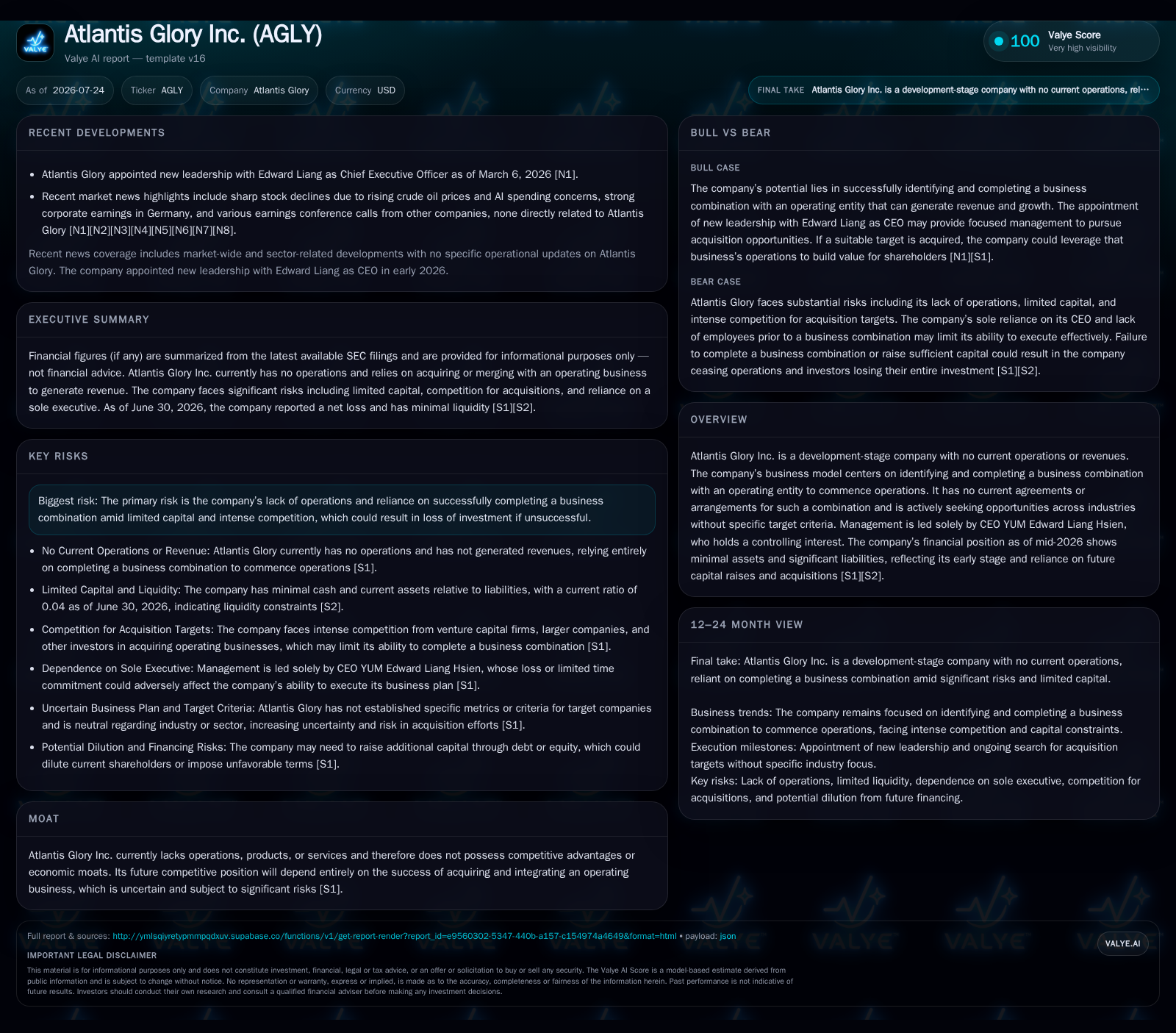
Atlantis Glory Inc. continues to operate as a blank-check shell with no revenues or operations, actively seeking a business combination but facing significant liquidity pressures and competitive disadvantages. The latest 10-Q confirms minimal cash resources and elevated liabilities, emphasizing the urgency of securing acquisition capital or risking shareholder value erosion. As a generalist SPAC without preferred sector focus or agreements, Atlantis Glory confronts intensified competition from better-capitalized peers and structural dilution risks inherent in SPAC capitalization mechanics such as warrants and potential PIPE financing. Future prospects hinge on management’s ability to identify attractive targets, complete a de-SPAC transaction within regulatory deadlines, and navigate shareholder redemption dynamics.
Latest Quarterly Filing Underscores Development-Stage Stasis and Capital Challenges
Atlantis Glory's July 24, 2026 quarterly report reconfirms its status as a development-stage entity with no operating revenues or business activities to date [S2]. The balance sheet as of June 30, 2026 shows zero cash equivalents against current liabilities exceeding $227,000, resulting in a critically low current ratio of approximately 0.04 [F1]. This stark liquidity mismatch means the company lacks sufficient liquid assets to meet near-term obligations absent immediate capital infusion or successful business combination closure. With no operating cash flow or revenue generation capabilities, sustaining operations hinges entirely on raising new funds or completing an acquisition promptly. Failure to do so elevates insolvency risk and potential total loss for shareholders.
No recent debt issuance is reported despite these pressures, suggesting limited access to credit markets or reluctance to increase leverage given the lack of operations [F1]. The filing reiterates standard risk disclosures emphasizing uncertainties around identifying suitable acquisition targets within regulatory timelines and the consequential risks if unsuccessful [S2][S15]. These financial constraints underscore the urgent imperative for management to secure viable deal prospects swiftly.
Business Model Reliant on Successful Acquisition Execution
As a Special Purpose Acquisition Company (SPAC), Atlantis Glory's core business model involves raising capital through an initial public offering to create a publicly traded shell company intended to merge with or acquire a private operating business [S1]. Until completion of this "de-SPAC" transaction, the company holds IPO proceeds in trust with limited ability to expend funds beyond administrative costs. It generates no standalone revenues or profits prior to consummating an acquisition.
Control over strategic decisions lies predominantly with CEO YUM Edward Liang Hsien who holds preferred stock convertible into a controlling common share position [S14][S20]. This concentration centralizes authority over target selection, negotiation terms, due diligence scope, and merger structuring. Shareholders have limited influence over these critical decisions due to corporate governance provisions limiting voting rights on such transactions.
No disclosed arrangements with prospective targets exist as of mid-2026 [S1], leaving the timeline for completing an acquisition open-ended. This indefinite search across any sector amplifies execution risk — prolonged search durations deplete resources through overhead while increasing dilution risk via potential equity raises needed for acquisitions. Failure to complete a qualifying transaction within typical SPAC regulatory windows (commonly two years post-IPO) would force liquidation and likely result in total shareholder loss.
Industry Context: Intensified Competition Compresses Acquisition Windows
The broader SPAC ecosystem faces intensified competition from other blank-check companies, venture capital firms, private equity investors, sector-focused SPACs, and strategic buyers all vying for quality acquisition targets amid market volatility [S11]. Atlantis Glory’s generalist approach without defined industry focus places it at a disadvantage compared to specialized peers who leverage domain expertise and established networks enabling faster deal execution.
Notable generalist SPAC sponsors such as Pershing Square Tontine Holdings (PSTH) have demonstrated how experienced leadership can mitigate search risks by accessing larger deal pipelines and negotiating favorable valuations through reputation. By contrast, smaller or less capitalized entities like Atlantis Glory contend with compressed timelines and fewer proprietary sourcing advantages. This scarcity elevates bidding intensity driving up purchase prices while diluting post-merger returns.
Such competitive pressures shorten due diligence cycles demanding swift yet thorough evaluations while pushing sponsors toward potentially dilutive capital structures or pricing compromises necessary to secure deals [S11][S15]. Access to PIPE financing is often decisive; well-funded peers benefit from larger PIPE pools that enhance deal certainty relative to less-capitalized generalists.
Dilution Dynamics: Sponsor Promote, Warrants, PIPE Financing & Redemption Rights
SPACs inherently feature complex capitalization structures that can erode investor stakes if not carefully managed. Atlantis Glory’s filings detail typical dilution sources including founder sponsor promotes—usually about 20% equity granted upfront—which dilute common shareholders upon conversion [S1][S3]. Additionally, warrants issued alongside IPO units provide holders rights to acquire shares at fixed prices that become valuable only if post-combination stock prices surpass thresholds.
PIPE investments commonly accompany de-SPAC mergers providing essential incremental funding beyond IPO proceeds but usually on preferential terms that further dilute existing shareholders when executed at discounts.
Investor redemption rights allow shareholders to opt out after merger announcements while reclaiming their pro-rata portion of funds held in trust; high redemption volumes reduce net merger proceeds forcing sponsors either to downsize deals or seek alternative dilutive financings [S1][S3]. For Atlantis Glory—with effectively depleted cash reserves—material redemptions would exacerbate financial strain undermining transaction viability.
Growth Drivers: Market Appetite, Regulatory Clarity & Capital Access
Despite challenges faced by generalist SPACs like Atlantis Glory, sector-level tailwinds persist supporting latent growth opportunities. Rising demand among private companies seeking expedited public listings outside traditional IPO processes sustains appetite for de-SPAC vehicles broadly. Favorable capital markets facilitating fresh IPO proceeds inflows combined with clearer SEC guidance on disclosure standards reduce uncertainty aiding smoother transactions.
However, realizing growth depends critically on management’s ability not only to identify attractive targets quickly but also secure complementary PIPE financing or alternative capital raising preserving sufficient deal leverage amid fierce competition.
Regulatory clarity around evolving compliance requirements mitigates timing risks enabling more predictable operational horizons compared with past years marked by heightened scrutiny dampening investor enthusiasm.
Absent these enablers alongside firm deal pipelines supported by proprietary sourcing or sector expertise—which Atlantis Glory currently lacks—the path toward accretive merger execution remains highly uncertain.
Watchpoints for Investors: Monitoring Progress Amid Uncertainty
Key indicators warrant close attention given the uncertainty surrounding Atlantis Glory’s progress toward consummating any business combination:
- Elapsed Time Relative to Regulatory Deadline: Tracking how much time has passed against typical two-year limits post-IPO provides early signals of mounting risk.
- Deal Announcements: Formal disclosures of letters of intent or merger agreements signal tangible advancement reducing execution risk.
- Shareholder Redemption Rates: Elevated redemptions post-announcement diminish net funds available impacting deal size feasibility.
- Capital Raises: PIPE or secondary offerings indicate efforts to shore up financing but reveal dilution magnitude.
- Management Commentary: Updates on target sectors under consideration or strategic shifts may reflect responses to competitive pressures [S2][S1].
These markers collectively illuminate whether Atlantis Glory is progressing toward transaction milestones or drifting toward failure modes threatening investor value.
Disclaimer: This is research-only, informational analysis and not investment advice. It may include AI-generated interpretation and general industry context. Always verify important details using primary sources.

Comments