
Alpine Income Property Trust Reports Resilient Net Lease Performance Backed by Strong Lease Metrics
Q2 results reflect high occupancy, durable lease terms, and solid tenant credit quality underpinning stable cash flows amid interest rate uncertainties.
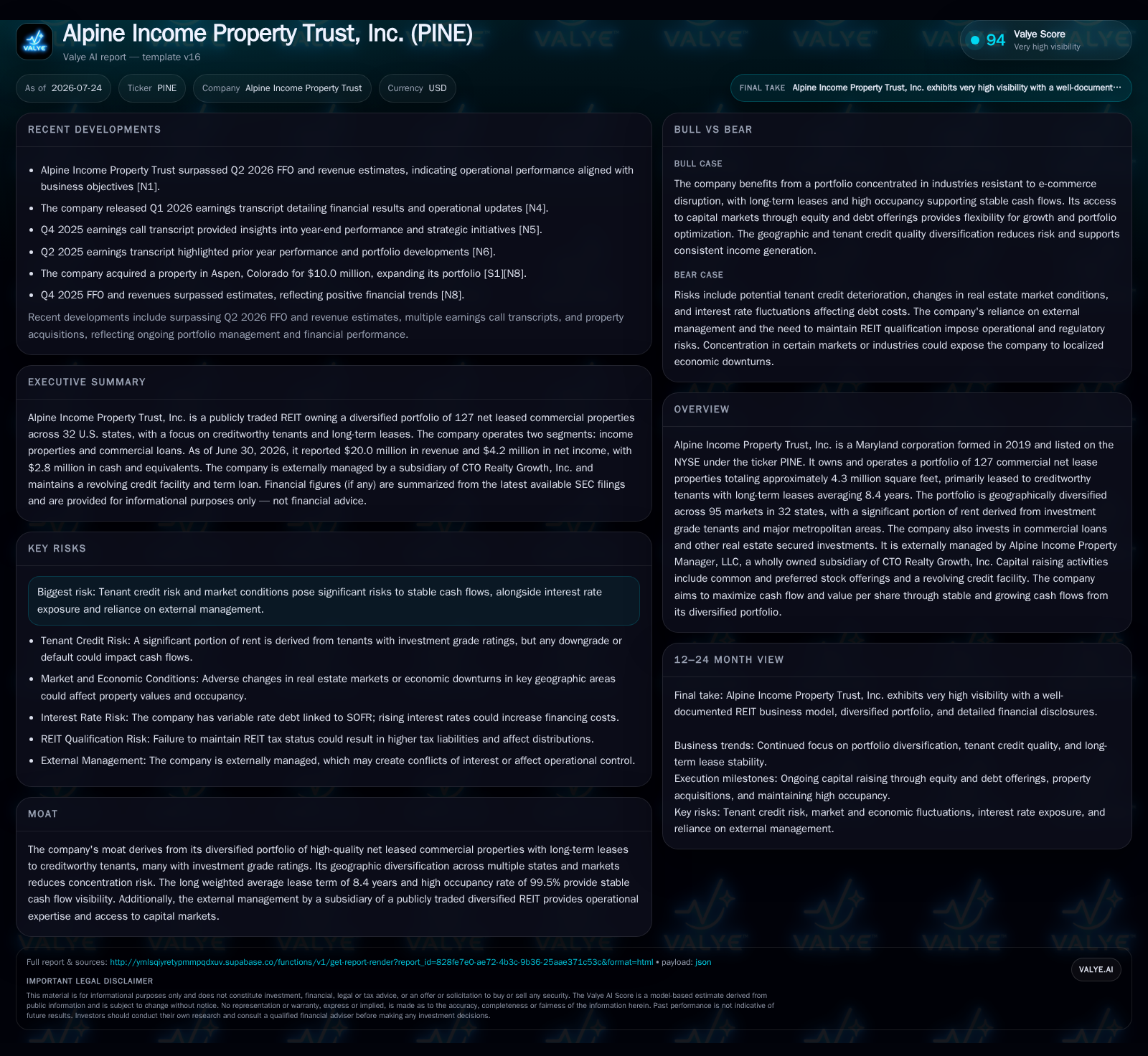
Alpine Income Property Trust (PINE) delivered a robust Q2 2026 operating update with a portfolio occupancy rate of 99.5% and a weighted average lease term (WALT) of 8.4 years, supporting predictable rental cash flow streams. Approximately 51% of annualized base rent (ABR) is sourced from investment-grade tenants across a geographically diversified base spanning 95 markets in 32 states. The company's externally managed structure by CTO Realty Growth provides operational expertise and capital markets access. While rising interest rates and tenant credit vigilance remain key risks, PINE’s diversified net lease model and supplementary commercial loan investments position it well for sustained funds from operations growth.
Q2 Operating Results Affirm Portfolio Stability Amid Market Dynamics
Alpine Income Property Trust, Inc. (PINE) reported strong operational results for the quarter ended June 30, 2026, as detailed in its 10-Q filing dated July 23, 2026 [S2]. The company maintained a high portfolio occupancy rate of 99.5%, supported by a weighted average lease term (WALT) of 8.4 years based on annualized base rent (ABR), underscoring the stability and predictability of its rental income streams [S2][N1]. These triple-net (NNN) leases shift property operating expenses—including real estate taxes, insurance, and maintenance—to tenants, reducing landlord exposure to variable costs and enhancing cash flow reliability amid economic uncertainties [S1]. Alpine’s ability to exceed consensus funds from operations (FFO) estimates this quarter further reflects operational resilience despite macroeconomic challenges [N1]. This performance aligns with sector benchmarks set by peers such as Realty Income (O) and National Retail Properties (NNN), which similarly emphasize long lease durations and high occupancy as key indicators of net lease portfolio durability.
Net Lease Model Drives Predictable Cash Flows and Tenant Credit Quality
PINE’s business model centers on ownership of commercial real estate assets leased predominantly under long-term, triple-net leases to creditworthy tenants [S1]. Approximately 51% of the company’s ABR is derived from investment-grade tenants, mitigating tenant credit risk and supporting low default probabilities [S1]. The triple-net lease structure not only transfers operating expense obligations to tenants but also typically includes contractual rent escalations, contributing to organic income growth over time. This tenant credit quality and lease structure underpin Alpine’s high occupancy and stable net operating income (NOI), critical metrics for sustaining funds from operations (FFO) and dividend payouts in the net lease REIT sector.
Geographic and Tenant Diversification Mitigate Concentration Risks
Alpine’s portfolio comprises 127 net leased properties totaling approximately 4.3 million square feet, diversified across 95 markets in 32 U.S. states [S1]. About 52% of ABR is concentrated in metropolitan statistical areas (MSAs) with populations exceeding one million, providing exposure to robust economic and demographic fundamentals [S1]. This geographic diversification reduces vulnerability to localized economic downturns or sector-specific disruptions. Additionally, the tenant base spans multiple industries, further diluting revenue concentration risk and enhancing portfolio resilience. These diversification strategies are consistent with industry best practices employed by comparable net lease REITs, which prioritize broad geographic and tenant industry spread to preserve cash flow stability.
External Management Structure Enhances Operational and Capital Efficiency
Alpine Income Property Trust is externally managed by Alpine Income Property Manager LLC, a wholly owned subsidiary of CTO Realty Growth, Inc. (NYSE: CTO), a publicly traded diversified REIT [S1]. This external management arrangement allows PINE to leverage CTO’s operational expertise, capital markets access, and scale advantages without incurring the fixed overhead typical of internally managed REITs. While external management can introduce potential conflicts of interest and fee layers, it is a common structure within the net lease REIT sector that balances cost efficiency with strategic growth capabilities. CTO’s role as both external manager and a minority equity holder aligns incentives toward disciplined capital deployment and portfolio management.
Growth Supported by Property Acquisitions, Commercial Loan Investments, and Capital Markets Access
Beyond rental income from net leased properties, Alpine has expanded its revenue streams through investments in commercial real estate secured loans, including construction loans, mortgage notes, and sale-leaseback transactions [S1]. These loan investments complement the core property portfolio by offering yield enhancement and diversification benefits. Recent capital raising initiatives include equity offerings through at-the-market (ATM) programs with a capacity of up to $150 million and preferred stock issuances totaling approximately $35 million [S13][S15]. Additionally, a revolving credit facility provides liquidity and financial flexibility to support accretive acquisitions and loan originations [S2][S3]. This balanced capital structure approach aims to sustain dividend coverage while managing leverage prudently.
Interest Rate Sensitivity and Tenant Credit Vigilance Remain Key Risks
Alpine’s total debt stood at approximately $369.5 million as of June 30, 2026, with cash and equivalents of $2.78 million, resulting in a net debt position near $366.7 million [F1]. Rising interest rates pose a risk by increasing debt servicing costs, which could pressure net operating income margins and compress valuation multiples, given the sector’s sensitivity to yield spreads relative to fixed income benchmarks. Tenant credit risk also requires ongoing monitoring, especially for tenants without investment-grade ratings, as defaults or lease renewal failures could disrupt funds from operations and dividend sustainability [S1][F1]. The company’s long WALT and diversified tenant base help mitigate rollover and concentration risks but do not eliminate exposure to economic downturns.
Lease Expiration Profile Supports Near-Term Cash Flow Stability
With a WALT of 8.4 years weighted by ABR, Alpine’s lease maturity schedule is longer than many peers, providing extended visibility into rental revenues and reducing near-term rollover risk [S1]. This staggered lease expiration profile is a critical factor in maintaining stable funds from operations and supports organic growth through contractual rent escalations and potential rent resets upon renewals. Monitoring lease renewal success rates and tenant credit trends will be essential to assess ongoing income stability and growth prospects.
Key Monitoring Points: Guidance, Acquisition Activity, and Tenant Credit Trends
Upcoming quarterly guidance disclosures will be important to track shifts in occupancy, tenant credit quality, and acquisition pipeline progress [S2][S3]. Market valuation trends among peer net lease REITs such as Realty Income and National Retail Properties will provide external context on investor sentiment toward net lease assets amid evolving interest rate conditions. Additionally, updates on capital deployment strategies balancing equity issuance dilution against accretive property acquisitions and loan originations will be critical to evaluate dividend coverage and growth sustainability.
Financial Position and Liquidity Considerations
As of June 30, 2026, Alpine reported cash and equivalents of approximately $2.78 million against total debt of $369.5 million, resulting in a net debt position of roughly $366.7 million [F1]. While on-hand liquidity appears modest relative to debt, the company’s access to capital markets through its external management relationship with CTO Realty Growth and its revolving credit facility provides additional financial flexibility [S1][S3]. Operating income was approximately $13.14 million as of year-end 2025, indicating a capacity to service debt under current conditions, though interest coverage ratios should be monitored closely in a rising rate environment [F1]. Maintaining strong funds from operations and occupancy levels will be essential to support dividend payouts and debt obligations.
This analysis synthesizes Alpine Income Property Trust’s latest operating disclosures primarily anchored on the Q2 2026 SEC filings, complemented by peer contextualization within the net lease REIT industry framework. It aims to provide a detailed understanding of PINE’s portfolio composition, business model, growth drivers, and risk factors relevant for assessing its operating and financial profile through mid-2026.
Financial snapshot
As of June 30, 2026, companyfacts data shows $2.78 million in cash and equivalents and $369.5 million in total debt, implying a net debt position near $366.7 million [F1]. These figures frame the company’s leverage and liquidity context alongside its operational metrics.
Disclaimer: This is research-only, informational analysis and not investment advice. It may include AI-generated interpretation and general industry context. Always verify important details using primary sources.

Comments