
FG Imperii Acquisition Corp. Faces Redemption Constraints While Pursuing Financial Services De-SPAC
New quarterly filing reveals stable trust holdings but highlights redemption risk and operating expenses ahead of a critical business combination.
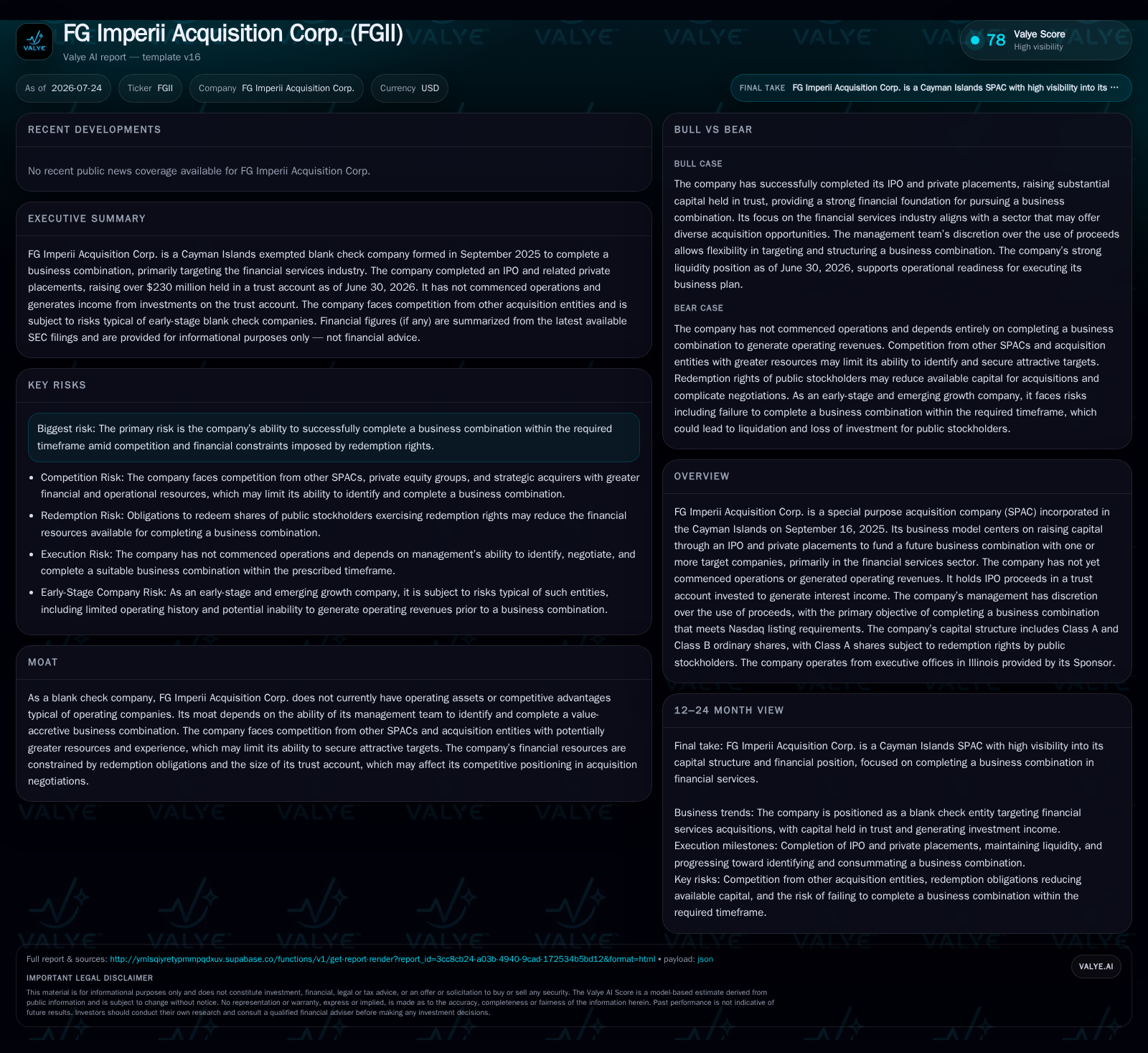
FG Imperii Acquisition Corp. (FGII) remains a pre-combination SPAC with capital raised through its IPO and private placements held in a trust account. The latest 10-Q filing shows a solid current ratio and minimal liabilities but underscores the operational drag from administrative fees and the inherent risk of public shareholder redemptions reducing acquisition capital. Focused on financial services targets, FGII’s ability to complete a value-accretive business combination within the mandated timeframe remains the key driver of its value proposition. Its competitive position is typical for early-stage SPACs, challenged by redemption pressures and sponsor resource constraints that influence deal feasibility.
Recent Operating Update
FG Imperii Acquisition Corp. reported its latest quarterly results in the Form 10-Q filed July 24, 2026, reaffirming its status as a Special Purpose Acquisition Company (SPAC) still seeking a business combination target primarily within the financial services sector [S2]. As expected for a blank check company at this stage, FGII continues without operating revenues but maintains cash and equivalents totaling approximately $986,205 against current liabilities of only $1,202—translating into an exceptionally high current ratio of over 820x that primarily reflects trust account holdings reserved for transaction purposes [F1].
A focal point of FGII's filings is the disclosure related to redemption rights exercisable by public shareholders upon the announcement of its de-SPAC transaction. Under ASC Topic 480 guidance, these shares are classified as temporary equity or liabilities depending on redemption conditions, which materially affect balance sheet presentation and potential dilution scenarios [S2]. This signals that available acquisition capital is vulnerable to being diminished substantially should shareholders choose to redeem their shares before deal closure.
On the cost front, FGII incurs administrative service fees payable to its Sponsor at $15,000 monthly (or $30,000 over six months as reported) for essential back-office support including executive oversight from Sponsor managers serving as CEO and CFO of the company [S2]. This expense level aligns with common SPAC structures where sponsor entities provide services without extensive operational infrastructure pre-merger.
No new debt beyond the existing $150,000 promissory note from the Sponsor was recorded post-IPO formation through June 2026. The company holds no significant off-balance sheet obligations or contingent liabilities affecting liquidity beside indemnification clauses tied to vendor claims against the trust account balance—a standard protective measure designed to safeguard shareholder funds during transition phases [S2], [F1].
Business Model
FG Imperii Acquisition Corp., incorporated in September 2025 in the Cayman Islands, is structured purely as a shell entity raising capital through an initial public offering supplemented by private placements. The proceeds reside in an interest-bearing trust account until FGII completes a qualifying business combination—referred to as a de-SPAC transaction—with one or more private companies primarily focused on financial services industries in North America but not restricted geographically or sector-wise until deal closure [S1],.
The monetization model involves temporarily generating non-operational revenue through interest income on trust assets while incurring administrative costs funded out of working capital advances from sponsors or existing cash balances. After completing a business combination meeting Nasdaq listing standards and obtaining shareholder approvals—including managing shareholder redemptions—FGII transitions into an operating public entity deriving revenue from acquired operations rather than blank check sponsorship activities.
Revenue drivers beyond ignition of post-merger operations essentially hinge on successfully securing and closing attractive acquisition targets within the stipulated timeframe (typically up to 18-24 months). Redemptions by public shareholders massively influence net acquisition capital availability since they reduce cash released from trusts available for purchase consideration and subsequent corporate initiatives. As such, redemption rates represent perhaps the most critical KPIs shaping feasibility economics prior to completion.
The capital structure includes Class A ordinary shares accessible by public investors with redemption rights and Class B founder shares held by sponsors constituting roughly 20% of post-IPO stock—a configuration consistent with industry-standard sponsor promotes aligning incentives albeit introducing dilution risks after de-SPAC transactions close [S1]. Warrants issued concomitant with units provide additional upside participation mechanisms common among SPACs.
Industry Structure and Competitive Position
Operating within the crowded SPAC ecosystem—a model embraced widely since the early 2020s—FG Imperii Acquisition Corp. confronts headwinds common among nascent acquisition vehicles: intense competition for lucrative financial services targets from peer blank check companies (e.g., Pershing Square Tontine Holdings, Churchill Capital), traditional IPO underwriters offering established routes to public markets, and private equity firms consummating direct acquisitions outside public listing frameworks.
SPAC management expertise is paramount given that organizational moats hinge more on sponsor credibility, deal sourcing networks, negotiation skillsets, and ability to efficiently deploy capital under conditions constrained by redemption risk before combination closure. Without operating revenues or assets pre-merger, FGII's competitive advantage depends mainly on these intangible factors along with its current financial standing.
That said, FGII’s relatively early-stage status suggests limited track record or deal announcements yet; thus its ability to distinguish itself rests heavily on future execution milestones rather than present operating scale or product differentiation.
Growth Drivers
Key growth catalysts stem from market dynamics fueling continued investor appetite toward alternative public listing mechanisms such as SPACs—in particular those focusing on financial services companies which typically benefit from regulatory tailwinds and ongoing industry consolidation trends. Additionally:
- A robust pipeline of private firms interested in access to public markets accelerates FGII's opportunities for value-accretive combinations.
- Favorable macroeconomic capital market conditions enhance possibility for efficient underwriting and investor participation in follow-on PIPE financings accompanying merger transactions.
- Regulatory clarity around SPAC disclosures offers greater transparency reducing uncertainty which had earlier curbed some investor enthusiasm across the space.
- Innovations around structuring deals including earn-outs or equity rollovers may improve attractiveness relative to plain vanilla IPO alternatives.
Dilution concerns also arise stemming from sponsor founder shares and outstanding warrants convertible upon completion potentially pressuring share prices post-merger if not offset by synergies.
Operationally, managing costs effectively while maintaining flexibility without committed debt beyond nominal facilities is essential since excessive outlays pre-business combination erode value stored in trust funds.
Potential conflicts between sponsor interests aiming at promoting deals versus protecting public shareholders’ redemptions pose governance questions frequently reviewed by independent directors or committees tasked with fairness opinions during transactions [S1]. Finally regulatory scrutiny evolving around accounting treatment, disclosures related to warrants exercise valuations or SPAC-deal incentives requires attention lest adverse rulings increase compliance burdens.
What To Watch Next
Critical near-term events encompass:
- Announcement of definitive agreements targeting specific financial services companies aligned with stated criteria.
- Shareholder votes enabling consummation or rejection of proposed mergers impacting capital release timing.
- Redemptions metrics reported proximate to deal announcements illuminating investor sentiment toward FGII’s target choices.
- PIPE financing commitments supplementing base trust funds enhancing net liquidity available for acquisitions.
- Any unexpected increases in administrative costs or contractual obligations impacting burn rate prior transaction close.
- Monitoring fair value adjustments in accordance with ASC guidelines especially regarding redeemable shares which may affect reported equity values.
These milestones collectively offer actionable insight into FGII’s trajectory toward transforming from blank check entity into operating publicly listed firm.
Financial Profile Discussion
As of June 30, 2026, FG Imperii Acquisition Corp. displayed a healthy liquidity position anchored by approximately $986,205 in current assets predominantly comprising cash reserved in trust accounts intended for eventual use in a business combination context [F1]. Total debt recorded was limited at $150,000 arising from non-interest bearing promissory notes extended by Sponsor entities during formation—typical pre-combination financing arrangements reflecting minimal leverage exposure on the balance sheet [F1]. Current liabilities were negligible at roughly $1,202 signifying limited operational payables outstanding entering Q3 calendar year 2026 reporting period [F1].
Operating losses continue reflecting costs associated solely with administrative expenditures estimated near $15,000 monthly fees paid under agreements with Sponsor providing organizational support functions prior merger completion; these losses are expected and characteristic for early-stage SPACs without operational revenues yet initiated [S2].
The accounting classification of ordinary shares subject to possible redemption as temporary equity adds complexity when interpreting shareholders' equity metrics; nonetheless it appropriately reflects liquidity uncertainties inherent until shareholder elections finalize during de-SPAC windows governed by Nasdaq listing rules and Securities Exchange Act provisions [S2]
Overall, FGII maintains prudent cash conservatism consistent with sustaining runway sufficient enough not currently forecasted as requiring additional funding before completing an initial business combination event soonest opportunities arise.
Disclaimer: This analysis is presented solely for informational purposes reflecting facts drawn exclusively from FG Imperii Acquisition Corp.’s SEC filings dated through July 24, 2026. It does not constitute investment advice or research views regarding securities transactions.
Disclaimer: This is research-only, informational analysis and not investment advice. It may include AI-generated interpretation and general industry context. Always verify important details using primary sources.

Comments