
MOGU Inc. Confronts Structural Headwinds Despite Narrow Profit in Latest Quarter
Q4 2026 reveals revenue pressures and regulatory challenges constraining MOGU’s operational flexibility and platform growth.
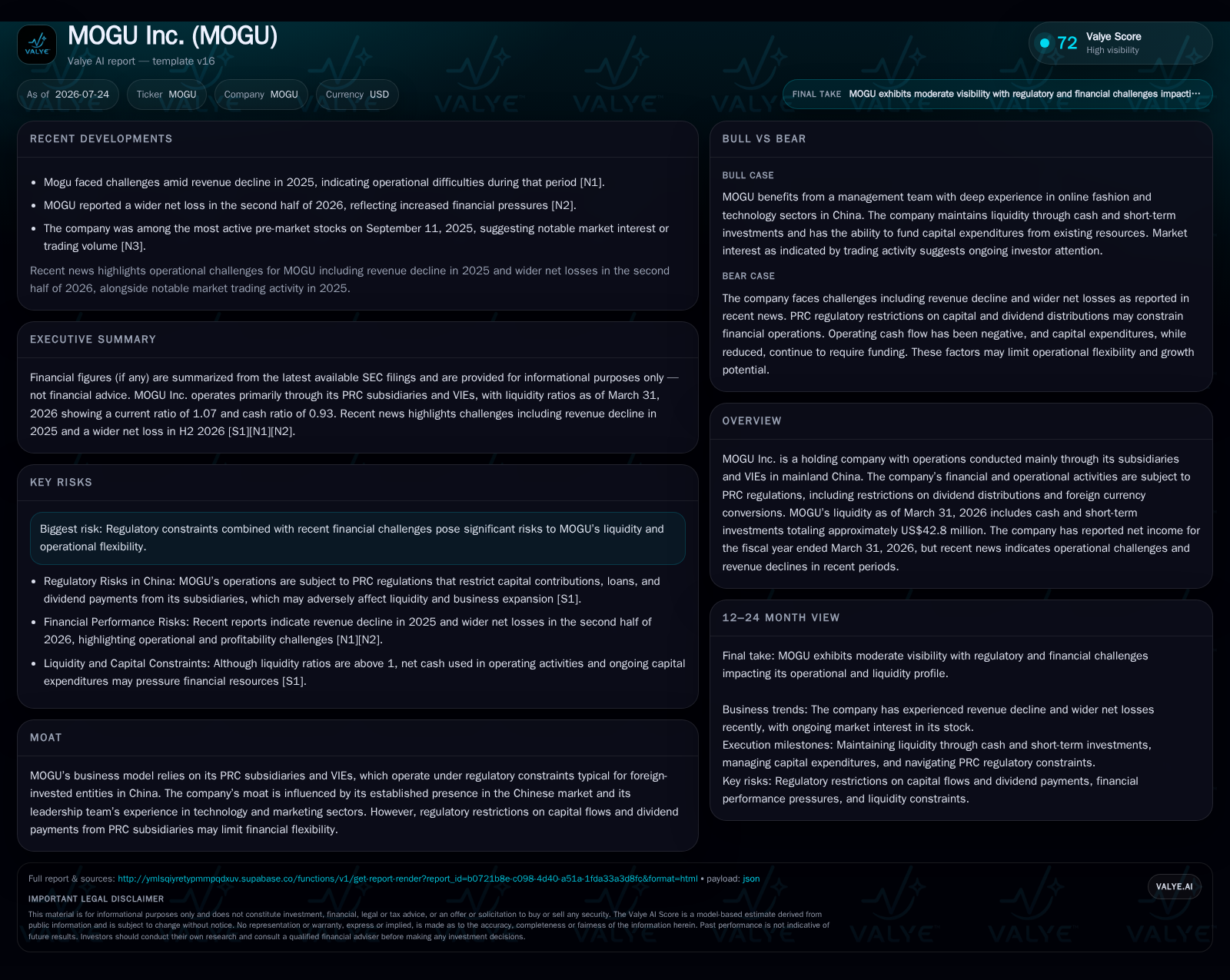
MOGU Inc.'s latest quarterly filing discloses a modest net income juxtaposed with persistent operating losses amid revenue decline, reflecting ongoing structural headwinds within China’s tightly regulated e-commerce landscape. The company’s business model leverages Key Opinion Leader-driven social commerce on a fashion-focused online marketplace but faces rising customer acquisition costs and constrained monetization levers. Regulatory limitations on capital repatriation further compress financial maneuverability despite a current ratio slightly above one and zero debt reported at quarter-end. Monitoring GMV trends, CAC efficiency, and regulatory developments will be critical to assessing MOGU’s path forward.
Latest Quarterly Performance: Revenue Deterioration Meets Marginal Profitability
This performance aligns with external commentary highlighting revenue declines during fiscal 2025 into early 2026 as the competitive environment intensified and consumer behavior evolved unfavorably toward MOGU’s platform [N1]. The company's net cash used in operating activities remained negative at RMB47.4 million (~$6.9 million), indicating ongoing cash consumption despite nominal accounting profits largely driven by accounting adjustments rather than robust cash inflows [S8]. Such a dynamic flags the importance of disentangling reported profitability from cash generation ability.
Platform Mechanics: KOL Engagement, Merchant Dynamics, and Monetization Levers
MOGU operates a fashion- and lifestyle-focused online marketplace distinguished by its integration of Key Opinion Leaders (KOLs) who serve as social commerce catalysts connecting merchants and consumers [S1]. The company generates revenue predominantly through commissions — commonly referred to as the take rate — applied to gross merchandise volume (GMV) transacted on its platform alongside fees for advertising and value-added services extended to merchants.
The ecosystem depends critically on user engagement driven by KOL content creation that stimulates discovery and purchase intent amid increasingly mobile-centric consumer behaviors. Core KPIs like GMV express overall transaction health; average order value (AOV) captures purchase quality; while customer acquisition cost (CAC) measures efficiency in drawing new buyers into this loop. Major Chinese E-Commerce Players and Niche Social Commerce Platforms
Within China's highly competitive internet retail landscape, MOGU occupies a niche focused on fashion-anchored social commerce relying heavily on influencer-driven sales channels. Compared broadly to giants like Pinduoduo or Vipshop that offer wider product assortment and scale-enabled cost advantages, MOGU's differentiated content-led approach targets a more curated segment but faces challenges achieving comparable merchant breadth or transactional scale.
Additional competition arises from other social commerce platforms and fashion lifestyle communities integrating transactions directly within social media environments (e.g., Xiaohongshu). While MOGU’s established KOL relationships confer some differentiation, replicating scale benefits or defending pricing power demands continuous innovation in platform experience and merchant incentives amid margin pressures.
Growth Opportunities Anchored in Consumer Trends and Social Commerce Expansion
Despite headwinds, strategic growth avenues remain tied to favorable secular trends shaping the Chinese e-commerce sector. Rising smartphone penetration combined with evolving middle-class preferences fuels broader adoption of mobile commerce channels where social interaction plays an increasing role in purchase decisions. MOGU's business model inherently benefits from expanding KOL influence effectiveness as consumers seek authentic research views within digital communities.
Capturing accelerated GMV growth or capturing improved take rates depends on extending active user base depth while controlling CAC through optimized marketing spend efficiency. Upgrading platform features to heighten user engagement and merchant satisfaction could unlock repeat purchase rates driving lifetime value up. Furthermore, incremental adoption of seamless digital payment methods bolsters transaction convenience securing stickier customer-merchant bonds [S1].
Regulatory Constraints: Capital Flow Restrictions Limiting Financial Flexibility
A critical constraint for MOGU arises from PRC regulatory restrictions impacting operational cash flow management [S5][S6]. As an offshore holding company conducting business via wholly foreign-owned enterprises (WFOEs) and Variable Interest Entities (VIEs) within mainland China, dividend repatriation is contingent upon subsidiaries generating statutory retained earnings by meeting profit accumulation thresholds plus mandatory reserve fund allocations capped at 50% of registered capital
Risks and Execution Watchpoints: From CAC Escalation to Market Volatility
Several risk vectors temper the outlook for MOGU. Foremost are escalating customer acquisition costs amid intensifying rivalry within China’s fashion e-commerce segment which compress unit economics absent commensurate improvements in AOV or retention rates. Continued deterioration in these KPIs may force further marketing investment or product promotions eroding margins.
Regulatory uncertainty remains omnipresent with stringent control over foreign exchange flows potentially throttling expansion initiatives or necessitating suboptimal reinvestment strategies internally rather than deploying capital flexibly across geographies or technology development efforts [S1]. Also notable are inherent market risks tied to shifting consumer trends in fast-moving fashion categories where preference volatility can rapidly undermine planned assortment strategies.
Operational execution risks include maintaining platform stability against technical disruptions crucial to preserving user trust in interactive commerce environments reliant on live streaming and real-time engagement tools integral to KOL-driven transactions.
What Comes Next: Key Metrics, Guidance Signals, and Strategic Imperatives for MOGU
Looking ahead, close monitoring of GMV trajectories will be pivotal—sustained contraction would affirm structural demand challenges whereas stabilization or inflection upward signals potential re-acceleration tied to refreshed consumer traction. Parallel attention should fall upon CAC dynamics relative to lifetime value enhancements via improved retention or cross-selling which would validate unit economic break-even improvements.
Regulatory developments either facilitating smoother currency repatriations or tightening capital flow controls would materially shift investment choices affecting both organic development funding as well as strategic acquisitions such as their recent AI infrastructure stake purchase signaling corporate ambition beyond core commerce activities [S20]. Enhanced disclosure around active user counts and KOL engagement metrics will also serve as leading indicators of platform vitality versus competitor advances.
Financial Profile Discussion: Balance Sheet Strength Amid Operating Cash Challenges
Overall financial positioning reflects a firm managing constrained resources amid regulatory traps that inhibit agile capital deployment—movements in short-term investment levels signal attempts to balance yield preservation against liquidity needs under uncertain growth scenarios.
This analysis synthesizes publicly filed financial statements alongside industry-contextual insights about the unique operating environment facing MOGU Inc., emphasizing the interplay between regulatory constraints, platform economics driven by KOL-powered social commerce models, competitive pressures from scaled multi-category players versus niche specialists, and the critical importance of key performance indicators such as GMV growth trajectories, CAC efficiency, take rate optimization, and consumer engagement metrics shaping future prospects.
This document is provided for informational purposes only without any investment advice or research view.
Disclaimer: This is research-only, informational analysis and not investment advice. It may include AI-generated interpretation and general industry context. Always verify important details using primary sources.

Comments