
Intel Leverages AI Demand for Record Revenue Despite Profitability Pressure
Intel's Q2 2026 results highlight AI-driven revenue growth amid ongoing operating losses and heavy capital investment.
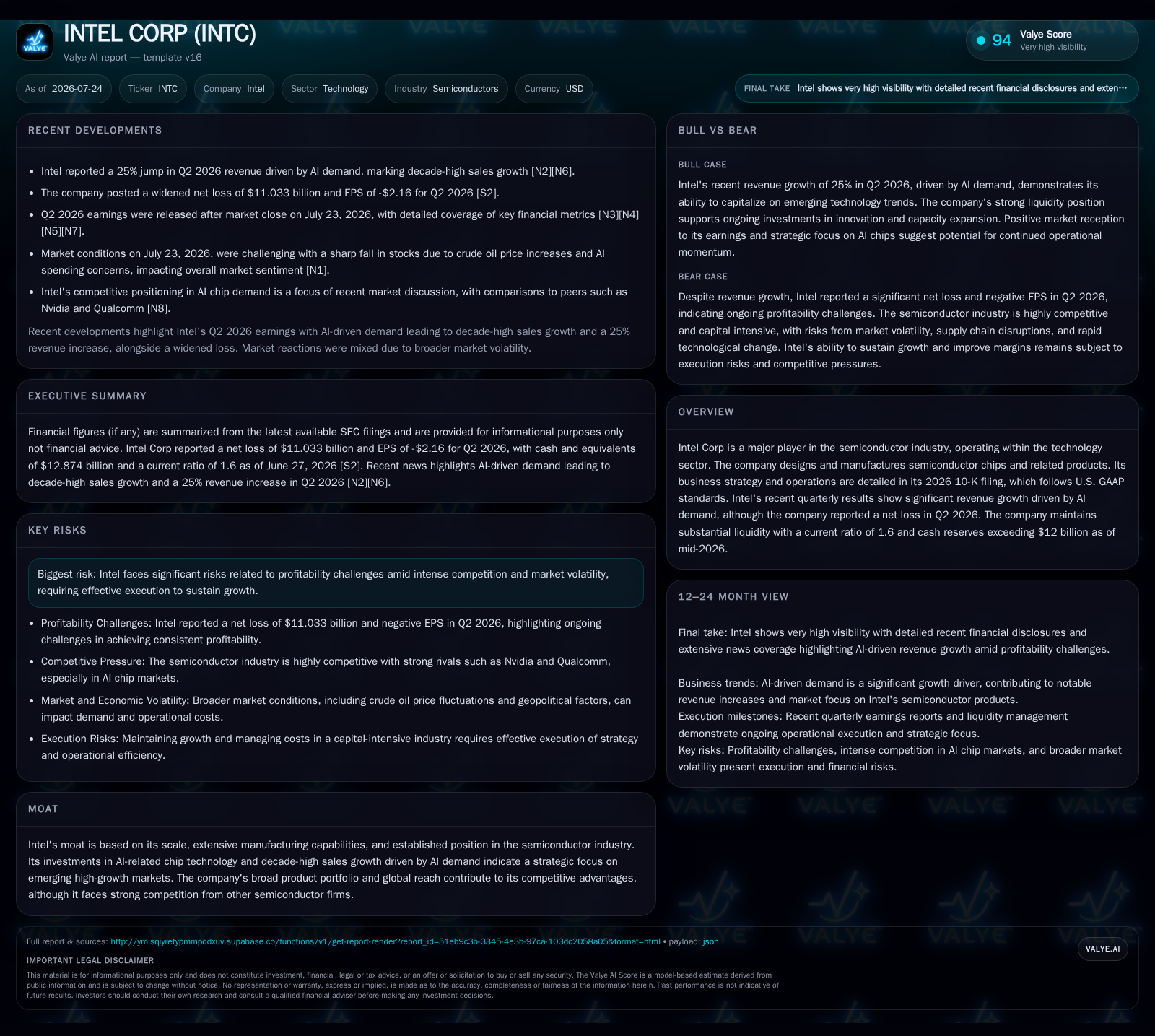
Intel Corp’s latest quarterly filing reveals a sharp upturn in sales growth driven by demand for AI-related silicon, marking its highest revenue increase in over a decade [S2][N1]. However, the company continues to report net losses as significant R&D and capital expenditures weigh on margins [S2][F1]. Operating as an integrated device manufacturer (IDM), Intel faces structural challenges from intense competition and the capital-intensive nature of semiconductor fabrication. Its broad product mix and expanding foundry services provide strategic strengths, while execution on technology leadership and supply chain resilience remain critical watchpoints [S1][S21].
Recent Operating Update
Intel reported a significant revenue increase in its second quarter ended June 27, 2026, driven primarily by accelerating demand for AI-optimized semiconductor products. This surge represents the company's strongest sales growth rate in over a decade, reflecting robust unit shipments and higher average selling prices (ASP) for AI-related processors and accelerators that support machine learning training and inference workloads [S2][N1]. Despite this top-line momentum, Intel posted a net loss for the quarter, attributable to elevated operating expenses including substantial research and development (R&D) investments, inventory reserves related to early-stage production of advanced process nodes such as Intel 18A, and ongoing cost restructuring efforts [S2][F1][N5]. These factors combined to pressure gross and operating margins, illustrating the capital-intensive and cyclical nature of semiconductor manufacturing.
The company’s quarterly disclosure highlights the tension between rapid revenue growth fueled by AI demand and the profitability challenges posed by high R&D intensity and manufacturing scale-up costs [S2]. This dynamic underscores the importance of operational KPIs such as fab utilization rates, yield percentages, and process node ramp efficiency in driving future margin improvements
Business Model Analysis
Intel operates as an Integrated Device Manufacturer (IDM), uniquely combining semiconductor design with in-house wafer fabrication across multiple fabs. This vertical integration contrasts with fabless competitors who outsource production and pure-play foundries specializing solely in wafer manufacturing [S4][S10][S16]. Intel’s product portfolio spans the Client Computing Group (CCG), focused on x86 architecture CPUs for PCs and client devices, and the Data Center & AI (DCAI) segment, which delivers high-performance logic chips including AI accelerators and network interface cards for cloud service providers (CSPs), original equipment manufacturers (OEMs), and industrial customers worldwide
Revenue is generated primarily through unit shipments of integrated circuits, with pricing influenced by ASP trends that reflect product complexity, process node maturity, and competitive market dynamics [S5][S24]. The product mix between traditional PC logic chips and specialized AI-focused accelerators significantly impacts gross margin profiles, as advanced nodes typically entail higher manufacturing costs and yield variability
Intel has also expanded its Intel Foundry Services (IFS) business, providing wafer fabrication capacity to third-party fabless chip designers seeking advanced U.S.-based manufacturing [S10][S14]. This foundry model extension aims to improve fab utilization and diversify revenue streams but introduces operational complexity and execution risks inherent in serving external customers with varying design requirements
Industry Structure and Competitive Position
The semiconductor industry is segmented among IDMs like Intel, fabless design companies such as NVIDIA and AMD, and pure-play foundries led by Taiwan Semiconductor Manufacturing Company (TSMC). Intel’s IDM model offers advantages in supply chain control and design-fab co-optimization but requires substantial capital expenditures for fab construction and process technology development, resulting in longer payback periods compared to fabless peers who focus on design licensing and outsource manufacturing.
Competitive pressures intensify as fabless companies rapidly innovate in GPU-accelerated AI processing units, while foundries push aggressively toward smaller process geometries ahead of mainstream cycles. Intel’s strategic focus on next-generation process nodes—specifically Intel 18A and 14A—and heterogeneous computing architectures that integrate x86 cores with specialized AI engines is critical to capturing growth in cloud high-performance computing (HPC) markets increasingly demanding tailored compute solutions [S9][S13][S28].
Customer diversification across OEMs, CSPs, and industrial clients mitigates concentration risk, but securing design wins remains essential to driving unit volumes and revenue growth [S10][S16]. Ecosystem partnerships aimed at reducing software-to-hardware integration complexity further differentiate Intel’s offerings amid evolving AI workload requirements
Growth Drivers
Intel’s addressable markets benefit from structural tailwinds including the explosive growth of AI applications requiring advanced microprocessors optimized for heterogeneous compute tasks. Expanding data center infrastructure globally drives demand for CPUs supplemented by integrated AI accelerators capable of efficient machine learning workloads.
Additionally, the proliferation of edge computing devices with enhanced processing capabilities supports Intel’s CCG segment, which targets PC refresh cycles and emerging AI-enabled client devices. Government incentives promoting domestic semiconductor manufacturing capacity provide a strategic advantage for Intel’s U.S.-based fabs amid rising geopolitical supply chain scrutiny.
Ongoing development of next-generation process nodes aims to improve performance-per-watt metrics, a key competitive factor across computing segments [S6][N1].
Risks and Watchpoints
Execution risks center on Intel’s ability to transition smoothly to newer process technologies, where manufacturing yield volatility could temporarily depress gross margins. Historical delays or setbacks in ramping advanced nodes risk eroding early adopter advantages critical for sustaining design wins.
Pricing pressure remains a challenge amid intense competition from agile fabless companies and cyclical demand fluctuations in end markets. Geopolitical factors, including export controls and trade tensions, pose material risks affecting equipment supply chains and international customer access.
Customer concentration risk persists due to dependence on a limited number of large OEMs and CSPs, whose strategic shifts could impact volume visibility [S21][S27]. Elevated R&D spending, while essential for innovation, continues to strain profitability until scale efficiencies and higher fab utilization are realized
What To Watch Next
Key indicators to monitor include sequential quarterly margin trends signaling stabilization or improvement as Intel ramps production on advanced nodes and inventory write-downs normalize post initial manufacturing phases. Announcements of design wins with leading cloud CSPs or silicon ecosystem partners will provide evidence of technology adoption and competitive positioning.
Capital expenditure disclosures will reveal alignment of fab expansion with market demand forecasts, impacting capacity utilization and operational leverage. Macroeconomic trends influencing technology spending patterns remain critical variables shaping near-term demand consistency.
Competitive developments in AI accelerator design by fabless peers and foundries will contextualize Intel’s relative positioning within this rapidly evolving market segment.
Financial Profile Discussion
As of the quarter ended June 27, 2026, Intel’s liquidity position remains solid with current assets of approximately $57.2 billion against current liabilities of $35.7 billion, yielding a current ratio near 1.6 [F1]. Cash and cash equivalents totaled $12.9 billion, providing a substantial buffer to support ongoing R&D and capital expenditure programs despite reported net losses [F1].
Total debt stood at approximately $47.2 billion as of the prior fiscal year-end, reflecting borrowings to fund capital investments in advanced fabs and technology development [F1]. This leverage level underscores the capital-intensive nature of Intel’s IDM business model and the importance of effective cash flow management to sustain long-term financial health.
The company’s ability to convert revenue growth driven by AI demand into improved profitability will depend on operational execution, including yield improvements, ASP management, and capacity utilization. Monitoring these financial and operational metrics will be essential to understanding Intel’s trajectory amid a competitive and cyclical semiconductor landscape.
This analysis synthesizes publicly filed financial documents alongside sector knowledge without providing investment advice or price forecasts. Readers should consider company-issued disclosures within their broader due diligence processes.
Disclaimer: This is research-only, informational analysis and not investment advice. It may include AI-generated interpretation and general industry context. Always verify important details using primary sources.

Comments