
Dow Inc. Advances Transform to Outperform Amid Geopolitical and Cost Pressures
Dow’s Q2 results highlight progress in restructuring and feedstock agility buffering margin pressures from ongoing Middle East tensions.
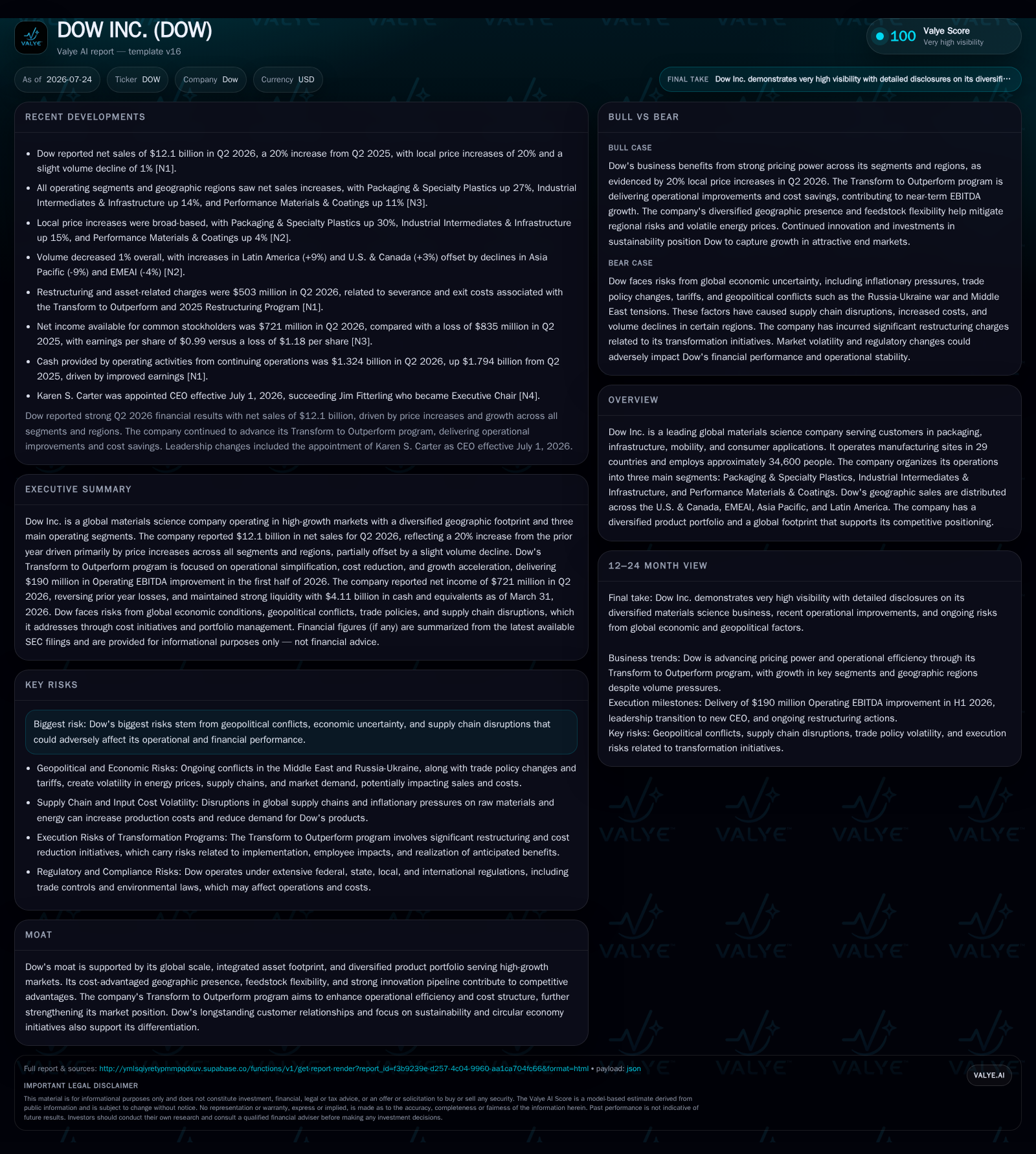
Dow Inc.'s latest quarterly filing reveals tangible progress in its Transform to Outperform program, generating $190 million operating EBITDA improvement in H1 2026 despite geopolitical disruptions impacting feedstock costs and supply chains. The company’s integrated manufacturing footprint and diversified segment exposure underpin resilience, although market headwinds persist due to industry overcapacity and economic uncertainty. Dow's delayed capex on the Path2Zero decarbonization project and active asset rationalization reflect strategic discipline amid sustained cyclical pressure. Financially, strong liquidity and conservative debt maturities support flexibility for execution of growth and efficiency initiatives.
Transform to Outperform Progress Shapes Near-Term Operating Profitability
Dow Inc.’s Q2 2026 results underscore steady advancement of its Transform to Outperform initiative aimed at better positioning the company through simplification of operations, cost reduction, and accelerated growth. The program has already yielded $190 million operating EBITDA uplift in H1 2026 alone, evidencing tangible improvements in productivity alongside continued workforce rationalization (approximately 4,500 roles targeted) [S2]. This increment enhances the foundation built by prior announced structural cost cuts exceeding $1 billion initiated in early 2025 [S1]. The ongoing realization of these savings is critical given persistent margin pressure from slower global GDP growth and sector overcapacity that continues to suppress pricing power across chemical end markets.
These internal actions support earnings stabilization amidst mixed demand signals while laying groundwork for sustainable profitability improvements. Observers should monitor incremental EBITDA contributions reported quarterly as a key confirmation of execution velocity.
Geopolitical Tensions Drive Feedstock Volatility but Assets Support Resilience
The volatile geopolitical landscape in the Middle East remains a dominant external factor impacting Dow’s operational environment. Conflicts involving Iran, Israel, and the United States have disrupted maritime transit through the Strait of Hormuz—a vital corridor for crude oil, natural gas, refined products, and petrochemical feedstocks like ethylene—resulting in supply chain constraints, longer shipping times, and increased transportation costs [S2]. These dynamics propagate to elevated feedstock input prices that traditionally weigh heavily on operating margins given the commodity-linked cost structure common among large integrated chemical producers.
However, Dow’s diversified geographic asset footprint concentrated notably in the U.S., Canada, Latin America, and Europe—with some flexibility on feedstock sourcing—has helped mitigate the full brunt of these challenges by enabling nimble adjustments to production inputs and logistics routing [S2]. This operational agility contrasts with less integrated peers who may face more rigid feedstock dependencies. Dow’s ability to maintain competitive production costs despite regional unrest positively affects its relative position against competitors such as LyondellBasell or BASF who face similar macro risks without equivalent supply chain options.
Segment Diversification: Balancing Growth with Market Cyclicality
Dow's multi-segment structure covering Packaging & Specialty Plastics; Industrial Intermediates & Infrastructure; and Performance Materials & Coatings fosters revenue diversification across varied end markets including packaging solutions, infrastructure materials (chlor-alkali products), automotive components, and consumer coatings [S1]. This breadth affords some insulation from cyclical downturns affecting individual segments.
Nonetheless, industry overcapacity—cited repeatedly by management—and inflows from competitively priced imports have constrained product pricing power broadly [S1]. Specialty plastics typically exhibit greater pricing resilience due to technical differentiation compared with commodity intermediates facing more elastic demand swings. Performance Materials & Coatings deliver value-add applications that can command premium pricing but remain sensitive to industrial activity levels.
Effective portfolio management reinforced by segment-specific innovation will be essential for Dow to capitalize on growth niches while navigating macroeconomic softness.
Cost Structure Optimization Effects on Cash Flow and Competitiveness
Q2 charges totaling approximately $58 million related mainly to asset impairments ($8 million) and exit or disposal activities ($50 million) reflect active progression of Dow’s portfolio rationalization strategy under its restructuring framework approved since mid-2025 [S2]. The bulk originated from Performance Materials & Coatings where select underperforming assets are being shuttered or divested.
These steps not only trim redundant fixed costs but also streamline capacity alignment closer to profitable demand profiles amid shifting market dynamics. While such charges temporarily depress cash flow metrics when recognized upfront, medium-term benefit accrues through lower ongoing operating expenses enhancing overall cycle resilience.
Investors should track sequential trends in segment-level EBIT margins as proof points of structural cost advantage gains materializing from these rationalizations.
Decarbonization Milestones Underpin Strategic Differentiation Efforts
Dow remains committed to decarbonizing its ethylene production chain—a highly energy- and carbon-intensive process—and advancing sustainability credentials crucial for long-term regulatory compliance and customer preferences focused on circular economy outcomes [S1]. Its flagship Path2Zero integrated ethylene complex project at Fort Saskatchewan faces a two-year delay with phased start-ups now planned for late 2029/2030 rather than earlier timelines [S1].
This postponement moderates near-term capital spend requirements but pushes back anticipated upside associated with novel low-emission products targeting pressure pipes, wire & cable insulation materials, and food packaging sectors. Nonetheless, this strategic investment differentiates Dow competitively as regulatory regimes globally tighten emissions standards around Scope 1 and Scope 2 carbon footprints.
Continued adherence to decarbonization goals aligned with measured execution will support premium positioning among buyers increasingly valuing ESG-aligned supply chains.
Emerging Risks: Supply Chain Reliability and Regulatory Challenges Ahead
The protracted geopolitical turbulence coupled with persistent uncertainty in global trade policies continue imposing systemic risk on feedstock availability and logistics reliability for Dow as well as wider industry peers [S1]. Shipping route restrictions via key chokepoints prolong inventory replenishment cycles adding cost stress particularly evident within Asian Pacific and European regions.
Moreover, legacy asbestos-related legal liabilities linked primarily to subsidiaries like Union Carbide present latent financial risk requiring ongoing provisioning attention [S1]. Regulatory scrutiny also intensifies concerning environmental compliance as governments enact stringent safety statutes mandating costly upgrades or shutdowns seen recently at certain European manufacturing sites slated for phased decommissioning by end-2027 [S1].
Like other large integrators such as DuPont or Bayer's material science units facing regulatory complexity alongside market cyclicality, Dow must navigate these headwinds carefully while preserving operational continuity.
Upcoming Catalysts: Execution Milestones and Market Demand Signals to Watch Next
Key near-term events validating Dow’s recovery trajectory center on amplification of Transform to Outperform benefits beyond the initial $190 million run-rate observed through H1 2026 into full-year performance improvements anticipated deepening into 2027 [S2]. Progress reports on Phase 1 startup of Path2Zero will serve as an inflection signal for strategic capital deployment unlocking new product revenue streams.
Additionally, signs of cyclic recovery within specialty plastics end markets—reflecting improving industrial production or packaging demand—would signal easing pricing pressures enhancing earnings visibility. Continued transparency regarding restructuring charge run-rate moderation alongside tangible gains from asset disposals will help assess sustainability of cash flow expansion narratives.
Financial Profile Discussion: Liquidity Strength Amid Capital Discipline
Dow maintains solid liquidity buffers supporting operational flexibility during cyclic troughs. As of June 30, 2026, the company reported approximately $13.5 billion in combined cash and readily available committed credit facilities—all undrawn—with no significant long-term debt maturities due until 2029 [S2]. Net working capital was approximately $8.9 billion at June 30, 2026, reflecting a strong current ratio and operational liquidity [S2].
Credit rating agency actions earlier in 2026 resulted in modest downgrades reflecting macroeconomic uncertainty yet acknowledge Dow's enduring strong asset base and proactive cost management practices keeping leverage ratios manageable under current covenant structures [S2]. Dividend policy remains cautious following a 50% reduction implemented mid-2025 aligned with retention of financial flexibility amidst ongoing market softness [S1].
This prudent capital allocation framework balances sustaining necessary investment into transformation projects against preserving balance sheet robustness critical for cyclical risk absorption.
Disclaimer: This analysis is based solely on publicly available information including recent SEC filings dated July 24, 2026 ([S2]), related event disclosures ([S3]), the latest annual filing ([S1]), supported by factual financial data ([F1]) where applicable. It is intended exclusively for informational purposes without constituting investment advice or research view.
Disclaimer: This is research-only, informational analysis and not investment advice. It may include AI-generated interpretation and general industry context. Always verify important details using primary sources.

Comments