
NextEra Energy Advances Renewable Investment Amid Regulatory and Market Dynamics
Second-quarter results highlight stable regulated operations and strategic growth in renewables, with ongoing integration of Dominion Energy pending.
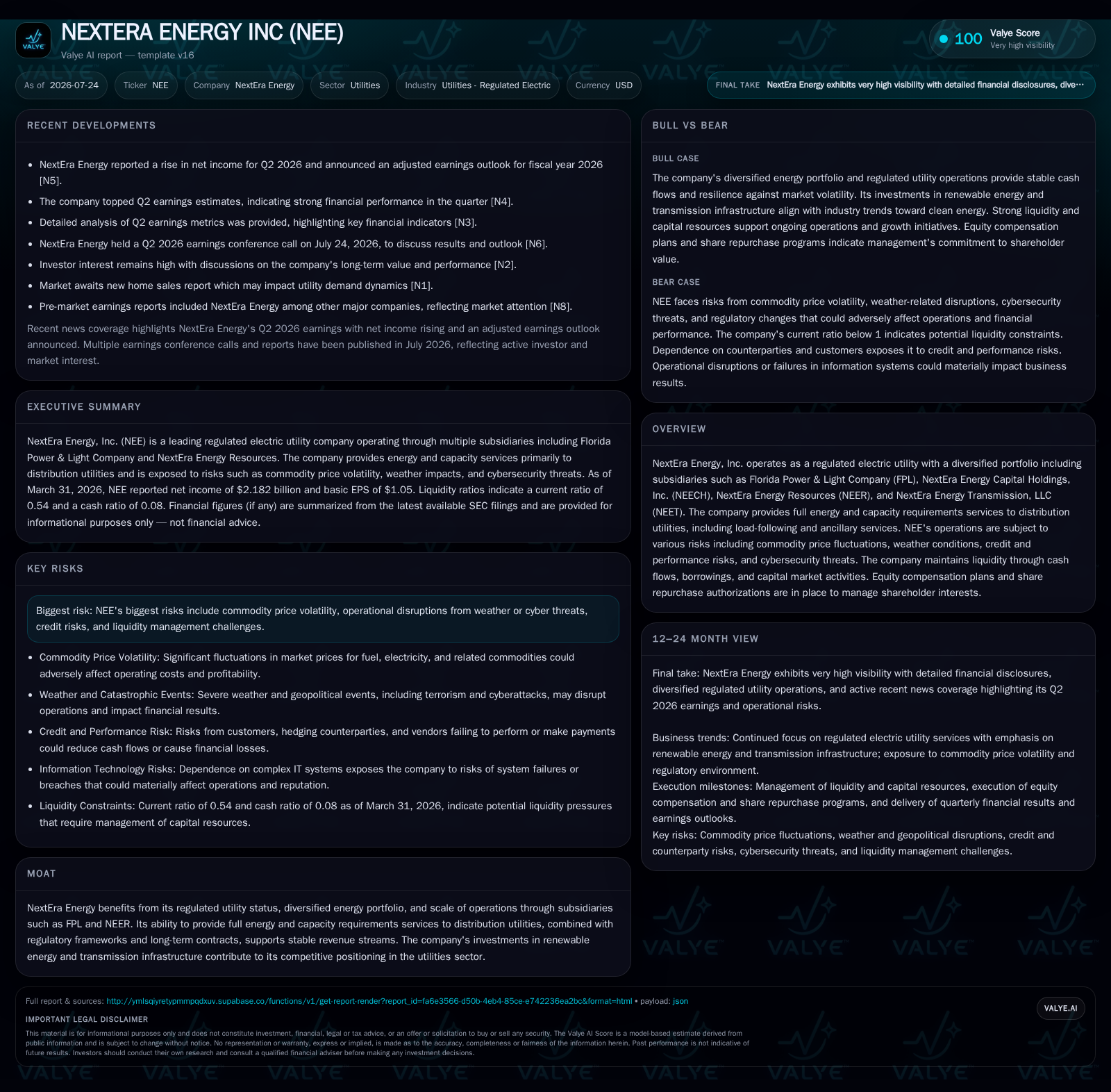
NextEra Energy's latest quarterly filing reveals steady progress in its regulated electric utility operations driven by subsidiaries Florida Power & Light (FPL) and NextEra Energy Resources (NEER). The company continues to navigate regulatory complexities while capitalizing on renewable portfolio standards and production tax credits. Liquidity remains solid with substantial cash reserves against high but manageable debt levels. The forthcoming merger with Dominion Energy introduces integration and regulatory approval risks but also potential scale benefits in regulated electricity transmission and generation.
Recent Operating Update
NextEra Energy’s second-quarter 2026 filing offers a clear view of its regulated utility operations anchored by subsidiaries Florida Power & Light Company (FPL), NextEra Energy Resources (NEER), NextEra Energy Transmission (NEET), and NextEra Energy Capital Holdings (NEECH) [S2][S3][S1]. The quarter reflected consistent energy delivery underpinned by regulatory frameworks such as the Florida Public Service Commission's oversight of retail rates and investment recovery mechanisms at FPL. The company continues leveraging production tax credits (PTCs) linked to renewable assets while meeting state renewable portfolio standards (RPS), which support its strategic growth in clean energy capacity
Capital allocation policies remain disciplined with ongoing share repurchases authorized up to 180 million shares post-stock split alongside equity compensation plans designed to align management incentives with shareholder interests [S2][S7]
Business Model Specifics
NextEra operates as a vertically integrated regulated electric utility providing power generation—including renewables—transmission infrastructure investments, and distribution services primarily within captive retail markets under regulated monopolies. Revenues stem largely from tariffs approved by state public utility commissions that include base rates plus cost recovery clauses allowing timely recoupment of fuel expenses and capital investments subject to prudency reviews. The company's ability to earn allowed returns on equity (ROE), set by regulators based on market conditions and investment risk assessments, is a key profitability driver [S1].
Beyond FPL’s core residential and commercial customer base in Florida, NEER focuses on independent power projects encompassing wind, solar, and natural gas peaking units. NEET owns high-voltage transmission lines providing ancillary services that stabilize the grid. Monetization occurs via volumetric electricity sales as well as capacity payments embedded in long-term power purchase agreements (PPAs), which enhance revenue stability during wholesale market fluctuations [S1][S2]
Critical operating KPIs include net generation (MWh), capacity factor reflecting asset utilization efficiency, system average interruption duration index (SAIDI) measuring service reliability, and operating & maintenance expenses—all influencing margin quality.
Industry Structure and Competitive Position
NextEra’s scale across diverse generation assets—particularly renewables—and its established regulated rate base primarily in Florida position it strongly among peers such as Duke Energy, Southern Company, Dominion Energy (pending acquisition), and American Electric Power. These peers similarly balance capital-intensive infrastructure investment with regulatory constraints aimed at ensuring reliable service at reasonable prices.
Regulatory decisions on allowed ROEs or cost disallowances can significantly impact earnings outcomes. Additionally, exposure to commodity price volatility—especially natural gas—requires effective hedging strategies to manage fuel cost risks. Operational risks from severe weather or cybersecurity incidents also pose significant challenges requiring proactive mitigation to maintain grid reliability [S1][S2].
Growth Drivers
Growth is propelled by expanding clean energy capacity driven by increasing RPS mandates across jurisdictions served by NextEra alongside federal incentives like PTCs enhancing returns on wind and solar projects. Electrification trends—including rising electric vehicle adoption—increase structural demand beyond traditional load patterns.
Investments in grid modernization aim to improve resilience through advanced transmission technologies facilitating renewable integration while expanding ancillary service offerings that create additional revenue streams.
Favorable regulatory rate cases allowing timely cost recovery support sustained rate base growth—a fundamental driver of long-term earnings consistent with the regulated utility business model [S1][S2].
Risks and Watchpoints
Regulatory risk remains central; failure to recover capital costs or achieve authorized ROEs can compress profitability. Commodity price fluctuations challenge margin stability despite hedging programs due to contract timing effects.
Severe weather events threaten operational continuity with potential costly repairs beyond those covered by storm protection plans approved by regulators. Cybersecurity vulnerabilities are an evolving risk requiring continuous investment.
Credit risk from wholesale counterparties necessitates robust credit management given large asset financing needs contributing to elevated debt levels.
The announced Dominion Energy acquisition adds execution complexity including regulatory approvals, shareholder votes, cultural integration challenges, and synergy realization timing uncertainties [S8][S14].
What to Watch Next
Key near-term milestones include regulatory decisions on merger approvals impacting strategic expansion timing. Monitoring quarterly earnings will be critical for assessing O&M expense management amid ongoing renewable development spending.
Net capacity additions from commissioned projects provide tangible growth indicators while Florida rate case outcomes will signal future allowed ROEs shaping returns on invested capital.
Given the company’s capital structure—with net debt approximating $95.8 billion against $2 billion cash reserves as of Q1 2026—the effectiveness of liquidity management strategies remains crucial to fund capex without impairing financial flexibility [F1][N3]
Financial Profile Discussion
NextEra's balance sheet reflects the capital-intensive nature of regulated utilities: total debt stood near $97.8 billion with cash & equivalents around $2 billion at March 31, 2026, resulting in a current ratio of approximately 0.54—typical for the sector where large fixed assets are financed predominantly via long-term debt instruments [F1]. This structural leverage underscores reliance on predictable operating cash flows derived from regulated tariffs that allow timely cost recovery plus authorized returns.
Capital expenditures focus on modernizing transmission/distribution infrastructure alongside expanding renewable generation aligned with regulatory decarbonization priorities [S2][S3]. Equity compensation schemes involving stock options and restricted stock units target aligning executive incentives with shareholder value creation while share repurchase activity demonstrates balanced capital return policies supporting shareholder interests during growth phases [S7].
Interest rate sensitivity remains a watchpoint given substantial debt servicing requirements amid evolving macroeconomic conditions influencing borrowing costs.
Financial position in context
As of 2026-03-31, companyfacts shows $1998mm in cash and equivalents and $97.8bn of total debt [F1]. The same snapshot implies net debt of roughly $95.8bn, keeping balance-sheet context relevant but secondary to the operating story [F1]. Current assets of $13.9bn and current liabilities of $25.6bn imply a current ratio near 0.54x for 2026-03-31 [F1].
This analysis synthesizes recent SEC filings alongside sector context specific to regulated electric utilities without speculative forecasts or unsupported assertions. The operating results combined with regulatory developments frame NextEra's current strategy emphasizing sustainable growth within a complex oversight environment characteristic of leading U.S utilities.
Disclaimer: This is research-only, informational analysis and not investment advice. It may include AI-generated interpretation and general industry context. Always verify important details using primary sources.

Comments