
J.B. Hunt's Q2 2026: Operational Resilience amid Freight Market Shifts and Margin Pressures
J.B. Hunt reports solid Q2 2026 earnings with net income of $181 million, navigating freight demand variability and fuel cost volatility through strategic service mix and operational control.
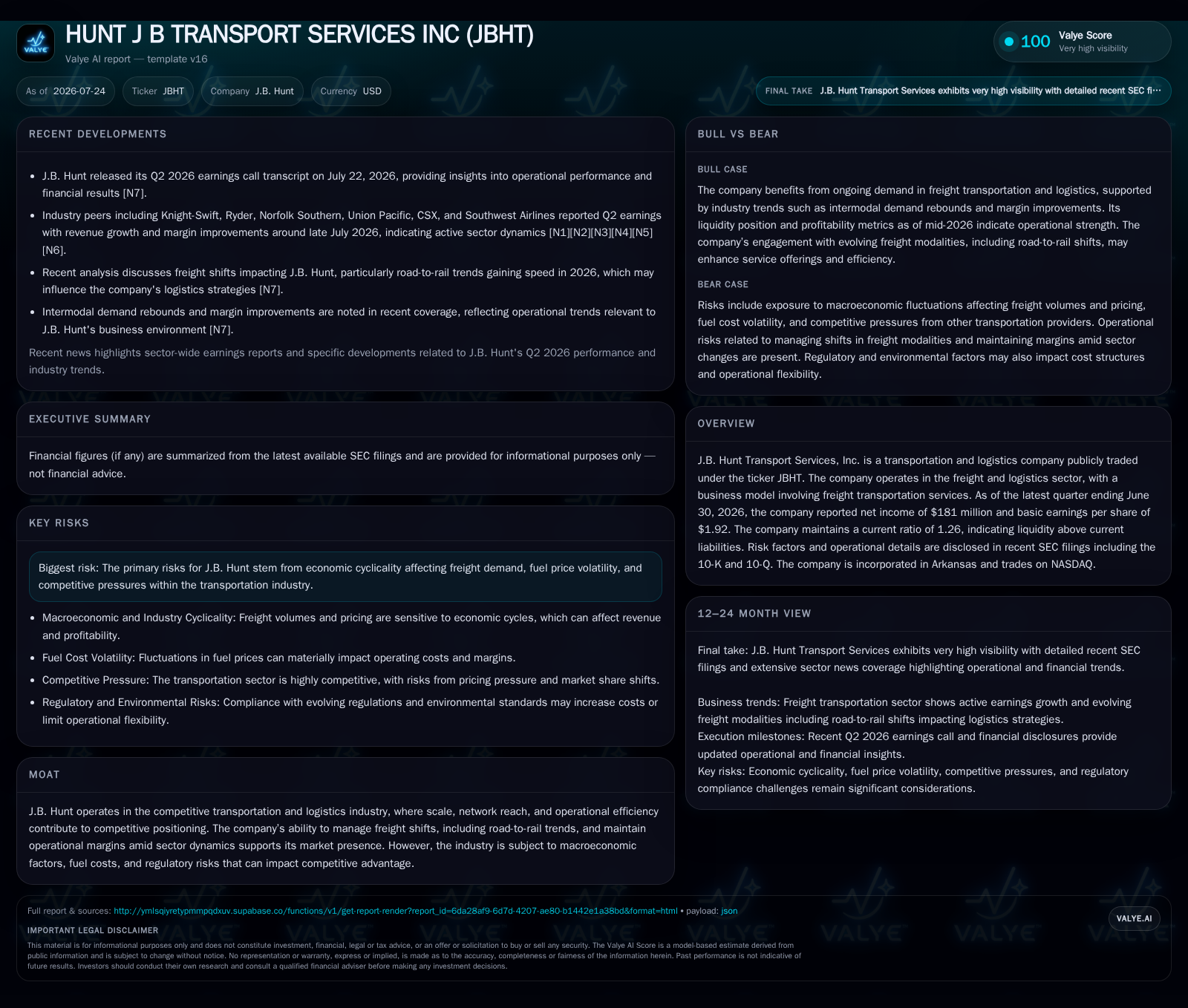
In Q2 2026, J.B. Hunt Transport Services demonstrated continued operational resilience in a challenging transportation environment, generating net income of $181 million and basic EPS of $1.92. The company maintains healthy liquidity with a current ratio of 1.26 as of June 30, 2026. Freight volume trends reflect ongoing modal shifts, particularly an uptick in intermodal services amid road-to-rail dynamics. However, industry-wide pressures from fuel price fluctuations and capacity constraints have tested operating margins. J.B. Hunt’s diversified business model—encompassing dedicated contract services, intermodal transport, and freight brokerage—positions it to adapt to evolving market demands. Key growth drivers include e-commerce expansion and technology-enabled route optimization, but risks remain from economic cyclicality and regulatory compliance.
Recent Operating Update: Q2 2026 Performance Highlights
J.B. Hunt Transport Services, Inc. reported net income of $181 million for the quarter ended June 30, 2026, corresponding to basic earnings per share of $1.92, reflecting operational discipline amid ongoing sector headwinds [S2][S3]. This performance underscores the company's ability to manage freight demand variability and cost pressures characteristic of the transportation and logistics industry during mid-cycle economic conditions.
Liquidity remains solid with a current ratio of 1.26 as of June 30, 2026, supported by current assets of approximately $1.81 billion against current liabilities near $1.44 billion, indicating sufficient short-term asset coverage to meet working capital needs [F1]. Despite margin pressures from elevated fuel prices—a significant operating expense—J.B. Hunt effectively utilized fuel surcharge mechanisms and rigorous capacity management to mitigate adverse impacts on operating margins [S2].
The quarter also highlighted a continued modal shift in freight volumes, with intermodal services gaining traction as shippers increasingly favor cost-efficient and environmentally friendly rail-truck combinations. This shift aligns with broader industry trends emphasizing modal balance to optimize transit times and fuel efficiency in supply chains [N14][S1].
Business Model Overview
J.B. Hunt operates a diversified multi-modal transportation platform encompassing truckload hauling, dedicated contract carriage (DCC), intermodal rail-truck hybrid services, and freight brokerage solutions [S1]. This integrated model enables the company to flexibly respond to changing commodity flows and market rate dynamics.
Revenue generation primarily derives from contracts with manufacturers, retailers, and distributors who pay for freight movement based on distance, volume, or contractual terms. The business model balances spot market freight, which offers pricing upside during demand surges, with dedicated contract services that provide predictable revenue streams and higher fleet utilization rates. Dedicated contracts typically facilitate optimized asset deployment and stable load factors, enhancing margin stability.
Intermodal operations leverage rail for the long-haul portion of shipments, with trucks handling first-mile and last-mile delivery. This approach reduces fuel consumption per ton-mile and supports compliance with environmental regulations incentivizing cleaner transportation modes. Freight brokerage contributes additional revenue by connecting shippers with third-party carriers without requiring direct fleet ownership.
Key operating metrics include load factor (percentage of capacity utilized per trip), fleet utilization rate (active hours or days of trucks), revenue per mile (pricing efficiency), on-time delivery rate (service quality), and operating ratio (operating expenses divided by operating revenue). These KPIs collectively inform management's ability to enhance operational efficiency and control costs, directly influencing profitability.
Industry Structure & Competitive Positioning
The U.S. transportation and logistics sector is characterized by fragmentation and intense competition across multiple freight modalities. Asset-heavy truckload carriers such as Knight-Swift focus on maximizing load factors through fleet scale and operational efficiency. Logistics providers like Ryder System combine fleet management with broader supply chain services, while rail freight operators including Norfolk Southern and Union Pacific exert competitive pressure through their intermodal offerings [N1][N2][N3].
J.B. Hunt’s competitive advantage lies in its substantial presence in dedicated contract carriage, which delivers more stable revenue streams and higher utilization rates, alongside a growing intermodal segment that capitalizes on shifting freight flows toward sustainable rail-based transportation amid increasing regulatory scrutiny on emissions [S1][N14]
Effective capacity management remains critical as the industry contends with persistent driver shortages and supply-demand imbalances that can constrain pricing power and compress margins [S1][N7]. The company’s investments in technology, including advanced data analytics for route optimization and supply chain visibility, enhance fleet utilization and enable tighter control over transit times, supporting premium pricing strategies and improved asset turnover
Growth Drivers
Several secular trends underpin J.B. Hunt’s growth prospects:
- E-commerce Expansion: The surge in online shopping increases demand for reliable last-mile delivery and integrated logistics solutions, benefiting carriers with flexible asset bases.
- Modal Shifts Favoring Intermodal: Rising fuel costs and environmental regulations encourage shippers to shift freight toward rail-inclusive intermodal services, where J.B. Hunt’s offerings are well positioned.
- Outsourcing Trends: Manufacturers and retailers increasingly outsource transportation to third-party specialists, expanding opportunities for dedicated contract carriage services.
- Technological Advancements: Digital freight matching and route optimization platforms improve load factor and reduce empty miles, enhancing operational efficiency.
- Infrastructure Improvements: Government investments in rail terminals and network capacity alleviate bottlenecks, facilitating faster throughput and better service reliability.
These drivers translate into measurable improvements in revenue per mile, fleet utilization rates, on-time delivery percentages, and dedicated contract service penetration—key indicators of operational health and margin sustainability.
Risks & Watchpoints
J.B. Hunt faces several industry-specific risks, including economic cyclicality that affects freight volumes and pricing, volatility in fuel prices impacting operating costs despite surcharge mechanisms, regulatory compliance costs related to safety and environmental standards, and ongoing challenges in driver recruitment and retention that can constrain capacity and elevate labor expenses [S4][S28]
Capacity imbalances in trucking markets may also pressure pricing and margins, while shifts in freight modality preferences require continuous adaptation of service offerings. Technological disruptions and cybersecurity risks pose additional operational uncertainties.
Monitoring freight volume trends post-Q2, particularly the balance between dedicated contract and spot market loads, will be critical to assessing demand stability. Operating ratio movements will indicate margin trajectory, while fuel cost pass-through effectiveness should be evaluated against prevailing energy prices. Driver availability and wage inflation metrics reported in future filings or industry surveys will provide insight into capacity constraints and cost pressures.
What to Watch Next
Upcoming quarterly disclosures will shed light on segment-level performance, revealing how intermodal and truckload contributions evolve amid current market conditions [S3]. Operational KPIs such as rising load factors and improved fleet utilization would signal successful demand capture despite macroeconomic headwinds.
Management commentary on pricing strategies, including adjustments to fuel surcharges and contract renewals, will offer insight into margin defense amid cost inflation cycles [N7]. Regulatory developments, especially those affecting emissions standards and compliance costs, could influence capital allocation and operational priorities.
Customer retention rates and new technology deployments related to route optimization and supply chain visibility will provide forward-looking indicators of competitive positioning and efficiency gains, potentially enhancing free cash flow generation.
Financial Profile Discussion
As of June 30, 2026, J.B [F1]. Hunt held current assets of approximately $1.81 billion and current liabilities of about $1.44 billion, resulting in a current ratio of 1.26, which supports adequate liquidity to cover near-term obligations such as payroll and vendor payments amid typical sector cash flow fluctuations
While the most recent total debt figure available dates to December 31, 2024, at approximately $978 million, net debt after cash offsets was roughly $974 million, suggesting manageable leverage levels given steady operating cash flows supported by the company’s diversified service mix [F1][S2]
Capital expenditures continue to focus on intermodal terminal enhancements and fleet modernization, balancing investment needs with free cash flow generation to maintain financial flexibility without compromising debt covenants or credit ratings.
Future quarters will provide clarity on operating income trends relative to revenue changes, illuminating margin resilience or compression essential for assessing sustainable profitability.
Financial position in context
As of June 30, 2026, companyfacts data shows cash and equivalents of approximately $4.16 million, current assets of $1.81 billion, and current liabilities of $1.44 billion, yielding a current ratio of 1.26x [F1]
This analysis integrates the latest SEC filings and contemporaneous industry insights to provide a detailed perspective on J.B. Hunt Transport Services’ operational and financial position within the evolving transportation and logistics landscape as of mid-2026. It is intended solely for informational purposes.
Disclaimer: This is research-only, informational analysis and not investment advice. It may include AI-generated interpretation and general industry context. Always verify important details using primary sources.

Comments