
Orchid Island Capital’s Agency RMBS Play: Q2 2026 Operating Dynamics and Strategic Posture
Orchid Island Capital reports strong liquidity and positive net income in Q2 2026, supporting its focused Agency RMBS investment strategy amid a complex interest rate environment.
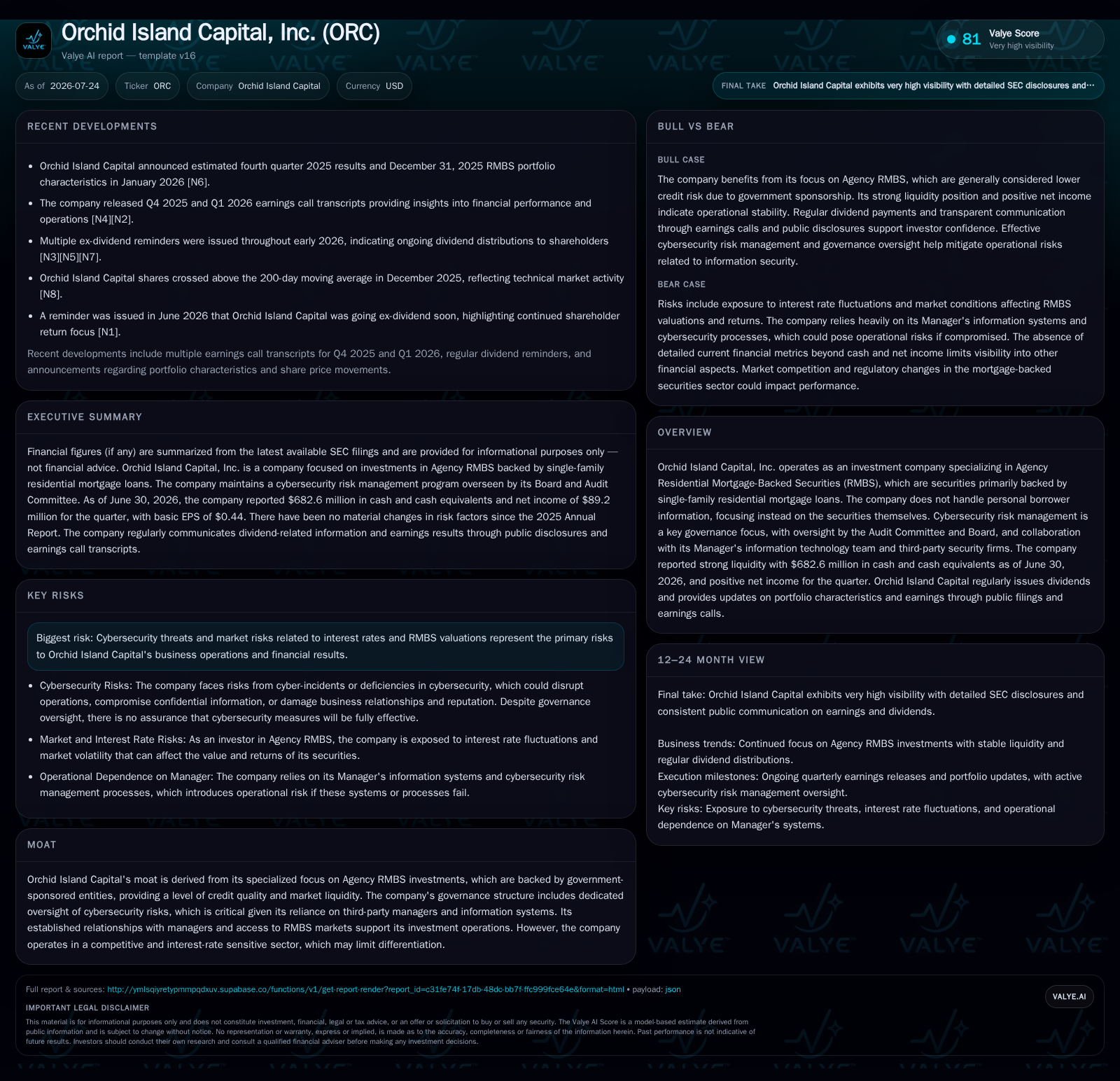
In its Q2 2026 filing, Orchid Island Capital demonstrated operational resilience with $682.6 million in cash and equivalents and continued dividend payments reflecting earnings stability. The firm's business model concentrates on investments in Agency Residential Mortgage-Backed Securities (RMBS), leveraging the credit support from government-sponsored entities to generate net interest income. Despite persistent interest rate sensitivities and prepayment fluctuations impacting portfolio yields, the company maintains disciplined leverage and hedging strategies, positioning it within a competitive landscape dominated by peers such as Annaly and AGNC. With robust liquidity enabling tactical capital deployment, management emphasizes cybersecurity risk governance while navigating the evolving mortgage REIT sector dynamics.
Q2 2026 Operating Highlights: Stability Amid Sector Volatility
Orchid Island Capital, Inc. reported operational resilience in its Q2 2026 results filed on July 24, 2026, demonstrating a strong liquidity position with $682.6 million in cash and cash equivalents as of June 30, 2026 [F1][S2]. This substantial liquidity base provides the company with flexibility to navigate the interest rate volatility and prepayment risks characteristic of the Agency Residential Mortgage-Backed Securities (Agency RMBS) sector. The firm also recorded positive net income for the quarter, reinforcing the sustainability of its dividend policy, which continues to deliver consistent monthly payouts aligned with earnings performance [S3][N1]. Orchid Island’s risk profile remained stable relative to its annual disclosures, indicating no material changes in exposure to sector-specific risks [S2].
Business Model Centered on Agency RMBS with External Portfolio Management
Orchid Island’s investment strategy is concentrated exclusively on Agency RMBS, securities backed by government-sponsored entities (GSEs) such as Fannie Mae and Freddie Mac, which guarantee timely principal and interest payments [S1]. This focus on single-family residential mortgage collateral mitigates credit risk relative to non-agency or commercial mortgage-backed securities, as the GSE guarantees substantially reduce default risk. Revenue is primarily generated through net interest income, derived from the spread between the coupon payments on Agency RMBS and the company’s funding costs. Leverage is employed prudently to enhance returns, amplifying net interest margins when spreads widen but also increasing sensitivity to spread compression and duration risk [S1].
The company outsources portfolio management to a specialized external Manager, enabling a lean operational structure that emphasizes investment execution and risk management without the overhead of direct servicing. This arrangement supports disciplined asset selection and hedging practices tailored to the nuances of Agency RMBS markets [S1].
Interest Rate Sensitivity and Hedging Strategies in a Complex Rate Environment
Mortgage REITs like Orchid Island face inherent interest rate sensitivity, as rising rates typically compress the market value of fixed-income assets and increase borrowing costs. The company actively manages duration risk and net interest margin volatility through hedging strategies designed to offset adverse movements in interest rates [S1][S2]. During Q2 2026, Orchid Island maintained consistent hedging approaches without material changes, reflecting a steady risk management posture aligned with sector practices.
Prepayment speeds—reflecting the rate at which borrowers refinance or pay down their mortgages—remain a critical variable affecting portfolio yield and income predictability [S1][S2]. Accelerated prepayments shorten the expected life of mortgage pools, reducing interest income and potentially forcing reinvestment at lower yields. Orchid Island monitors prepayment trends closely and adjusts hedging levels to mitigate the impact on net interest margins and portfolio duration
Competitive Landscape: Positioning Among Agency RMBS-Focused Mortgage REITs
Within the mortgage REIT sector, Orchid Island operates alongside larger peers such as Annaly Capital Management (NLY) and AGNC Investment Corp. (AGNC), both of which also specialize in Agency RMBS investments backed by GSE guarantees. While these peers benefit from scale advantages and broader diversification, Orchid Island’s more concentrated portfolio and disciplined leverage approach provide a focused exposure to single-family residential mortgage securities with controlled credit risk.
Compared to mortgage REITs with mixed portfolios including non-agency or commercial mortgage-backed securities, Orchid Island’s exclusive Agency RMBS focus offers a relatively stable credit profile but may limit diversification benefits. The company’s reliance on an external Manager for portfolio oversight contrasts with some peers that maintain internal asset management teams, potentially reducing operational complexity but increasing dependence on third-party risk controls.
Market liquidity for Agency RMBS remains robust due to GSE backing, facilitating efficient portfolio repositioning and capital deployment relative to less liquid mortgage sectors. Federal Reserve policies and macroeconomic conditions continue to influence supply-demand dynamics and valuation spreads within this competitive set.
Liquidity Strength as a Strategic Advantage for Capital Deployment
Orchid Island’s liquidity position, with cash and equivalents exceeding $680 million at quarter-end, represents a strategic asset enabling opportunistic capital deployment amid fluctuating Agency RMBS issuance and market dislocations [F1][S2]. This financial flexibility allows the company to selectively acquire securities when pricing is favorable or to reposition its portfolio in response to evolving interest rate environments.
Federal Reserve monetary policy remains a key external driver, as accommodative stances typically increase Agency RMBS supply and support tighter spreads, while tightening cycles can reduce issuance and increase spread volatility. Orchid Island’s liquidity buffer positions it to capitalize on these market cycles, enhancing potential returns while managing downside risks.
Operational and Cybersecurity Risk Governance
Recognizing the operational risks inherent in reliance on third-party portfolio management and information systems, Orchid Island emphasizes cybersecurity governance as a critical risk management area [S1]. Oversight responsibility is assigned to the Board’s Audit Committee and senior management, who coordinate with the Manager’s IT team and external security firms to monitor, detect, and respond to cyber threats.
The company’s cybersecurity program includes periodic risk assessments, incident response planning, and ongoing monitoring to safeguard operational continuity and data integrity. While no recent cybersecurity incidents have been reported, the layered governance framework reflects an awareness of the potential reputational and operational impacts of cyber risks in the mortgage REIT sector.
Key Operating Metrics and Monitors for Future Performance
Investors and analysts may focus on several critical operating variables to assess Orchid Island’s ongoing performance and risk profile. These include dividend declarations and payout ratios, which serve as indicators of earnings sustainability and cash flow adequacy [N1][S3]. Leverage ratio adjustments and disclosures will provide insight into the company’s risk appetite and capital structure management.
Monitoring the effectiveness of hedging strategies remains essential, particularly as interest rate volatility persists and Federal Reserve policies evolve. Prepayment speed trends will continue to influence portfolio yield and duration, requiring active management to preserve net interest margins.
Supplemental quarterly disclosures and investor communications offer transparency into portfolio repositioning activities and risk management initiatives, supporting informed evaluation of the company’s strategic execution [S3][S8].
Financial Profile: Liquidity and Earnings Context
As of June 30, 2026, Orchid Island’s cash and cash equivalents totaled approximately $682.6 million, providing a substantial liquidity cushion relative to sector peers [F1]. Positive net income reported for the quarter supports the company’s dividend continuity and reflects operational stability amid a complex interest rate environment [S3]. The firm’s financial position enables measured leverage deployment to enhance returns while maintaining prudent risk controls.
No forward-looking financial guidance is provided in the filings; therefore, assessment of future performance should consider macroeconomic factors such as interest rate trends, mortgage market conditions, and regulatory developments that influence Agency RMBS valuations and earnings potential.
Disclaimer: This analysis is for informational purposes only and does not constitute investment advice. It incorporates company-reported data and industry context without forward-looking guarantees.
Disclaimer: This is research-only, informational analysis and not investment advice. It may include AI-generated interpretation and general industry context. Always verify important details using primary sources.

Comments