
Spruce Power's Subscription Solar Model Faces Liquidity Test Amid Capital Demands
Q1 2026 results show steady subscription revenue from solar leases but a stretched balance sheet raises refinancing concerns for Spruce Power.
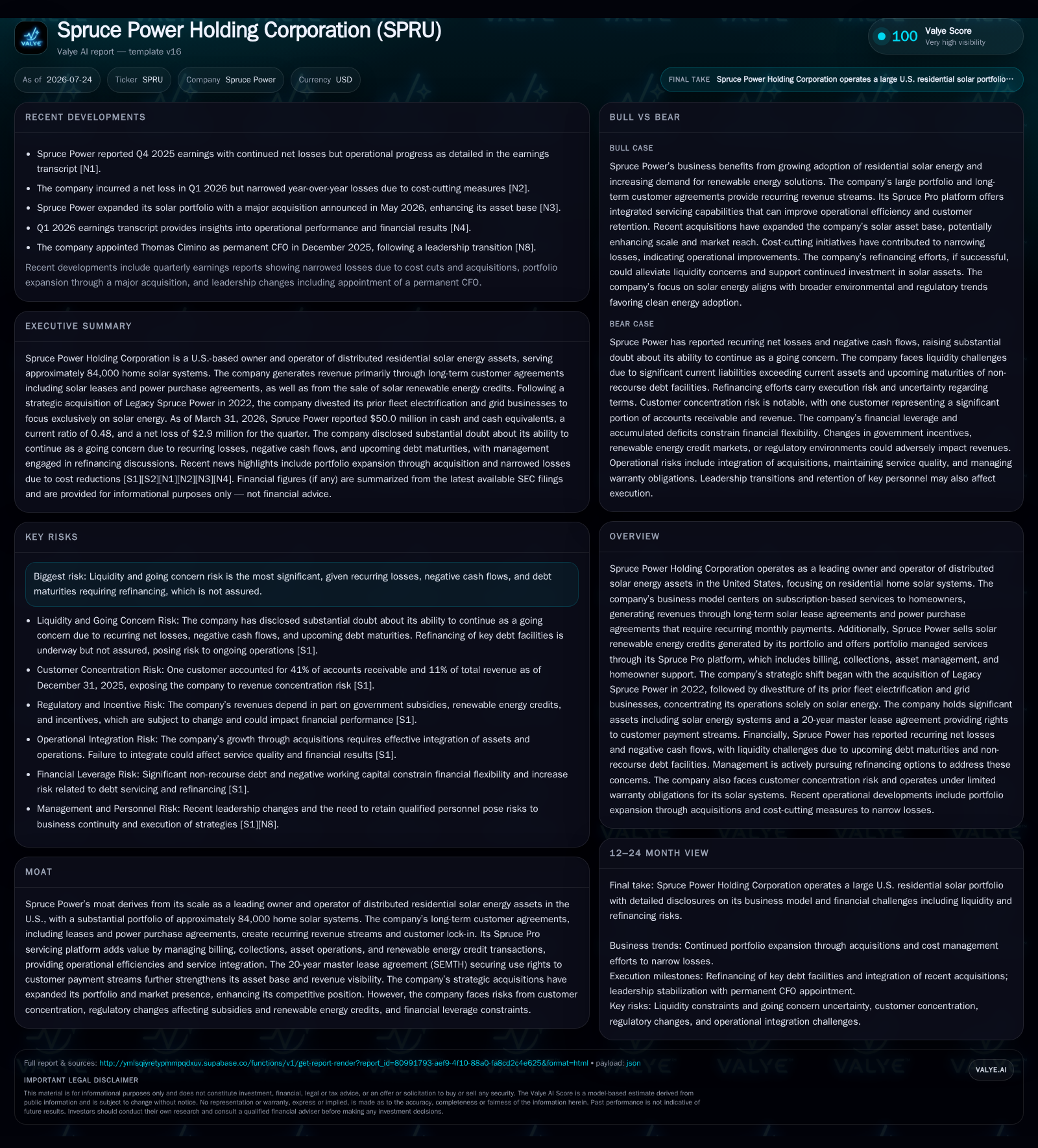
Spruce Power Holding Corporation’s latest quarterly filing highlights stable monthly recurring revenue driven by its substantial portfolio of approximately 84,000 residential solar systems, anchored by long-term lease and power purchase agreements. The company’s integrated servicing platform enhances operational efficiency and supports asset management. However, the capital-intensive nature of distributed solar asset ownership paired with sustained losses and a current ratio below 0.5 underscores significant liquidity and refinancing risks. Upcoming milestones on contract growth and refinancing efforts will be critical to validating the business model’s durability amid challenging financial leverage.
Q1 2026 Operating Update: Subscription Revenue Stability Meets Refinancing Challenges
Spruce Power Holding Corporation reported in its May 14, 2026 quarterly filing that it managed a portfolio of approximately 84,000 residential distributed solar systems at the end of Q1 2026, generating stable monthly recurring revenue (MRR) primarily through long-term solar leases and power purchase agreements (PPAs) with homeowners [S2][S1]. These subscription-based contracts provide predictable cash flow streams critical to the capital-intensive business model. A key strategic asset is the SEMTH Master Lease, acquired in early 2023 via SS Holdings 2017 LLC, which encompasses roughly 22,500 customer payment streams under a 20-year agreement, enhancing revenue visibility and contract duration profile [S1]. Despite this operational foundation, Spruce Power’s liquidity position remains strained, with a current ratio of 0.48 and total debt near $687 million against cash balances of approximately $50 million as of March 31, 2026, underscoring refinancing risks amid ongoing net losses and challenging credit markets [F1][S2].
In governance developments, the company appointed Bobby L. Owens as General Counsel effective July 13, 2026, signaling an effort to strengthen legal and compliance oversight during a critical phase of financial and operational restructuring [S3]
Business Model and Economics: Monetizing Distributed Solar Assets Through Subscription Contracts
Spruce Power’s business model centers on owning and operating distributed residential solar assets, monetizing electricity production via subscription-based revenue streams from solar leases and PPAs [S1]. Customers pay fixed monthly fees under contracts typically spanning multiple years, creating durable and forecastable MRR that supports asset-level cash flow generation. The SEMTH Master Lease acquisition further diversifies and extends contract duration by acquiring rights to a significant subset of customer payment streams, effectively securitizing long-term revenue.
Revenue is augmented by sales of Renewable Energy Credits (RECs), tradable environmental commodities that certify clean energy generation [S1]. These REC sales leverage favorable regulatory incentives and contribute positively to gross margins beyond power sales alone
Operational efficiency is enhanced by Spruce’s proprietary Spruce Pro platform, which integrates billing, collections, asset maintenance, and customer service functions into a centralized portfolio servicing system. This vertical integration reduces operating expenses per megawatt (MW) of capacity under management and supports customer retention, a critical KPI given the subscription nature of contracts [S1]
Competitive Landscape: Positioning Among Distributed Solar Asset Owners
Spruce Power competes in the distributed residential solar sector alongside peers such as Sunrun Inc. and Vivint Solar, which also operate large portfolios of leased or contracted solar assets generating recurring revenues from residential customers [S1]. Competitive differentiation hinges on portfolio scale (number of installed systems and MW capacity), contract economics (lease and PPA pricing and duration), and operational platform capabilities that drive margin efficiencies and customer retention.
Unlike utility-scale renewable developers, Spruce’s business model aggregates numerous small-scale customer payment streams, exposing it to higher customer credit risk and necessitating robust billing and collections infrastructure. Spruce’s integrated Spruce Pro platform provides an operational edge over peers relying more on outsourced servicing, potentially lowering operating and maintenance (O&M) costs and improving asset uptime and availability.
However, the company faces ongoing competitive pressures related to customer acquisition cost (CAC), contract renewal rates, and regulatory changes that may affect incentive programs or contract enforceability across its geographic footprint.
Growth Drivers: Contract Portfolio Expansion and Renewable Energy Credit Participation
Growth prospects for Spruce Power are supported by increasing residential solar adoption driven by rising electricity prices, favorable government incentives such as tax credits, and technological improvements enhancing solar panel efficiency and reducing levelized cost of energy. The company’s portfolio expansion, including incremental asset additions post-SEMTH acquisition, contributes to MRR growth and scale economies [S1].
Participation in REC markets provides an additional revenue stream tied to solar energy production volume, with legislative trends favoring renewables supporting REC price stability or appreciation. Operational improvements via Spruce Pro also enhance asset performance metrics such as capacity factor and uptime, indirectly boosting REC sales and overall revenue.
Risks and Watchpoints: Refinancing, Credit Exposure, and Regulatory Uncertainty
Spruce Power’s capital-intensive model results in significant leverage, with net debt approximating $637 million as of March 31, 2026, against limited cash reserves of roughly $50 million, yielding a current ratio of 0.48 that signals short-term liquidity pressure [F1]. Sustained net losses constrain free cash flow generation, intensifying refinancing risk amid volatile interest rate and credit market conditions [S2]. Monitoring debt service coverage ratios and covenant compliance will be critical to assessing financial flexibility.
Customer credit risk inherent in subscription payment streams poses a threat to MRR stability if delinquency or default rates rise. The company’s ability to manage collections effectively through Spruce Pro is a key mitigating factor. Additionally, customer concentration risk exists if regional economic downturns disproportionately impact subsets of the portfolio.
Regulatory risks include potential changes to subsidy programs, renewable energy credit frameworks, or contract enforcement laws, which could adversely affect REC valuations, contract revenue, and profitability.
Key Performance Indicators and Milestones to Monitor
Investors and analysts should track quarterly MRR growth rates as a direct measure of contract portfolio expansion and retention effectiveness. Contract duration and renewal rates provide insight into revenue durability. Delinquency and default metrics will reveal credit risk trends and collection efficiency.
Operational KPIs such as operating expenses per MW, asset uptime, and capacity factor indicate the effectiveness of asset management and the Spruce Pro platform’s contribution to margin improvement. REC sales volume and pricing trends will reflect regulatory and market conditions impacting supplemental revenue.
Debt covenant negotiations, refinancing outcomes, and changes in interest coverage ratios will be important financial markers to assess liquidity and leverage risk. Regulatory developments affecting incentive programs or REC markets should be closely monitored for their potential impact on growth and profitability.
Financial Snapshot: Liquidity Constraints Reflect Capital-Intensive Asset Ownership
As of March 31, 2026, Spruce Power reported cash and equivalents of approximately $50 million against total debt of about $687 million, resulting in net debt near $637 million [F1]. Current assets stood at $111 million versus current liabilities of $231 million, yielding a current ratio of 0.48, which highlights near-term liquidity challenges [F1].
The capital-intensive nature of distributed solar asset ownership requires substantial upfront investment, with cash inflows from subscription contracts realized over extended periods. This dynamic, combined with ongoing net losses, pressures free cash flow and necessitates external financing or refinancing to sustain operations and growth.
This analysis is based on public filings as of July 2026 and does not constitute investment advice. Readers should consult primary sources and disclosures for comprehensive evaluation.
Disclaimer: This is research-only, informational analysis and not investment advice. It may include AI-generated interpretation and general industry context. Always verify important details using primary sources.

Comments