
Distribution Solutions Group's Revenue Growth and Margin Challenges in Specialized Distribution
DSG leverages diversified segments and acquisitions for revenue growth but faces margin pressure and debt servicing costs amid inflationary headwinds.
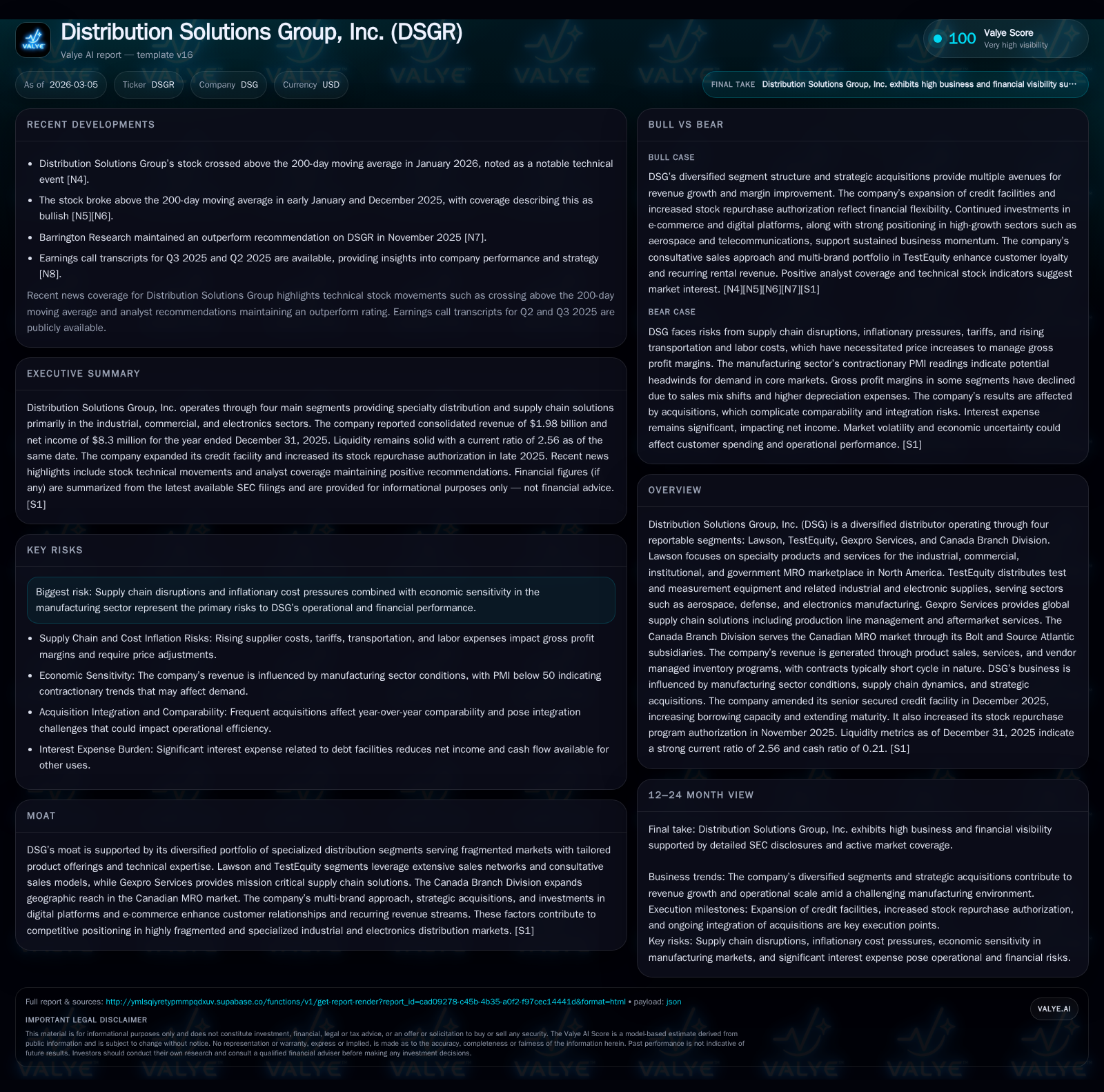
Distribution Solutions Group, Inc. (DSG) operates four specialized distribution segments serving fragmented industrial and electronics markets in North America. Between 2023 and 2025, DSG exhibited consistent top-line growth driven by acquisitions and organic gains, particularly from expanding its Canadian operations and TestEquity’s rental equipment business. However, margin erosion due to higher costs and sales mix shifts poses a challenge. The company refinanced debt in late 2025 to extend maturities but maintains substantial leverage with floating interest rates. Management’s increased stock repurchase authorization signals confidence despite modest net income and limited returns on equity.
Company Overview
Distribution Solutions Group, Inc. (DSG) operates as a diversified distributor targeting specialized niches within the industrial maintenance, repair & operations (MRO) sector as well as electronics manufacturing markets. DSG’s reported segments include Lawson, TestEquity, Gexpro Services, and the recently added Canada Branch Division formed after the acquisitions of Bolt Supply House and Source Atlantic in 2024 [S1][S5].
Lawson focuses on specialty products and services critical to industrial, commercial, institutional, and government MRO demand across North America. TestEquity distributes test & measurement equipment alongside electronic production supplies serving aerospace, defense, semiconductor manufacturing, wireless communications, automotive sectors and electronics assembly industries [S1][S8]. Gexpro Services delivers global supply chain solutions centered on mission-critical production line management including aftermarket installation programs [S1][S6]. The Canada Branch Division expands DSG’s geographic footprint into the Canadian market through warehouse shipments and walk-up branches [S9][S11].
DSG derives revenues primarily from product sales, service offerings including vendor managed inventory programs (VMI), and equipment rentals with short contract cycles typically less than a year but sometimes extending with optional renewals [S11][S6].
Historical Financial Performance
DSG exhibited steady growth over the three-year period ending December 31, 2025. Total consolidated revenues climbed from approximately $1.57 billion in 2023 to just under $2 billion in 2025 ([F1], [S8][S9]). This represents an aggregate increase of about 26%, attributable to both organic growth — including strengthening demand across aerospace/defense verticals — as well as accretive acquisitions notably Source Atlantic consolidation into the Canada Branch Division [S6][S10].
Operating income showed impressive progression rising by about 40% to roughly $78.3 million in 2025 from $43 million reported in 2023 [F1]. However, profitability remains constrained overall with net income improving only recently from losses recorded during 2023–24 to posting $8.35 million positive earnings last year [F1]. This reflects ongoing investments and some margin headwinds.
The following table summarizes key annual financial metrics for fiscal years ended Dec 31:
Historical performance (annual)
| FY | Net ($mm) | CFO ($mm) | OpInc ($mm) | Capex ($mm) | Net YoY |
|---|---|---|---|---|---|
| 2025 | 8 | 84 | 78 | 21 | +213.8% |
| 2024 | -7 | 56 | 56 | 14 | +18.2% |
| 2023 | -9 | 102 | 43 | 15 | -221.1% |
| 2022 | 7 | -11 | 42 | 8 |
Source: SEC companyfacts cache [F1].
Capital returns and efficiency (annual)
| FY | Buybacks ($mm) | FCF ($mm) | ROE% |
|---|---|---|---|
| 2025 | 24 | 63 | 1.3 |
| 2024 | 3 | 43 | -1.1 |
| 2023 | 4 | 87 | -1.4 |
| 2022 | 2 | -19 | 1.3 |
Source: SEC companyfacts cache [F1].
Segment performance shows balanced contributions to revenue gains:
- Lawson: Stable growth focused on expanding specialized MRO product distribution.
- TestEquity: Modest revenue improvement (up ~22% since ’23) driven partly by rental equipment expansion; however gross margins declined amid higher depreciation costs on new assets [S14][S23].
- Gexpro Services: Notable revenue rise (~23%) aligning with elevated aerospace/renewable energy vertical demand.
- Canada Branch Division: Rapid scale-up post-acquisition nearly quadrupling segment revenues since ’23.
Operating Performance Drivers + Strategic Themes
DSG's growth engine is supported by its diverse segment portfolio addressing fragmented markets requiring technical expertise and relationships [S1]. Lawson leverages a consultative sales model over a broad network accessing industrial MRO purchasing managers. TestEquity’s multi-brand approach allows offering deep product breadth for test instrumentation calibrated for specialized aerospace/defense applications [S10]. Meanwhile Gexpro Services targets OEM production schedules delivering integrated inventory management under VMI along with aftermarket field services [S6]. The Canadian expansion taps underserved regional customers through branch network effects.
Acquisition activity bolstered revenue notably: the Source Atlantic acquisition enlarged Canadian reach; others such as TCR enhanced TestEquity’s rental assets contributing recurring margins [S14][S18]. Pricing passthrough mechanisms have attempted offsetting tariff increases and inflationary pressures since early ‘20s but operating margin percentage faced pressure due to sales mix shifts favoring lower-margin rental/provision segments within TestEquity plus higher stock write-offs [S23].
From a macroeconomic angle DSG tracks Purchasing Managers Index (PMI) trends relevant to manufacturing sector health which hovered below expansion threshold (~48-49 level) suggesting subdued but slightly improving industrial spending conditions impacting demand patterns [S1]. Supply chain volatility coupled with inflation elevated product input costs that DSG countered partly through price hikes but margin squeeze persisted.
Forecasts / Expectations / Milestones
No explicit formal forward guidance was disclosed as of the latest filings dated March ‘26 [N4][S3]. However:
- Management projects continued capital expenditure between $25-$30 million in FY26 focused on sustaining operational capabilities including expanded rental inventory assets predominantly at TestEquity alongside branch infrastructure investment at Canada Division [S7][S14].
- The recently amended credit agreement extends senior secured borrowings through end of calendar year 2030 with larger revolver capacity aimed at supporting working capital needs plus bolt-on acquisitions capacity [S4].
- Business momentum indicators suggest CFP initiatives around e-commerce investments are expected to boost recurring revenue streams particularly within digital VMI platforms deployed across Lawson/TestEquity segments [S1].
- Customer concentration remains low given broad market diversification but volume sensitivity is present due to cyclical exposure inherent in MRO demand linked closely to manufacturing utilization rates.
Key developments to watch include performance of newly acquired bolt-on subsidiaries' integration progress especially within Canada Branch Division spatially dispersed operations that contribute nearly ~11% of consolidated revenues already [S9][S25]; further margin recovery initiatives at TestEquity; impact of global economic conditions affecting discretionary maintenance spending among industrial OEMs.
Capital Structure & Capital Allocation
DSG maintains moderately elevated leverage reflecting an overall net debt position near $704 million at year-end ’25 complemented by liquidity availability via a revolving credit facility totaling $400 million after recent amendments executed late Q4 ’25 extending tenure through December ‘30. Interest expenses have risen reflecting floating rate exposure tied primarily to SOFR-linked borrowings with total cash interest cost approaching higher single digits percent effective rates during ‘25 (~6.56% term loan rate post-refinance vs avg ~6.86% previously) [F1][S19].
The refinancing reduced near-term amortization burdens maintaining quarterly principal installments of roughly $8.75 million extending maturity bulk payment until final tranche comes due in ‘30 [S20][S27][S28]. Balance sheet strength shows solid asset base near $1.75 billion segmented capital deployment across units plus equity growing moderately year-over-year despite share count changes following stock split action in ’23 plus rights offering proceeds earmarked for recent strategic investments [F1][S13].
Free cash flow generation remains positive at approximately $63 million after deducting ongoing capex from operating cash flows last fiscal year illustrating stable underlying cash conversion despite modest net earnings given working capital consumption dynamics [F1][S16][S24]. Notably:
- Share repurchases ramped up sharply with nearly $23.5 million spent buying back approximately ~777k shares at average price ~$30/share during FY25 versus nominal buyback activity in prior years signaling focus on shareholder return alongside opportunistic valuation levels as per board authorization increase increasing program ceiling from $37.5 million up to $67.5 million total authorized repurchase capacity [F1][S17][S21].
- No dividends have been declared reflecting reinvestment priorities plus leverage risk management focus historically.
Return on equity remains compressed near roughly low single digit territory (~1.3%) given thin profitability amid sizable equity base although recent earnings improvement hints at potential for gradual uptick pending sustained operational efficiency improvements or margin recovery strategies [F1].
Risks Summary
Primary risks highlighted center around cyclical manufacturing exposure making DSG susceptible to downturns reducing customer order volumes or prolonging payment cycles compounded by inflation-induced cost pressures limiting passthrough potential leading to margin contraction [S1]. Supply chain interruptions also continue as a persistent challenge affecting timely delivery of specialized inventory components impacting service levels.
Financially, the company faces refinancing risk related to covenant compliance embedded within amended credit facilities while also absorbing interest rate volatility impacting funding costs given exclusive reliance on floating rate instruments without hedging arrangements currently employed [F1][S26]. Legal proceedings remain low-impact according to disclosures but warrant monitoring nonetheless.
Management’s success depends heavily on execution of integration efforts especially within Canadian expansion acquisitions plus ability to maintain competitive positioning via consultative sales models that deliver tailored solutions amidst increasingly consolidating suppliers while leveraging technology for operational efficiencies across distribution networks.
Closing Thoughts
Distribution Solutions Group’s trajectory exhibits credible topline expansion complemented by strategic portfolio diversification balancing somewhat uneven profitability trends shaped by industry-specific dynamics like product mix changes and inflation inputs. The company prudently extended its debt maturity profile while actively managing shareholder returns through buybacks signaling confident liquidity management despite modest earnings scale relative to enterprise size.
Going forward key indicators will include stabilization or improvement of gross margins impacted by mix shifts especially within TestEquity rentals segment; efficiency enhancements harnessing digital transformation in inventory management services; accretive acquisition pipeline execution particularly enhancing Canada Branch Division footprint; and prudent funding cost control amidst macroeconomic uncertainties impacting global industrial supply chains.
This report is for informational purposes only, summarizing publicly available data without providing investment recommendations or price targets regarding Distribution Solutions Group Inc.
Disclaimer: This is research-only, informational analysis and not investment advice. It may include AI-generated interpretation and general industry context. Always verify important details using primary sources.

Comments