
Diana Shipping's Strategic Fleet Moves and Financial Trajectory in 2025
Diana Shipping Inc. balances fleet diversification, charter contracts, and disciplined capital deployment amid a challenging dry bulk market.
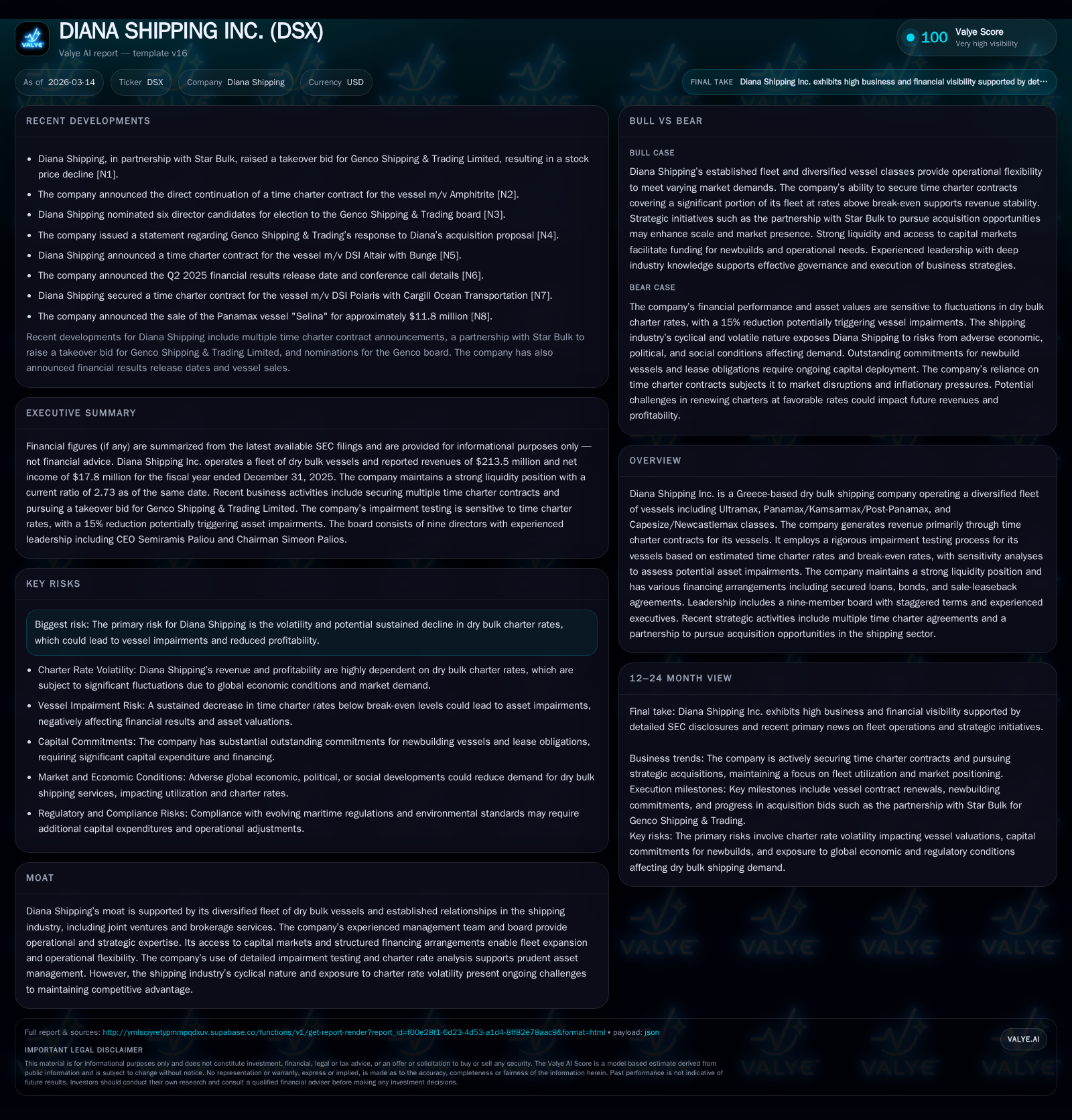
In 2025, Diana Shipping experienced a moderation in revenue and profitability compared to the peak years of 2022 and 2023, reflecting the cyclical volatility of the dry bulk charter market. The company’s diversified fleet across Ultramax, Panamax/Kamsarmax/Post-Panamax, and Capesize/Newcastlemax vessel classes supports operational flexibility and risk mitigation. Careful impairment testing linked to time charter equivalent rates underscores vulnerability to prolonged rate declines, although current contracted coverage provides a buffer. Strategic initiatives include an increased takeover bid for Geneco Shipping through a partnership with Star Bulk and new or extended time charter contracts that secure approximately 81% of ownership days in 2026. Diana Shipping maintains a robust liquidity profile supported by secured loans, bonds, sale-leaseback arrangements, and prudent capital allocation policies including reduced capital expenditures, resumed dividends, and selective share repurchases.
From Peak Revenues to Moderated Growth: Diana Shipping’s Recent Performance Snapshot
Diana Shipping Inc.’s financial trajectory over recent years illustrates the typical cyclicality intrinsic to dry bulk shipping markets. In fiscal year (FY) 2025, the company reported revenues of approximately $213.5 million, down from a peak of nearly $290 million in FY2022 — marking a significant top-line contraction over the three-year horizon [F1]. The year-over-year (YoY) decline from FY2024’s $228.2 million represents a -6.4% reduction.
Operating income mirrored this contraction more sharply, falling by -28.2% YoY from $58.8 million in FY2024 to roughly $42.2 million in FY2025 [F1]. This reflects lower charter rates impacting vessel utilization economics despite continued focus on operational efficiency.
Net income showed resilience with a +39.9% increase YoY to $17.8 million in FY2025 despite the operating income drop—this likely reflects one-off financial or non-operating items improving net profits relative to prior periods [F1]. Meanwhile, operating cash flow (OCF) decreased -43.1% YoY to about $47.5 million amid shrinking earnings and working capital shifts.
Capital expenditures (CapEx) dropped sharply compared to prior years with the latest detailed figure showing approximately $29.7 million spent in FY2023; however, specific FY2025 CapEx data is not available [F1]. The company has curtailed spending following elevated investment cycles culminating in newbuildings and asset upgrades earlier.
Historical performance (annual)
| FY | Rev ($mm) | Net ($mm) | CFO ($mm) | OpInc ($mm) | Rev YoY | Net YoY |
|---|---|---|---|---|---|---|
| 2025 | 214 | 18 | 48 | 42 | -6.4% | +39.9% |
| 2024 | 228 | 13 | 84 | 59 | -12.9% | -74.4% |
| 2023 | 262 | 50 | 70 | 86 | -9.6% | -58.1% |
| 2022 | 290 | 119 | 159 | 143 |
Source: SEC companyfacts cache [F1].
Capital returns and efficiency (annual)
| FY | Div ($mm) | Buybacks ($mm) | FCF ($mm) |
|---|---|---|---|
| 2025 | 5 | 23 | |
| 2024 | 29 | 4 | |
| 2023 | 41 | 0 | 41 |
| 2022 | 80 | 4 | -71 |
Source: SEC companyfacts cache [F1].
Table note: CapEx data available only for selected years per [F1].
Fleet Composition and Charter Rate Sensitivities: Navigating Asset Impairment Risks
Diana’s strategic advantage partly derives from its diversified fleet mix comprising Ultramax, Panamax/Kamsarmax/Post-Panamax, and Capesize/Newcastlemax classes—vessels spanning deadweight tonnage categories serving multiple cargo segments globally [S1]. This heterogeneity provides tactical flexibility amidst volatile demand-supply dynamics.
The company employs rigorous impairment testing under U.S GAAP protocols by assessing each vessel as a single asset group against undiscounted projected net operating cash flows derived primarily from historical and forecasted time charter equivalent rates (TCEs). Key inputs entail average daily TCEs over various horizons compared against calibrated break-even costs—including operating expenses, financing costs implicit in mortgage-backed vessels, general & administrative costs allocated per ship class—and residual values judged conservatively at scrap estimates [S22].
As of December 31, 2025, average estimated daily TCE rates used were approximately $16,309 for Ultramax vessels versus a break-even rate near $13,276; Panamax/Kamsarmax had estimated TCEs around $13,596 compared with break-even of roughly $9,960; and Capesize/Newcastlemax vessels posted TCE estimates near $17,517 against break-even thresholds about $12,954 per day [S22]. These spreads reflect current cushion built into contracted charters.
However, Diana acknowledges that a reduction of some ~15% in TCEs would provoke vessel impairments on certain units; as many as ten vessels currently flagged with impairment indicators would be adversely impacted should rates fall below their respective break-even points on a sustained basis [S22]. The analysis thus highlights latent exposure should dry bulk spot rates endure decline beyond seasonal or short-cycle fluctuations.
Usage of one-, three-, or five-year blended average TCE rates would not trigger impairments presently — indicating stability is expected only under moderate rate variation scenarios rather than deeper cyclical troughs [S22].
Strategic Acquisitions and Time Charter Contracts: Expanding Presence Through Partnerships
Consistent with growth ambitions within its sector niche, Diana Shipping advanced acquisition tactics alongside charter contract renewals underpinning fleet employment stability.
On March 6, 2026, the company announced an enhanced all-cash offer to acquire all outstanding shares of Genco Shipping & Trading Limited—executed jointly with maritime peer Star Bulk Carriers Corp.—signaling both cooperative synergy aims and potential consolidation effects within dry bulk shipping [N1],[S2]. This partnership leverages combined operational expertise and asset base scale while endeavoring to secure cost efficiencies.
Fleet employment efforts have reinforced contracted revenue streams: recent announcements confirm continuation of time charter contracts such as for the m/v Amphitrite Panamax vessel [N2] and fresh engagements like the Panamax m/v Crystalia secured through SwissMarine Pte., Singapore [S3]. Such fixed-rate charters contribute to firming forward-looking earnings visibility amidst uncertain spot market conditions.
Currently contracted revenues cover roughly 81% of ownership days for fiscal year 2026 at average time charter rates exceeding break-even levels—with around an additional ~9% fixed entering calendar year 2027—denoting substantial pre-commitment across fleet utilization [S1]. This coverage mitigates near-term market volatility risks while preserving upside exposure on unallocated days.
Capital Structure in Detail: Navigating Debt Facilities, Financing Newbuilds, and Liquidity
Diana Shipping's capital framework demonstrates well-structured debt layering tailored via secured term loans coupled with newer issuance of senior unsecured bonds retaining disciplined amortization schedules.
As of December 31, 2025, long-term debt totaled approximately $529 million split among major facilities including export-import bank financing ($57 million), Nordea Bank refinancing ($167 million), Danish Ship Finance programs ($100 million), DNB Bank loan ($100 million), and National Bank of Greece credit lines ($55 million) [S4],[S6],[S7],[S14],[S20],[S21]. These borrowings are secured by first-priority ship mortgages on over thirty vessels alongside revenue pledges plus insurance assignments—the standard collateral approach prevalent in shipping finance markets.
Interest rate risk was partially mitigated through derivative instruments such as interest rate swaps linked to SOFR-based floating exposures capped by fixed coupons around mid-4%-levels on select indebtedness [S7].
Future liquidity demands include committed capital expenditure obligations totaling approximately $73.6 million earmarked for construction of two environmentally progressive methanol dual-fuel Kamsarmax newbuilds slated for delivery between Q3/2027 and Q1/2028—a strategic move aligning with emerging regulatory pressures toward cleaner fuels maritime sector-wide [S1],[S4],[S9].
Additional commitments encompass €9.4 million related to joint ventures (Windward), $8.2 million toward LPG vessel constructions expected delivery also during calendar year ’27 plus non-cancellable purchase obligations aggregating over $50 million under lease agreements financing existing assets [S1].
Liquidity metrics remain healthy with cash equivalents at roughly $50 million together with current assets comfortably exceeding current liabilities at a ratio exceeding ~2.7x as per latest filings—a critical balance allowing flexibility amid payment schedules tied to debt service obligations as well as dividend distribution capability [F1],[S14],[S16],[S20].
An Examination of Capital Allocation: Dividends, Buybacks, and Investment Priorities
After suspending common stock dividends since late-2008 due to market deterioration,[S5] Diana Shipping reinstated quarterly dividends starting Q3’21 reflecting improved earnings expectations aligned with recovering market fundamentals.
Dividend outflows moderated commensurate with earnings volatility—total payment for FY25 registered approximately $4.63 million down notably from prior year payouts exceeding $29 million reflecting cautious cash retention policies attendant to ongoing market uncertainties [F1],[S5].
Concurrently the company engaged selectively in share repurchases ramping buyback activity notably up to around $23 million during FY25 compared with lower levels earlier evidencing opportunistic capital return amid stock price valuations deemed attractive within industry cycles [F1],[S10].
These distributions alongside controlled capital expenditure support an approximate return on equity (ROE) near ~3.5%, consistent with shipping peers managing cyclically influenced earnings but focusing on shareholder value preservation where prudent [F1],[S29].
Investment priorities include adherence to low-emission vessel acquisitions aligned with ESG-driven maritime regulations alongside corporate growth via M&A pursuits such as the Genco collaboration effort detailed earlier targeting industrial-scale synergies.
Forward-Looking Metrics: Contract Coverage and Market Exposure
Looking ahead into calendar years ’26–’27 momentum rests principally on contracted employment levels covering ~81% ownership days at above break-even TCE rates plus an additional ~9% locked into fixed charters early into ’27 providing baseline revenue streams insulated partially from spot fluctuations during unfixed days [S1].
Key metrics warrant close scrutiny including renewal success at favorable time charter re-pricing thresholds post-contract expiration given changing macro drivers impacting dry bulk commodity shipping demand including inflationary pressures and geopolitical trade dynamics.
Further monitoring includes outcome realization surrounding the Geneco acquisition bid co-led with Star Bulk—transaction execution or regulatory hurdles will materially influence fleet scale growth trajectories alongside cost synergy opportunities.[N1]
Additional watchpoints are asset utilization metrics where excessive off-hire or downtime could erode operating leverage despite contractual coverage levels plus potential impacts arising from newly implemented environmental compliance necessitating further capex or operational adjustments.
Conclusion: Sustaining Competitive Edge Amid Industry Cyclicality
Diana Shipping’s competitive edge is grounded firmly in its diversified dry bulk vessel portfolio balanced amongst key shipping sectors ranging from Ultramax feeder sizes through Panamax intermediary classes to Capesize tonnage targeting high-volume bulk carriers capable of economies of scale across iron ore or coal trades.
Complementing this fleet diversity are strategic partnerships providing acquisition avenues aimed at consolidating fragmented scale advantages while leveraging brokerage expertise rooted historically within affiliated entities.
The company’s prudent financial stewardship manifests in robust liquidity buffers paired with prudent leverage ratios supported through multi-source long-term financing structures tailored specifically for shipping industry needs such as mortgage collateralization and amortizing balloon payments.
Nonetheless inherent exposure remains pronounced due to persistent volatility endemic to dry bulk charter markets where sudden demand shocks or supply imbalances can compress TCE rates affecting profitability and potentially triggering asset impairments impacting accounting results—a perennial risk factor underscored repeatedly by management disclosures.
Moving forward requires maintaining agility via contracted revenue coverage optimization alongside disciplined capital deployment steering investments towards low-emission technologies compliant with tightening regulatory frameworks ensuring sustainability credentials increasingly demanded by charterers globally.
In sum: Diana Shipping navigates cyclical headwinds leveraging fleet diversity and financial flexibility while strategically expanding footprint via selective partnerships positioning itself cautiously yet resolutely for long-term value creation within volatile ocean freight markets.
This analysis is intended solely for informational purposes outlining Diana Shipping Inc.’s operational context and financial profile based strictly on disclosed filings without providing investment advice.
Disclaimer: This is research-only, informational analysis and not investment advice. It may include AI-generated interpretation and general industry context. Always verify important details using primary sources.

Comments