
Kestrel Group Ltd's Capital-Light Insurance Platform Balances Growth Ambitions With Legacy Reinsurance Risks
Kestrel Group leverages exclusive fronting relationships and aims to grow fee income while managing legacy liabilities and significant debt.
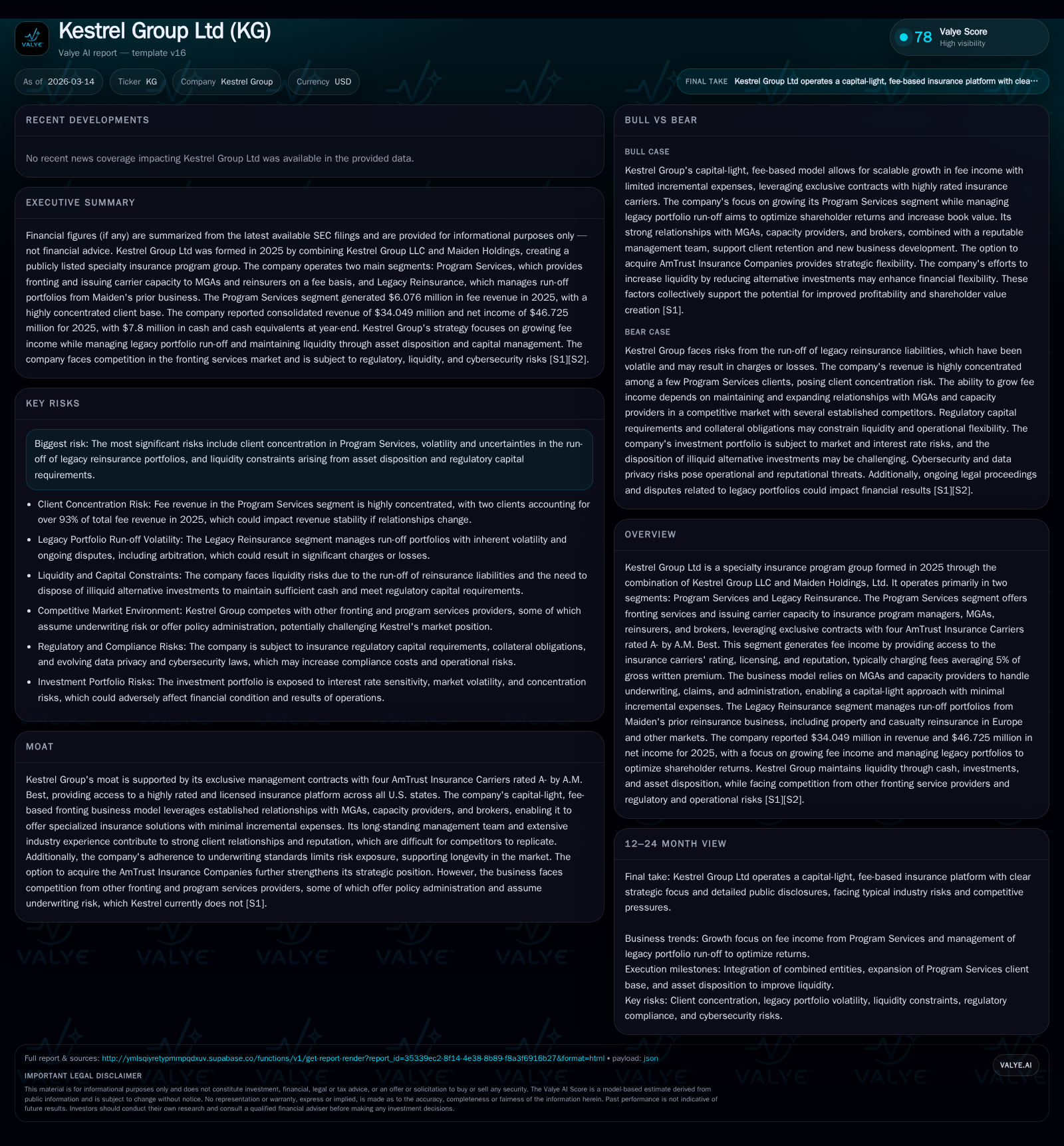
Kestrel Group Ltd, formed in 2025 from the combination of Kestrel LLC and Maiden Holdings, operates a specialty insurance business focused on fronting services via exclusive contracts with four A- rated AmTrust carriers. Its capital-light Program Services segment generates fees primarily from MGAs and capacity providers, supporting strong operating leverage. Concurrently, the company manages volatile run-off legacy reinsurance portfolios from Maiden, creating earnings complexity and risk. Despite growing revenues reaching $34.0 million in 2025 and a reported net income of $46.7 million, elevated fixed costs, heavy debt service, and client concentration constrain profitability expansion. The firm’s future growth depends on accelerating Program Services fee income, exploring selective underwriting participation, and resolving legacy asset monetization challenges while navigating regulatory compliance and liquidity constraints.
Company Formation and Business Model
Kestrel Group Ltd was established in May 2025 via the combination of Kestrel Group LLC and Maiden Holdings, Ltd [S1]. The merger created a specialty insurance platform focused on fronting services under exclusive contracts with four AmTrust Insurance Carriers rated "A-" (Excellent) by A.M. Best with Financial Size Category XV [S9]. This structure provides Kestrel access to an established insurance carrier network with broad state licenses across all U.S. jurisdictions.
The core Program Services segment leverages these exclusive fronting arrangements to deliver insurance capacity for managing general agencies (MGAs), reinsurers, brokers, and other program managers operating specialized property and casualty books [S4]. The company earns fees typically around 5% of gross written premium. These fees are generated by providing access to AmTrust’s rating, licensing, and reputation but rely on third parties—MGAs or capacity providers—to perform underwriting, claims handling, policy administration, and cash management [S4]. This unique business model allows Kestrel to operate capital lightly with minimal incremental expenses relative to premium volumes.
Simultaneously, Kestrel manages a Legacy Reinsurance segment comprised of run-off portfolios inherited from Maiden Holdings’ previous operations focusing on alternative assets and reinsurance liabilities [S1]. These portfolios entail distinct risks related to claim development volatility and asset disposition timing.
Historical Performance Trends
Despite being a nascent public entity created only in mid-2025, Kestrel’s reported top line demonstrates rapid growth supported by expanded fee revenue generation. For full-year 2025, consolidated revenue reached approximately $34.0 million USD [F1], inclusive of Program Services fees as well as Legacy Reinsurance income (which earned net premiums totaling approximately $7.8 million) [S21].
Specifically within its Program Services segment—the key engine for future growth—premium produced surged from about $103.8 million in 2024 to $188.3 million in 2025 while related fee revenue increased from $3.6 million to $6.1 million over the same period [S9]. This doubling reflects successful expansion of existing client programs alongside new business development initiatives targeting brokers and MGAs.
The company’s profitability metrics present a complex picture. While the overall net income for 2025 was $46.7 million USD [F1], this figure is significantly influenced by legacy investment returns and non-operating items rather than operational cash flows from core program services alone [S25]. Consequently, the return on equity calculation based on reported net income divided by year-end equity yields a notable figure around 36% [F1], though it should be interpreted cautiously given combined segment dynamics.
A summary table below captures key financial data for recent years:
Historical performance (annual)
| FY |
|---|
| 2025 |
Source: SEC companyfacts cache [F1].
Note: Detailed segmented net income or operating profit breakdowns are not disclosed separately; total revenue includes multiple streams.
Drivers Behind Historical Growth
The company's growth has been anchored primarily in its Program Services segment leveraging AmTrust’s licensed carrier capacity under exclusive contracts that provide differentiated market access [S9]. This arrangement allows Kestrel’s clients—often MGAs or reinsurers seeking licensed U.S.-market entry or rating upgrade—to write specialized P&C business efficiently [S4]. The scaling success is apparent in both gross premium production increases and corresponding fee revenue gains.
An important factor supporting this growth has been Kestrel’s effective use of capacity distribution agreements restricting competitors from accessing these same underwriting platforms without going through Kestrel or its network carriers [S9]. Additionally, its management team brings a long-standing industry presence fostering trusted broker relationships that help sustain near-term client retention despite the segment's heavy customer concentration (two clients making up over 93% of fees in 2025) [S4].
However, results have also been affected by operational challenges associated with absorbing a significant fixed cost base tied to Maiden’s prior higher scale activities—including approximately $19.1 million annual interest expense on senior notes originally issued when Maiden was larger—which currently weigh on operating margins [S10]. Moreover, the continuation of run-off liabilities in Legacy Reinsurance adds earnings volatility.
Future Growth Prospects
Strategically, Kestrel places priority on expanding its Program Services fee income due to its capital-light nature and margin potential [S22]. Management indicates intentions to accelerate this by increasing direct relationships with MGAs and capacity providers beyond traditional brokerage channels through marketing efforts including conference engagements internationally [S7]. There is also exploration underway for selective underwriting participation alongside program managers or existing carrier partners aimed at optimizing shareholder returns—a shift that could broaden revenue sources albeit with some controlled risk assumption [S28].
Concurrently, the company plans active management of its extensive alternative investment portfolio valued at approximately $218.6 million as of December 31, 2025—a portfolio partly inherited from Maiden—including private equity securities and credit funds [S28]. Disposal efforts aim to improve liquidity position amid prevailing market uncertainty surrounding interest rates and capital markets volatility.
Nevertheless, potential constraints include existing large client concentration requiring diversification over time; ongoing regulatory compliance costs especially in tightly regulated insurance environments; and uncertainties attached to legacy claim runoff volatility which could produce unexpected reserve developments or litigation costs affecting cash flow profiles long term [S10][S27].
Another critical variable will be maintaining sufficient liquidity given that most fixed maturity investments are pledged as collateral (~91%) limiting free cash availability for operational flexibility or growth investments even though unrestricted cash & equivalents stood at about $7.8 million end-2025 [S14][F1].
Forecasts & Milestones to Monitor
The company has provided no formal guidance post-combination but flags key milestones including:
- Expansion pace of Program Services fee revenue beyond current doubling trends,
- Outcomes concerning negotiations or exercises of the option to acquire the AmTrust Insurance Companies within three years,
- Successful disposition or monetization timelines for alternative investment holdings,
- Progress resolving ongoing arbitration relating to one open reinsurance agreement within Legacy portfolios,
- Regulatory approvals influencing sale attempts for European insurance subsidiaries formerly part of Maiden’s international operations,
- Legal proceedings outcomes which may affect expense levels or operational disruptions [N1][N2][S3][S10][S21].
Investors should watch quarterly trends in fee income versus fixed costs plus claims development commentary for early signals on profitability inflections.
Capital Allocation & Returns Profile
Kestrel maintains significant debt obligations originating from Maiden Holdings before the combination including senior notes issued in 2013 ($152 million principal) and 2016 ($110 million principal), whose interest payments alone represent a substantial fixed cost burden [$19.1 million annually] reducing operating leverage potential [S10][S11][S12].
With scarce unrestricted liquidity ($7.8 million cash/equivalents at end-2025), capital allocation towards dividends or buybacks is limited; no dividends have been declared post-merger nor repurchases announced as the firm prioritizes balance sheet strengthening through debt servicing and alternative asset disposals [S22][F1].
Reported net income included marks from investment portfolio returns rather than purely underwriting profits so traditional ROE metrics near 36% should be contextualized accordingly; adjusted operating returns may be more modest given legacy runoff volatility and ongoing high fixed expenses.
Capital raising remains a potential necessity if strategic underwriting expansion occurs or if collateral/support needs increase unexpectedly due to claims environment shifts or regulatory changes impacting solvency margins [S5][S8][S16]. Also notable is loss carryforward utilization that could enhance GAAP book value but depends on sustainable taxable earnings growth primarily from expanding program services fees [S22].
Risks Overview
Key risks weighing on Kestrel consist primarily of:
- Client concentration risk within Program Services segment reducing diversification;
- Volatility associated with running off legacy reinsurance liabilities carrying uncertain claim development trajectories;
- Liquidity limitations exacerbated by significant pledged collateral requirements restricting cash deployment flexibility;
- Elevated fixed interest costs inherited through acquisition hampering near-term operational profit sufficiency;
- Regulatory compliance cost increases impacting ability to maintain licensing approvals crucial for fronting arrangements;
- Litigation and arbitration risks attached both to legacy agreements as well as ongoing contractual disputes within investment portfolios;
- Market risk impacting valuation realizations for illiquid alternative assets held within investment portfolio, detailed extensively throughout filings particularly Item 1A Risk Factors section [S10][S13][S20][N2] .
Conclusion
In sum, Kestrel Group Ltd represents a specialized insurance platform carved out from a merger designed to capitalize on capital-light fronting services paired with strategic management of legacy reinsurance runoff exposures derived from prior Maiden entities. The firm exhibits encouraging premium production growth translating into rising fee revenues underpinning improved operational scale prospects.
However substantial headwinds remain stemming from costly fixed financial commitments largely carried over post-combination along with exposure tied to asset-liability mismatches borne within legacy portfolios plus market & regulatory uncertainties that together challenge consistent profit expansion.
Going forward success hinges principally on accelerating organic growth within core program services fees via new client acquisition efforts; optimally deploying additional underwriting capacity selectively without compromising risk profiles; prudently managing liquidity needs against collateral demands; continuing progress toward monetizing or otherwise resolving non-core alternative investments; navigating evolving regulatory landscapes shaping compliance costs; plus controlling legal contingencies inherent given complex historical legacy exposures.
Investors tracking KG should focus closely on quarterly fee revenue traction metrics relative to overhead cost containment progress along with updates around run-off claims experience evolution as leading indicators signaling a durable shift into stable profitability territory.
Disclaimer: This report is for informational purposes only based on publicly available data as of March 14, 2026. It does not constitute investment advice or recommendations regarding any securities discussed herein.
Disclaimer: This is research-only, informational analysis and not investment advice. It may include AI-generated interpretation and general industry context. Always verify important details using primary sources.

Comments