
New England Realty Associates' Revenue Growth Amid Operating and Capital Allocation Challenges
Robust revenue growth contrasts with declining operating income and net losses, while capital allocation balances dividends, buybacks, and investments.
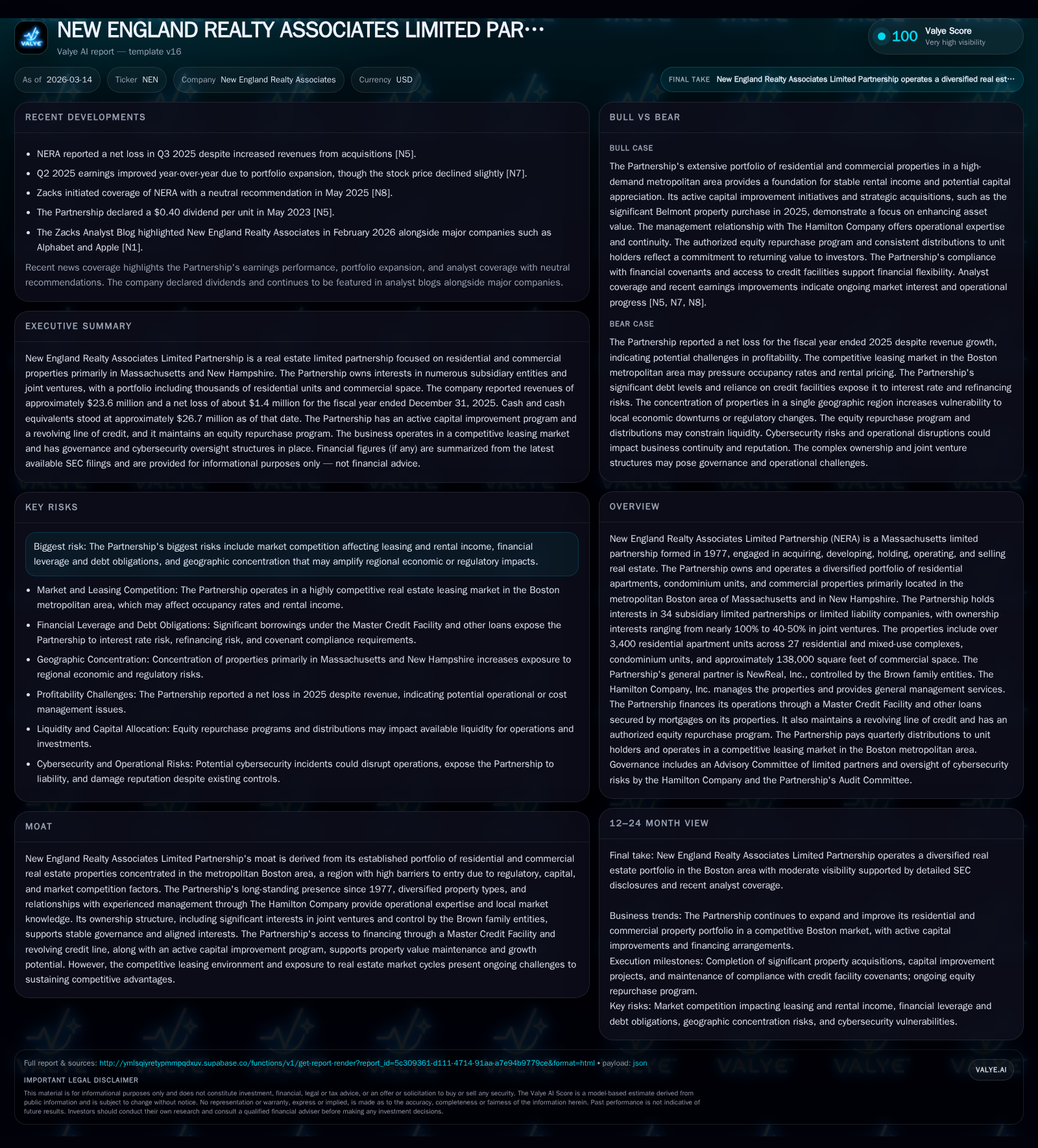
New England Realty Associates Limited Partnership reported a strong revenue increase of 15.7% in 2025 to $23.6 million, continuing a multi-year growth trend. However, operating income declined by 50% to $3.3 million, and net income swung to a loss of $1.4 million, highlighting operational pressures. The partnership maintains positive operating cash flow, though down 13%, amid significant capital expenditures focused on property improvements and development projects. Its portfolio centers on over 3,400 residential units and commercial properties primarily in Eastern Massachusetts and Southern New Hampshire. Capital allocation includes $11.2 million in dividends and ongoing share repurchases under an extended buyback program capped at $5 million annually. The capital structure features a $156 million Master Credit Facility with fixed-rate mortgages and a $25 million revolving credit line with covenants supporting liquidity but limiting distributions. Key near-term focus areas include managing refinancing risk on maturing debt, sustaining occupancy and rental growth in concentrated markets, and balancing reinvestment with shareholder returns.
Historical Financial Performance
New England Realty Associates Limited Partnership (NEN) has demonstrated steady top-line growth over recent years with revenues rising from approximately $17.7 million in FY2022 to about $23.6 million in FY2025 [F1]. This represents a compounded annual growth rate near 10%, with the latest year showing a robust 15.7% increase year-over-year.
Despite this revenue momentum, operating income declined sharply by half from $6.6 million in FY2024 to around $3.3 million in FY2025 [F1]. Net income followed suit, swinging from positive results in previous years to a loss of approximately $1.4 million last year—a decrease exceeding 130% year-over-year [F1]. Operating cash flow remained solid at nearly $27.7 million but contracted about 13% compared to the prior year [F1], indicating increased capital spending or working capital use.
Historical performance (annual)
| FY | Rev ($mm) | Net ($mm) | CFO ($mm) | OpInc ($mm) | Rev YoY | Net YoY |
|---|---|---|---|---|---|---|
| 2025 | 24 | -1 | 28 | 3 | +15.7% | -133.0% |
| 2024 | 20 | 4 | 32 | 7 | +3.3% | +83.3% |
| 2023 | 20 | 2 | 24 | 5 | +11.4% | +7.3% |
| 2022 | 18 | 2 | 22 | 5 |
Source: SEC companyfacts cache [F1].
Capital returns and efficiency (annual)
| FY | Buybacks ($mm) |
|---|---|
| 2025 | 1 |
| 2024 | 2 |
| 2023 | 4 |
| 2022 | 5 |
Source: SEC companyfacts cache [F1].
Source: SEC filings and company financial data [F1], [S1]
Portfolio Composition and Geographic Concentration
NEN's portfolio comprises more than 3,400 residential apartment units along with nearly 138,000 square feet of commercial real estate primarily located in Eastern Massachusetts and Southern New Hampshire [S21]. Properties are held through various subsidiary limited partnerships or LLCs with ownership stakes ranging from majority to minority interests.
This concentration offers competitive advantages due to barriers such as zoning restrictions and land scarcity characteristic of the Boston metropolitan area [S21]. The partnership has invested heavily in property improvements—approximately $30.7 million spent during FY2025 including the Mill Street Development project—with additional planned capital expenditures around $17 million for ongoing upgrades across multiple assets [S8]. Operational management by The Hamilton Company provides local expertise critical to maintaining occupancy levels and managing tenant relations effectively.
Capital Structure and Liquidity
The Partnership's indebtedness is largely secured by project-specific mortgages without cross-collateralization [S9]. A key component is the Master Credit Facility established with KeyBank totaling $156 million as of late 2021 bearing fixed interest rates near 2.97%, with subsequent amendments adding advances at rates around mid-4% [S16], [S22]. One mortgage matured August 31, 2024 at a fixed coupon of approximately 5.425%, representing refinancing risk amid higher interest rate environments [S8].
Additionally, NEN maintains a revolving line of credit of $25 million initiated November 2024 bearing floating SOFR-based interest plus margin; this facility includes covenants restricting leverage (not exceeding ~65%), minimum liquidity ($15 million), debt service coverage ratio (≥1.5x), among others [S14]. The line cannot be used for dividend payments or equity repurchases but supports acquisitions and capital improvements.
As of December 31, 2025, cash and equivalents stood at nearly $26.7 million [F1], positioning the Partnership comfortably within covenant requirements while providing liquidity for operations and investments.
Capital Allocation Strategy: Dividends and Buybacks
NEN returned approximately $11.2 million via distributions during FY2025 [S3]. The Partnership has maintained an equity repurchase program since August 2007 allowing buybacks of Depositary Receipts subject to limits; this program was extended through March 31, 2025 and renewed for one additional year into early-2026 under Rule10b5-1 compliant plans [S16].
Buyback activity has slowed markedly relative to earlier years—from over $5 million annually between FY2022-FY23 down to approximately $821 thousand in FY2025—as the Partnership balances shareholder returns against operational challenges [F1], [S12], [S15]. Repurchases are proportionally allocated among Class A Units (80%), Class B Units (19%), and General Partner Units (1%) per the Partnership Agreement.
Meanwhile, capital expenditures emphasize reinvestment into existing properties including large-scale redevelopment projects like Mill Street Development where cumulative investment surpassed $35 million through end-2025 [S8]. Planned capex for ongoing property upgrades is budgeted near $17 million for FY2026.
Outlook and Key Risks
Growth prospects hinge on leveraging local market expertise within the Boston metro area alongside strategic acquisitions financed via credit facilities supported by strong operating cash flows [N1], [S21]. Recent acquisitions such as the Belmont mixed-use property comprising nearly 400 residential units underscore targeted portfolio expansion.
However, geographic concentration exposes NEN to regional economic cycles impacting occupancy rates and rental pricing amidst competition from alternative housing options including condominiums and single-family rentals [S18]. Regulatory compliance costs related to laws such as the Americans with Disabilities Act may also pressure cash flows.
The maturity profile of secured mortgage debt presents refinancing risks given current interest rate environments; failure to refinance on favorable terms could impact liquidity and operational flexibility [S9], [S18]. Financial covenants embedded within debt agreements impose constraints on additional borrowing capacity.
Monitoring quarterly trends post-FY25 will be essential on:
- Operating margin recovery amid cost controls;
- Lease-up progress on newly acquired assets;
- Refinancing outcomes for maturing loans;
- Capital expenditure effectiveness translating into NOI growth;
- Dividend sustainability alongside potential adjustments to repurchase programs.
This analysis is based exclusively on information available through March 13, 2026 filings by New England Realty Associates Limited Partnership (NEN) without speculative assumptions beyond verified data sources.
Disclaimer: This is research-only, informational analysis and not investment advice. It may include AI-generated interpretation and general industry context. Always verify important details using primary sources.

Comments