
US Energy Corp's Financial Challenges Amid Industrial Gas Development and Commodity Price Pressures
The company reported narrowing losses in 2025 but continues to face liquidity constraints and operational risks tied to commodity price volatility and early-stage industrial gas investments.
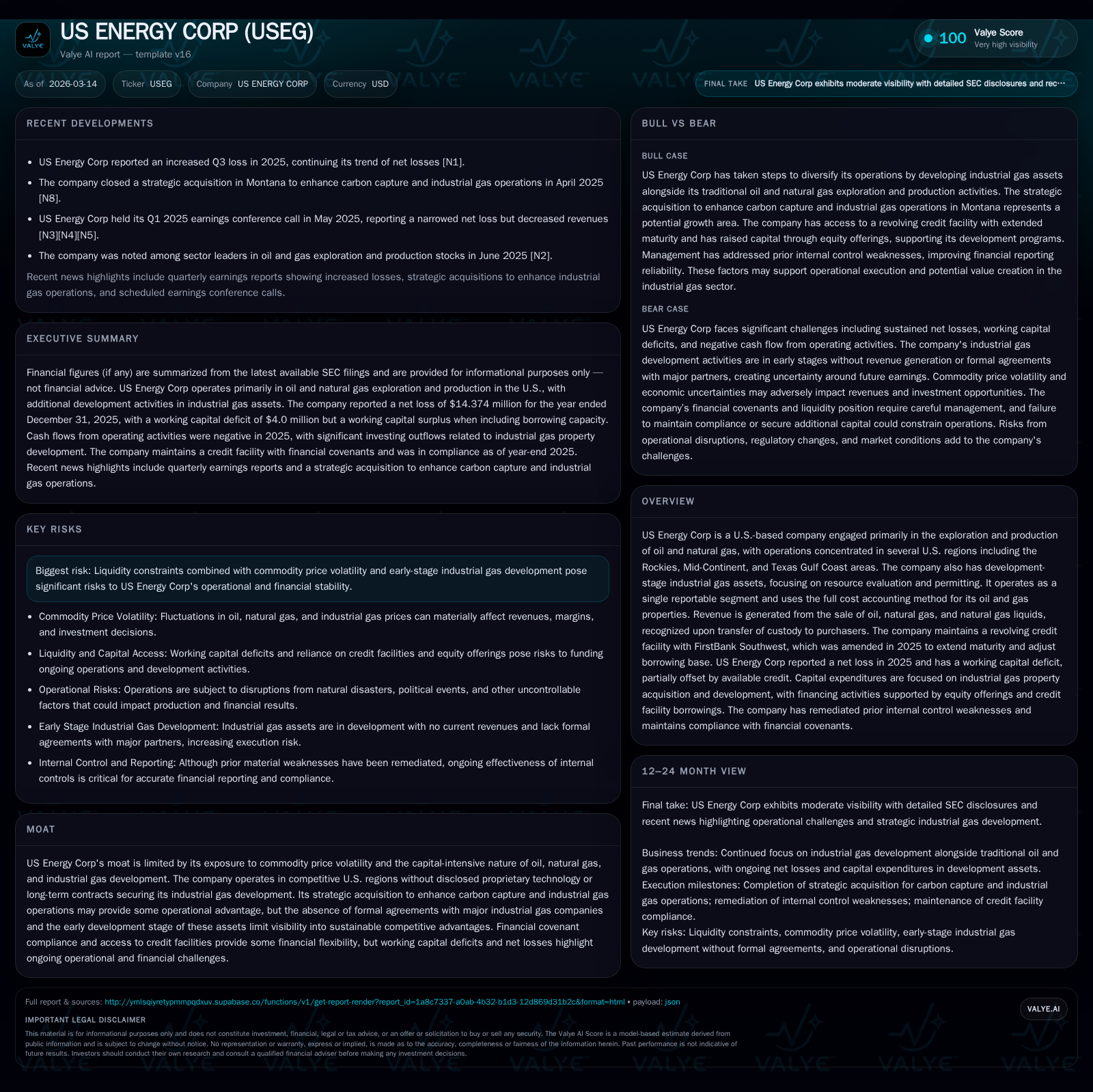
US Energy Corp, focused on U.S. oil, natural gas, and industrial gas sectors, reported a reduced net loss in 2025 driven by improved operating income but negative cash flows. Despite an amended credit facility extending maturity to 2029, the company holds a working capital deficit offset by borrowing capacity and has heavily invested in industrial gas development. Volatility in commodity prices and capital needs underscore persistent financial challenges. The absence of dividends and modest share repurchases reflect cautious capital allocation amid ongoing losses and uncertain growth prospects.
Company Overview
US Energy Corp operates primarily in the exploration and production of oil, natural gas, and industrial gas within the United States across regions including the Rockies, Mid-Continent, and Texas Gulf Coast [S1][S26]. It reports as a single segment under full cost accounting for oil and gas properties [S1][S26]. Revenue recognition occurs upon transfer of custody of hydrocarbons produced [S24].
The company is actively developing industrial gas assets focusing on resource evaluation, permitting, engineering, and related capital expenditures; these activities have not yet generated revenue [S1][S26].
Historical Performance
Recent financial trends show US Energy's revenue slightly declined by approximately 3.8% year-over-year to around $32.38 million in fiscal year 2025 [F1]. Operating income improved from significant losses but remained negative at -$14.36 million, while net loss narrowed to -$14.37 million compared to prior year losses exceeding $25 million [F1].
Operating cash flow deteriorated sharply, turning negative at -$7.14 million in 2025 from positive $4.59 million the prior year, indicating tightening liquidity conditions [F1]. Capital expenditures increased substantially to approximately $12 million largely due to acquisition and development spending on industrial gas properties alongside modest oil and natural gas capital outlays [S5][F1].
Working capital showed a deficit of about $4.0 million at December 31, 2025 versus a smaller deficit previously; however, this is partially offset by an available borrowing base of $7.5 million under the company's credit facility which was amended in 2025 to reduce the borrowing base from $20 million to $10 million and extend maturity through May 31, 2029 [S4][S6][S18].
Financial Summary Table
Historical performance (annual)
| FY | Net ($mm) | CFO ($mm) | OpInc ($mm) | Net YoY |
|---|---|---|---|---|
| 2025 | -14 | -7 | -14 | +44.3% |
| 2024 | -26 | 5 | -26 | +20.3% |
| 2023 | -32 | 5 | -35 | -3259.9% |
| 2022 | -1 | 11 | 4 |
Source: SEC companyfacts cache [F1].
Capital returns and efficiency (annual)
| FY | Div ($) | Buybacks ($) | ROE% |
|---|---|---|---|
| 2025 | 316000 | -59.4 | |
| 2024 | 0 | 788000 | -108.2 |
| 2023 | 1192000 | 368000 | -69.5 |
| 2022 | 1735000 | -1.2 |
Source: SEC companyfacts cache [F1].
*Includes industrial gas property acquisitions/development per disclosures [S5]
Growth Outlook and Milestones
Future growth largely hinges on several key factors:
- Transitioning industrial gas operations from development stage into commercial production with associated revenue streams remains critical but unproven given no current revenues or disclosed customer contracts [S1][S26].
- Oil and natural gas production levels will be affected by market commodity prices; full cost accounting exposes the company to potential impairments if prices decline below those used in ceiling tests (approximately $65/bbl for oil and $3.39/MMBtu for natural gas as of end-2025) [S12].
- The strategic focus on carbon capture integration as part of asset acquisitions may offer mid-term operational benefits but lacks publicly disclosed long-term agreements limiting near-term competitive advantages [S1].
- Maintaining access to capital markets and credit facilities is essential for funding ongoing development; however, covenant restrictions on leverage ratios and borrowing base reductions impose financial discipline that could constrain opportunistic growth or flexibility [S6][S18].
- Regional competition for acreage leases and drilling services remains intense with additional cost pressures from labor/material shortages noted industry-wide.
No explicit forward guidance or detailed milestones are provided within disclosures; key indicators include semiannual borrowing base reviews starting April/October each year which reflect lenders’ views on asset values influenced by commodity prices, progress updates on industrial gas project development phases such as permitting or pilot commissioning, and quarterly compliance with debt covenants tied to EBITDAX leverage ratios [S6][S10][S18][S26].
Returns and Capital Allocation
Financial returns remain challenged; approximate return on equity for fiscal year 2025 calculates near -59%, reflecting persistent net losses relative to equity of about $24 million [$-14.37M / $24M] [F1]. Free cash flow is negative estimated around -$7.57 million after subtracting capital expenditures from operating cash flow demonstrating ongoing cash burn [F1].
The company has not paid dividends recently consistent with a preservation strategy amid losses; share repurchases continue at modest levels with approximately $316 thousand spent during fiscal year 2025 under an authorized buyback program but remain discretionary based on market conditions and liquidity needs rather than signaling strong return enhancement intentions [F1][S9]. Capital deployment favors sustaining core operations alongside funding new asset development over distributions.
Risk Factors Summary
Per regulatory filings, primary risks include liquidity constraints exacerbated by volatile commodity prices impacting cash flows and asset valuations through impairments or ceiling tests [S1][S16]. Early-stage industrial gas investments carry execution risk including recruitment challenges for skilled personnel alongside uncertain commercial viability absent firm contracts or revenues [S1][S16]. Regulatory changes such as environmental legislation could impose additional costs or operational restrictions while heightened competition increases pressure on lease terms and service costs.
Credit agreements secured against substantially all company assets provide borrowing support but also pose risks of enforcement or foreclosure if covenant breaches occur potentially harming equity holders’ interests [S7][S8][S10][S17]. Legal or litigation risks exist as part of ordinary business though no material claims are currently pending [S16][S22][S25].
Conclusion
US Energy Corp is navigating significant headwinds balancing continued financial losses against strategic investments into nascent industrial gas businesses. Despite improvement in operating losses compared with prior years, negative cash flows combined with working capital deficits underscore persistent liquidity management challenges. Heavy capital commitment toward industrial gas development signals intent for diversification but execution timelines remain unclear. Investor focus should weigh ongoing commodity volatility impacts against limited structural competitive advantages while monitoring covenant adherence, commodity price trends affecting impairments, project development progress, and capital expenditure scaling as key markers going forward.
This analysis synthesizes information from US Energy Corp's SEC filings through March 13, 2026 ([S1]-[S29]) alongside verified financial data ([F1]) without extrapolated forecasts or unverifiable projections.
Disclaimer: This is research-only, informational analysis and not investment advice. It may include AI-generated interpretation and general industry context. Always verify important details using primary sources.

Comments