
Passive Portal Technology Emerges as Radiation-Free Security Solution
DTII advances prototype manufacturing and prepares for marketing launch while confronting critical financial constraints.
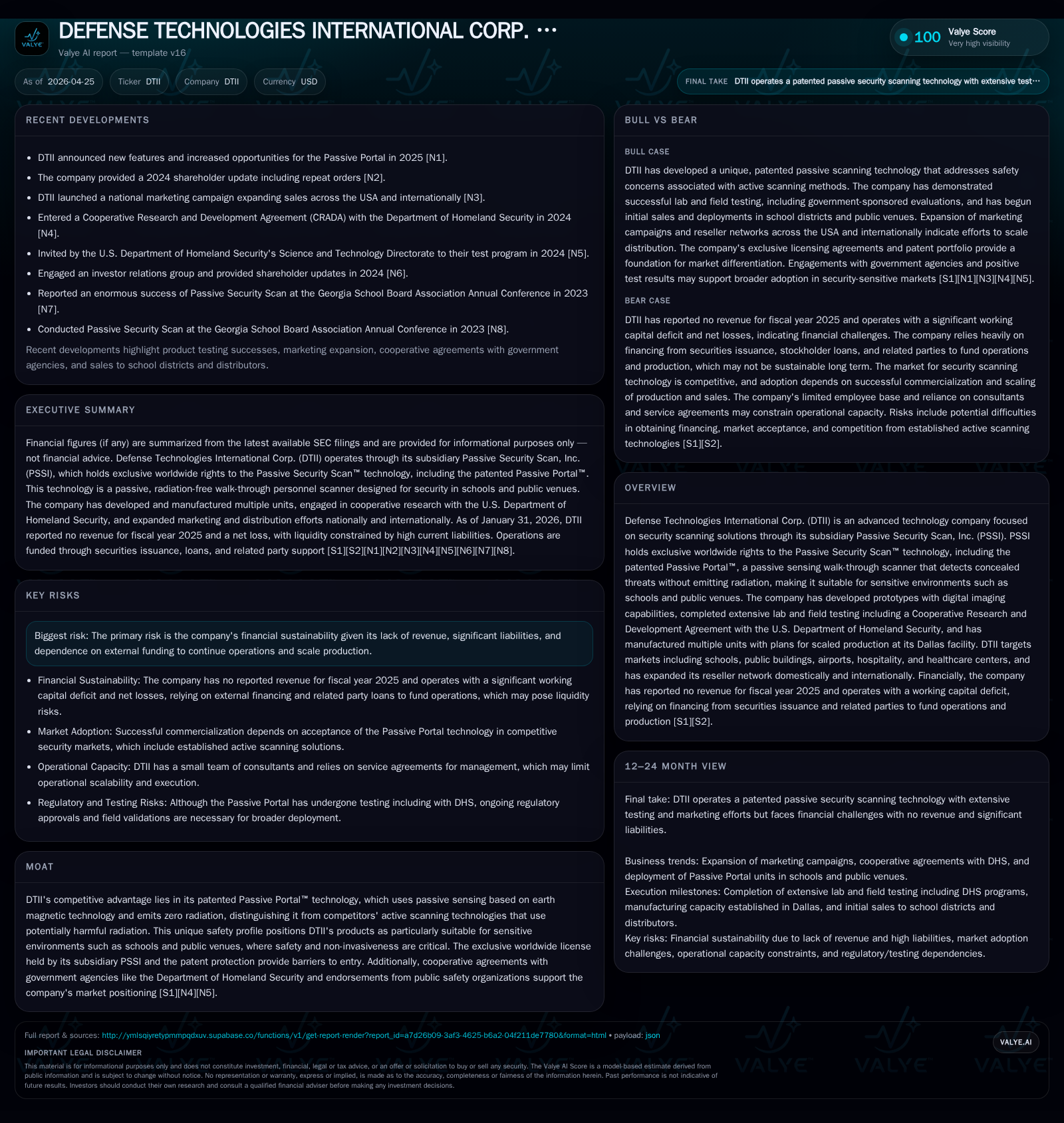
Defense Technologies International Corp. (DTII) revealed progress toward scaled production of its patented Passive Portal passive sensing security scanner in its latest 10-Q, marking a pivotal step from development to commercialization. The device’s unique radiation-free detection capability targets sensitive venues like schools and airports, differentiating DTII from active radiation-based competitors. However, persistent financial challenges, including substantial working capital deficits and absence of revenue, underscore significant operational risks. Key milestones ahead include funding completion, marketing campaign commencement, and early order fulfillment.
Latest Operating Update Highlights Production Progress
Defense Technologies International Corp.'s most recent 10-Q filing dated April 24, 2026 [S2] details meaningful operational strides: the company has manufactured and assembled 35 Passive Portal walk-through scanner units and holds parts inventory capable of producing an additional 25 units at its Dallas production facility. This manufacturing output reflects progress from prototype development toward readiness for commercial deployment. Notably, initial units have been deployed in beta tests at educational venues in Texas and Alabama, with operations geared toward coordinating a major marketing campaign following the anticipated completion of required funding [S1]. The transition from R&D-centric operations to scaled production signals a pivotal junction for DTII's commercialization ambitions.
Business Model and Product Innovation: The Passive Portal Advantage
DTII's revenue model revolves around exclusive manufacturing and sales rights of the Passive Security Scan™ technology held by its subsidiary Passive Security Scan Inc. (PSSI). At the core lies the patented Passive Portal™ device (US Patent 7408461), which uniquely employs passive sensing based on earth magnetic fields to detect concealed weapons without emitting any ionizing or electromagnetic radiation. This contrasts sharply with existing active scanning solutions that rely on x-rays, microwaves or radio frequency signals—methods often scrutinized for potential health risks over prolonged exposure [S1][S16].
The product suite includes the basic Passive Portal for weapons detection, a variant integrating Elevated Body Temperature (EBT) cameras for pandemic-responsive screening, and standalone EBT stations [S21]. The inclusion of digital imaging capabilities in prototypes allows recording passage through the portal for retrospective security reviews. By outsourcing some production yet maintaining assembly capacity in Dallas (~500 units/month theoretically), DTII aims to scale efficiently while managing unit economics during early commercialization stages.
Industry Context: Competing with Active Radiation-Based Security Scanners
The security scanning industry is largely dominated by active sensing technologies that leverage x-rays or microwave signals to detect concealed threats. These technologies face growing regulatory scrutiny due to their radiation emission profiles. Customer institutions such as school districts and hospitals are increasingly sensitive to these health concerns, especially following heightened health awareness post-COVID-19 [S1][S24].
DTII’s passive sensing approach addresses a vital niche — offering radiation-free detection — that could reduce resistance from communities and regulatory bodies wary of cumulative exposure risks inherent in active scanners. However, customers are typically slow adopters given procurement cycles involving budget approvals, safety certifications, and pilot testing phases. Moreover, entrenched incumbents with established relationships may pose competitive barriers despite DTII’s technological differentiation.
Growth Opportunities Centered on Sensitive Venue Penetration
Market demand drivers center on environments prioritizing non-invasive security methods that do not raise health concerns: K-12 schools, healthcare facilities, small airports, hospitality venues, and public buildings constitute target segments [S1][S24]. Increased public emphasis on safety coupled with legislative initiatives promoting less invasive security solutions could underpin structural growth rather than cyclical trends.
DTII benefits additionally from cooperative research agreements such as the CRADA with the Department of Homeland Security [S14], lending credibility to its technology and potentially opening doors within governmental segments — an important channel given stringent product qualification requirements prevalent in defense-related markets.
However, penetration depends heavily on completing marketing efforts synchronized with funding availability—a current sticking point—and successfully proving operational reliability via extensive beta testing outcomes that convert into purchase orders.
Constraints from Funding Gaps and Market Adoption Risks
The dominant near-term risk elemental to DTII’s commercial aspirations lies within its precarious financial footing. The company reported no revenue in FY2025 and prior years except a one-off ~$49K in FY2024 [F1], continuing a trend of deep operating losses exceeding $1.3 million annually most recently [F1].
Critically, working capital deficits remain severe: as of January 31, 2026 total current liabilities were approximately $2.67 million versus current assets around $7.8K—yielding a zero current ratio [F1]. This imbalance threatens operational continuity absent renewed external funding inflows predominantly coming from related party loans and convertible notes [S10][S15]. Such financing sources expose the company to dilution risk and execution delays if market confidence does not materialize concurrently with product readiness.
These liquidity pressures constrain accelerated scaling plans; any delay in converting prototypes/betas into firm purchase contracts further strains credibility among prospective customers accustomed to proven established offerings.
Key Upcoming Milestones and Performance Metrics to Monitor
The immediate focus is securing completion of necessary funding rounds which management anticipates will catalyze the launch of major marketing campaigns aligned with increased production volume aiming at fulfilling school district demand demonstrated during earlier outreach [S2][S1]. Monitoring cash burn relative to fundraising cadence will be crucial.
Additional key performance indicators include:
- Confirmation of first commercial order volumes beyond beta phases;
- Expansion into additional venue types such as healthcare or airports;
- Regulatory endorsements or certifications enhancing market acceptability;
- Progression toward digital imaging feature commercialization;
- Any partnerships or contracts emerging from governmental cooperation frameworks like DHS CRADA agreements.
Investment community observers should track quarterly operating expense trends alongside reported shipment/sales data once available to gauge traction.
Financial Overview: Liquidity, Capital Structure, and Funding Challenges
Historical performance (annual)
|
| FY | Rev ($) | Net ($mm) | CFO ($) | OpInc ($) | Rev YoY | Net YoY |
|---|---|---|---|---|---|---|
| 2025 | 0 | -1 | -390520 | -1379209 | -100.0% | -63.7% |
| 2024 | 49012 | -1 | -16503 | -606536 | +77.6% | |
| 2023 | 0 | -3 | -109607 | -1734115 | -281.2% | |
| 2022 | 0 | -1 | -867597 |
Source: SEC companyfacts cache [F1].
Capital returns and efficiency (annual)
|
| FY | ROE% |
|---|---|
| 2025 | 55.0 |
| 2024 | 28.1 |
| 2023 | 158.9 |
| 2022 | 17.5 |
Source: SEC companyfacts cache [F1].
A summary snapshot based on the latest reported figures through FY2025 and Q1 FY2026 underscores considerable financial risk attached to DTII's business trajectory:
|
| FY | Revenue (USD) | Op Income (USD) | Net Income (USD) | Current Assets (USD) | Current Liabilities (USD) | Cash & Equivalents (USD) | Total Debt (USD) |
|---|---|---|---|---|---|---|---|
| 2025 | 0 | -1,379,209 | -942,295 | ~7,791 (Q1 '26) | ~2,668,948 (Q1 '26) | 4,558 (FY22) | 7,500 (FY25) |
| 2024 | 49,012 | -606,536 | -575,766 | ||||
| 2023 | 0 | -1,734,115 | -2,575,641 | ||||
| 2022 | 0 | -867,597 | -675,624 |
Operating cash flow remains negative (-$390K FY2025), underscoring continued reliance on financing activities rather than operational cash generation [F1]. Notably, the company's equity base is negative (-$1.7M as of FY2025), reflecting accumulated losses.
Debt primarily consists of convertible notes payable alongside related-party loans. The derivative liabilities associated with conversion features introduce earnings volatility due to valuation mark-to-market accounting [S10][S13]. It does not constitute investment advice or an endorsement of any securities.*
Disclaimer: This is research-only, informational analysis and not investment advice. It may include AI-generated interpretation and general industry context. Always verify important details using primary sources.

Comments