
DYCOM Industries Expands Footprint with Strategic Acquisition and Strong Q1 Results
DYCOM’s integration of Power Solutions coupled with robust Q1 fiscal 2027 results positions it to leverage sustained fiber and data center infrastructure demand.
In its latest quarter, DYCOM Industries demonstrated operational strength highlighted by positive revenue trends and margin resilience, driven partly by the recent acquisition of Power Solutions, LLC. This acquisition broadens DYCOM’s service portfolio into building systems, complementing its core telecommunications specialty contracting business. The company benefits from enduring telecom capital expenditures primarily aimed at fiber deployments and data center electrification, supported by regulatory funding programs. Key risks include concentrated customer exposures and execution complexities tied to the integration of acquired businesses. Monitoring backlog growth and contract renewal activity will be critical for tracking future performance.
Latest Quarterly Update Anchored by Strong Execution
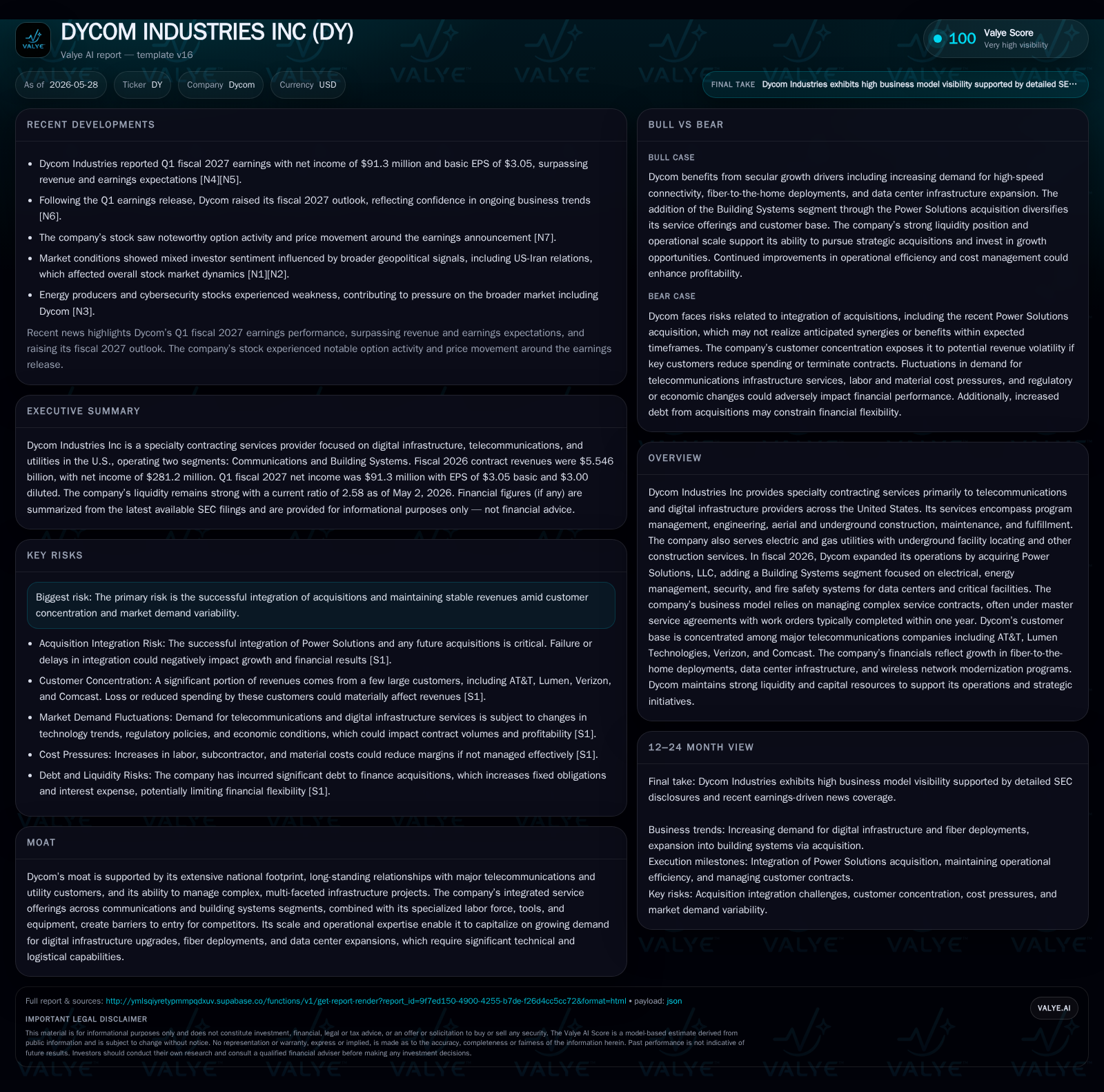
Dycom Industries reported its fiscal 2027 first quarter results on May 27, 2026 [S2][S3], surpassing analyst earnings and revenue estimates as noted by Nasdaq coverage [N1][N2]. This quarter marked an inflection where contribution from the recently acquired Power Solutions segment began to visibly lift both top-line growth and adjusted EBITDA margins. Management simultaneously raised full-year financial guidance to reflect sustained momentum across both communications construction and the nascent Building Systems operations centered around electrical and energy management solutions for data centers [N3].
Key drivers cited included ongoing fiber infrastructure deployments anchored by expanding telecommunications provider investment plans—especially following AT&T's acquisition of Lumen’s mass markets fiber assets early in calendar year 2026—and heightened hyperscale data center buildouts necessitating power, security, and fire safety system installations provided through Power Solutions’ capabilities. The company also emphasized successful absorption of acquisition-related costs with improving cost controls.
Business Model: Integrated Specialty Contracting with Technical Depth
Dycom operates through a comprehensive specialty contracting model focused primarily on the telecommunications sector but increasingly augmented by facility-oriented building systems services via its Power Solutions acquisition completed in late 2025 [S1][S4]. It provides end-to-end execution spanning program management, engineering design, aerial and underground construction as well as maintenance and fulfillment activities. Revenue is largely derived under master service agreements (MSAs) predominantly structured around one-year or shorter-duration work orders reflecting discrete network upgrade projects or maintenance packages.
The company supplies its own skilled labor force along with specialized tools and equipment—a high-touch technical backbone critical for managing complex contracts from large carriers like AT&T, Verizon, Lumen, and Comcast. The newly added Building Systems segment delivers integrated electrical contracting services focused on mission-critical facilities such as hyperscale data centers, thereby diversifying Dycom's exposure while leveraging existing customer relationships.
Industry Context: Telecommunications and Digital Infrastructure Dynamics
The demand landscape underpinning Dycom’s addressable market is characterized by several interrelated structural growth catalysts. Telco capital expenditure trends show multi-year commitments to fiber-to-the-home expansions funded partially by federal/state digital divide subsidies aimed at closing broadband gaps in underserved regions—a significant source supporting sustained volume [S1]
Simultaneously the hyperscale cloud providers' appetite for expanded data center capacity drives substantial incremental electrical infrastructure investment complemented by security and fire safety installations serviced through Dycom’s Building Systems operations acquired recently [S1]. Wireless network modernization programs responding to increasing mobile traffic further support outdoor construction volumes exhibiting typical seasonal patterns tied to weather conditions.
However, these cycles are subject to variation in customer capex budgets influenced by economic conditions, regulatory environment shifts, merger & acquisition activity among carriers (e.g., AT&T’s consolidation moves), as well as technology evolution timelines [S1]
Competitive Position and Service Quality Differentiators
Dycom’s moat resides in its extensive national footprint covering all major US regions combined with historically entrenched relationships with leading telecom providers responsible for upwards of half its revenues (notably AT&T exceeding 25%) [S1]. Its ability to orchestrate complex multifaceted infrastructure projects spanning planning through fulfillment favors scale players with deep operational expertise.
Integrated service offerings bridging communications infrastructure with building systems present bundled solutions that elevate switching costs for customers seeking consistency of quality across diverse scopes of work. The company's specialist labor pool capable of handling intricate aerial/underground challenges alongside precision electrical contracting enhances barrier to entry versus smaller regional contractors lacking breadth or technical depth.[S1]
Moreover, long-tenure contracts under widely utilized master service agreements stabilize revenue flows while permitting nimble adaptation to evolving technology demands.
Growth Catalysts Driven by Fiber Expansion and Data Center Demand
Organic growth opportunities are fueled principally by sustained fiber installation initiatives triggered partly through customer consolidation (most notably AT&T's purchase of Lumen fiber assets) which consolidate work scopes under fewer but larger accounts benefitting Dycom given its scale advantage [S1][S2][N3]
The burgeoning need for advanced electrical infrastructure in hyperscale data centers dovetails into Power Solutions’ service set adding recurring revenue streams less correlated directly to traditional outdoor telecom buildouts. Cross-selling potential exists between segments especially as data center security/power solutions become more integrated into broader digital infrastructure roadmaps.
Government stimulus programs targeting persistent digital access shortfalls accelerate project awards contributing backlog visibility enhancements [S1][N3]
Key Risks Including Customer Concentration and Acquisition Integration
Customer concentration notably involving AT&T (~25%+ revenue share) imposes inherent revenue volatility linked to their capex spending cadence [S1]. Telecom spending is also prone to macroeconomic sensitivity impacting backlog consistency.
Warranty claims remain a material operational risk requiring allocation of labor resources without incremental compensation that can erode margins if defect rates increase or large-scale rework arises.[S1]
Labor market tightness prevalent across telecom specialty contracting heightens cost pressures alongside difficulties scaling workforce rapidly during cyclical demand spikes.
Integration challenges stemming from the large Power Solutions deal weigh on near-term financials given non-cash intangible amortization charges disclosed previously.[S4] Retention of key personnel and maintaining customer retentions post-acquisition are pertinent execution milestones.
Forward Looking: Milestones and Indicators to Monitor
Investors should track subsequent quarterly reports for updates on Power Solutions profitability contribution trends excluding initial acquisition-related costs. Evidence that synergies are materializing can be assessed via gross margin stabilization metrics.
Contract renewal success rates among flagship telecom customers like AT&T serve as proxies for backlog sustainability amid shifting industry consolidation efforts [S2][S3]
Award announcements under federal/state digital divide programs provide cues on future project volume inflows.
Monitoring capital expenditure pacing within telecommunications clients alongside semiconductor-driven hyperscaler buildouts offers leading indicators for sector-wide demand trajectories.
Maintaining leverage ratios within covenant limits affirms balance sheet flexibility necessary for opportunistic acquisitions or capital expenditures supporting long-term growth.
Financial Profile: Liquidity, Capital Structure, and Profitability
As of May 2, 2026 quarter-end [F1], Dycom held approximately $539 million in cash & equivalents against current liabilities totaling roughly $1.15 billion yielding a healthy current ratio near 2.58x signaling sound short-term liquidity management.
Net debt stood at an estimated $97 million reflecting conservative leverage relative to trailing EBITDA levels discussed in filings [F1]. There was no indication from Q1 disclosures of immediate refinancing risk or distress amid ongoing capex outlays expected between $210-$220 million annually primarily directed toward fleet modernization and growth support [S9].
Profitability gains noted in recent quarters stemmed from operating efficiencies augmented by acquisition income streams partially offsetting intangible asset amortization related charges [N3][F1]
Overall capital structure remains aligned with strategic flexibility objectives maintaining compliance across all credit covenants outlined in the December 23, 2025 amended credit agreement that refinanced prior facilities enabling ample revolver availability up to $800 million maturity beyond 2030-33 range.
This analysis presents factual operational insights derived from the latest SEC filings as of May 28, 2026 without offering investment advice or predictions about future stock performance. It focuses on assessing Dycom Industries' business composition, market positioning, risk landscape, and financial standing within its competitive environment based solely on disclosed information.
Disclaimer: This is research-only, informational analysis and not investment advice. It may include AI-generated interpretation and general industry context. Always verify important details using primary sources.

Comments