
Electronic Arts Inc: Balancing Franchise Strength and Merger Uncertainties in a Dynamic Gaming Landscape
EA’s robust gaming franchises fuel operational momentum, yet a pending merger introduces strategic complexities and risk factors.
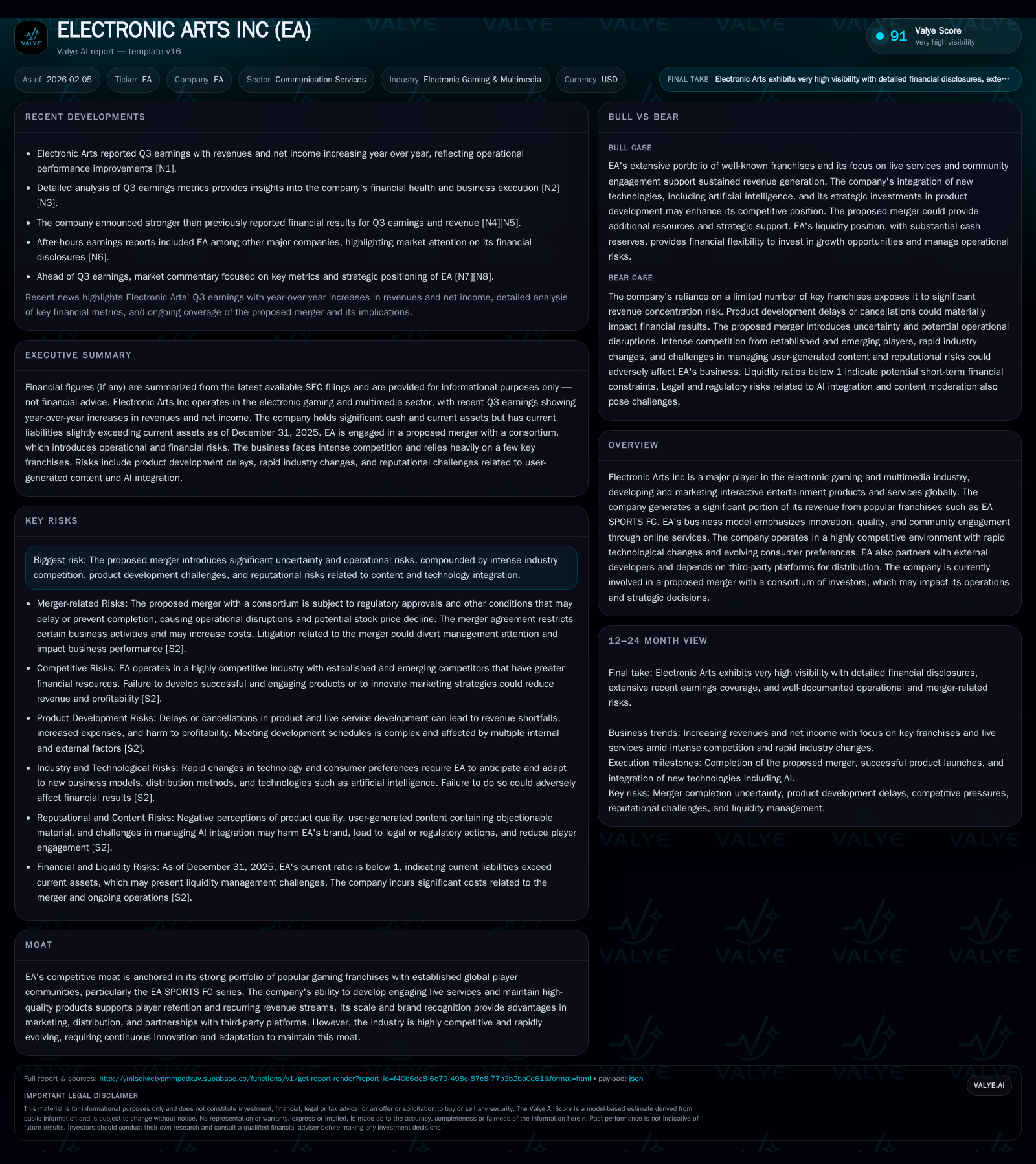
Electronic Arts Inc continues to leverage its globally recognized franchises like EA SPORTS FC, demonstrating strong revenue growth despite a recent net income decline. The company’s competitive advantages are rooted in its franchise portfolio and live services, which underpin recurring revenues amid a fast-evolving industry. However, the announced merger with a consortium led by notable investors brings significant strategic uncertainty, imposing operational restrictions and regulatory hurdles. This analysis explores EA’s current financial health, competitive positioning, operational impacts from the transaction, and the broader challenges posed by a rapidly shifting electronic gaming ecosystem.
From Iconic Franchises to Quarterly Results: EA’s Current Operating Landscape
Electronic Arts Inc (EA) remains an influential force within the electronic gaming industry, largely propelled by its marquee franchises such as EA SPORTS FC. These titles not only captivate millions worldwide but also serve as cornerstone assets for sustained revenue generation through ongoing live online services. The company's most recent quarterly results reaffirm this positive trajectory: revenues have shown marked growth compared to the prior year’s period [N1][N4]. Yet beneath this surface of top-line expansion lies a nuanced picture—net income has contracted recently [N12][F1]. This divergence signals underlying operational complexities possibly reflecting higher development costs, content investments, or margin pressures.
EA's prominence in interactive entertainment involves developing high-quality experiences while actively engaging player communities through both competitive play and social features integrated within their live services platform [valye_report_excerpt]. Such engagement not only enhances customer loyalty but also translates into recurring monetization opportunities beyond discrete game sales.
Dissecting EA’s Franchise Moat Amidst Industry Dynamism
The firm’s competitive moat is firmly anchored in an elite portfolio of established franchises with global player bases. For instance, EA SPORTS FC preserves brand equity accumulated over decades while adapting gameplay mechanics and online components that deepen user involvement [valye_report_excerpt]. The company's clever pivot toward live services further strengthens retention by continuously introducing new content updates, events, and microtransactions tailored for loyal players.
Nonetheless, this moat exists within an intensely competitive environment characterized by rapid technological changes—from evolving console hardware capabilities to emergent trends such as cloud gaming and virtual reality. Consumer preferences also shift swiftly with rising demand for social connectivity and immersive experiences. Consequently, continuous innovation is imperative for EA to uphold its position; faltering could allow agile rivals or new entrants to erode market share.
Financial Strengths and Liquidity: What Latest Metrics Reveal
Examining EA's balance sheet as of December 31, 2025, reveals cash and cash equivalents approximating $2.78 billion [F1], signifying substantial liquidity to support operations and strategic initiatives in the near term. Current assets total around $4.11 billion versus current liabilities surpassing $4.43 billion [F1], yielding a current ratio near 0.93—below the conventional threshold indicating potential short-term liquidity constraints.
This ratio underscores nuances relevant amid merger conditions: despite sizable cash reserves cushioning immediate needs, overall working capital positioning warrants close monitoring especially if integration or regulatory hurdles prolong uncertainty. Maintaining adequate liquidity buffers will be crucial should market disruptions or transaction-related costs increase unexpectedly.
The Proposed Merger: Expectations, Risks, and Strategic Implications
On September 28, 2025, EA entered into a definitive merger agreement with a consortium involving Saudi Arabia's Public Investment Fund, alongside private investment funds affiliated with Silver Lake Group and Affinity Partners [S2]. This transaction aims for completion in the first quarter of fiscal year 2027 but hinges on satisfying various closing conditions including regulatory approvals—factors largely outside EA's unilateral control.
The deal signifies a monumental shift for EA’s ownership structure with potential implications spanning governance changes to strategic direction recalibrations [valye_report_excerpt]. While offering opportunities for fresh capital infusion or operational realignment under new stewardship, it simultaneously introduces notable uncertainties that could weigh on decision-making agility during pendency.
Navigating Market and Regulatory Uncertainties Surrounding the Merger
Securing requisite regulatory clearances constitutes a principal gating factor delaying or imperiling deal closure [S2]. Antitrust considerations may surface given EA's status as an industry heavyweight in digital interactive entertainment. Any review processes extending beyond expectations could trigger investor nerves leading to share price volatility.
Moreover, legal challenges are already materializing against board members connected with the transaction [S2], compounding procedural risk layers. Market perception of these complexities tends to dampen confidence among stakeholders including customers wary of future product stability or partners cautious about contractual continuity.
Operational Constraints Imposed by the Pending Transaction
Under terms specified in the merger agreement [S2], EA faces explicit restrictions limiting its ability to pursue certain acquisitions or investments absent consortium consent until transaction completion or termination. Additionally, access to debt and equity markets may be curtailed or become costlier due to credit rating agencies' reaction following deal announcement.
These "shotgun" clauses impede tactical flexibility precisely when responsiveness is vital to counter competitive moves or capitalize on emerging content opportunities—a predicament reflecting typical trade-offs inherent in large takeover scenarios.
Furthermore, transactional costs—covering advisory fees plus potential termination penalties up to $1 billion—represent material outlays impacting near-term earnings regardless of ultimate outcome [S2].
Competitive Forces and Content Innovation Challenges
Beyond merger-specific dynamics lie ongoing industry pressures confronting EA's core business model [valye_report_excerpt]. The rapid pace of technology adoption forces continuous reinvestment into game engine upgrades, data infrastructure supporting multiplayer modes, and seamless integration of novel content forms such as esports features.
Competition from other major publishers striving for wallet share intensifies pricing pressures alongside greater demand for blockbuster titles with high production values. Concurrently, reputational risks escalate when technological integrations falter resulting in product glitches or customer dissatisfaction—events that can impair long-term community goodwill crucial for sustaining live service revenues.
The Talent and Community Factor in an Era of Transition
Key personnel retention represents another critical dimension amid executive focus fragmented by merger distractions [S2]. Employee motivation often suffers when organizational futures become ambiguous especially if compensation incentives hinge on normal operating assumptions disrupted by deal timelines.
Community trust similarly encounters stress as users monitor corporate communications for signs of possible product road map changes post-transaction. Effective transparency and engagement strategies are essential to mitigate churn while maintaining partner confidence across distribution platforms governing digital storefronts.
Valuation Considerations Considering Earnings, Risks, and Growth Prospects
Synthesizing the above factors places EA's valuation at a crossroads balancing resilient earnings generated from enduring franchise strength against augmented risk premiums demanded due to merger execution uncertainties [N1][N4][F1][valye_report_excerpt].
Investors must weigh how recurrent revenue streams derived from live services might offset cost headwinds introduced by transaction-related expenditures plus opportunity costs linked to restricted corporate actions during negotiation periods.
Moreover, successful navigation through regulatory scrutiny would enhance medium-term outlook by unlocking potential strategic refocus under new ownership structures aligned with emerging market trends such as cloud adoption or AI-enhanced gameplay innovations.
This analysis focuses on understanding Electronic Arts Inc’s operational performance juxtaposed against significant corporate governance changes stemming from its pending acquisition. The complex interplay between established competitive advantages within a fast-evolving industry context versus transactional constraints underscores both opportunities and challenges facing management and stakeholders alike. Nothing herein should be construed as investment advice but rather as a detailed review combining financial data with strategic examination sourced from publicly available filings and news reports.
Disclaimer: This is research-only, informational analysis and not investment advice. It may include AI-generated interpretation and general industry context. Always verify important details using primary sources.

Comments