
Edgemode Advances AI Data Center Development Amid Legal and Capital Challenges
Edgemode continues its strategic pivot to AI-focused HPC infrastructure through joint ventures in Spain and Panama, facing critical funding needs and legal disputes affecting asset control.
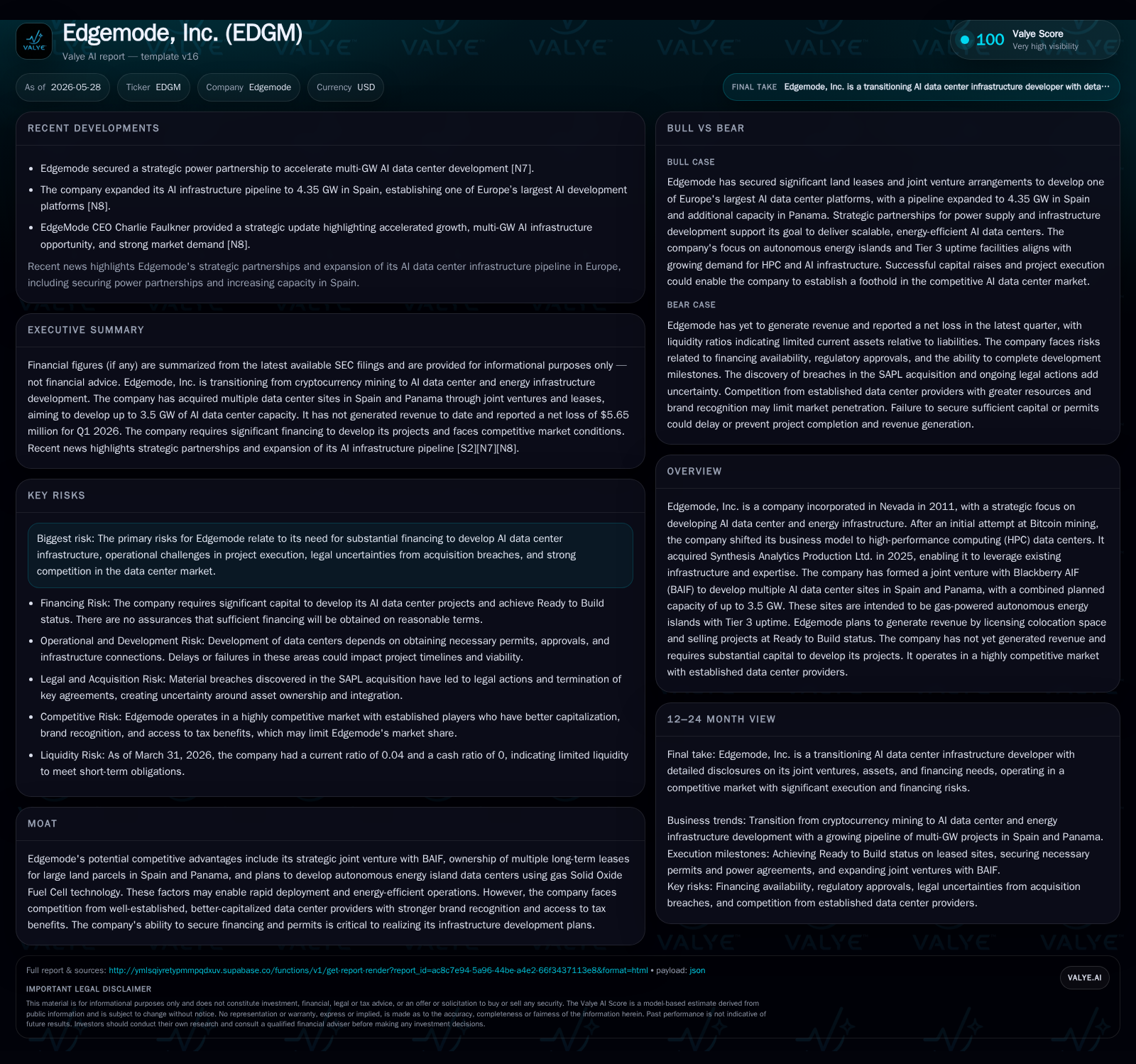
In its May 2026 quarterly filing, Edgemode detailed ongoing efforts to develop high-performance computing data centers via a joint venture with Blackberry AIF (BAIF) across multiple Spanish sites and a Panamanian location. The company’s AI data center business model centers on licensing colocation capacity with fixed and variable payments tied to electric capacity, but it remains pre-revenue and capital intensive. Key near-term challenges include securing over $11 million in committed funding, navigating complex permitting processes, and resolving litigation related to its April 2025 SAPL acquisition involving encumbered assets. Execution milestones focus on meeting JV capital contributions, regulatory approvals, and project readiness for revenue generation.
Recent Quarterly Update Highlights Strategic Focus and Capital Commitments
Edgemode's May 28, 2026 quarterly filing underscores its ongoing transition from cryptocurrency mining toward developing AI-focused HPC data center infrastructure through its wholly owned subsidiary SAPL and joint venture arrangements [S2]. The company remains pre-revenue as of December 31, 2025 but is actively engaged in advancing multi-site digital colocation projects.
Central to this effort is the Joint Venture Agreement established in January 2026 with Blackberry AIF (BAIF), forming DC Estate Solutions Cayman Limited which manages eight special purpose vehicle entities responsible for data center developments across five Spanish cities plus an additional site in Panama totaling approximately 3.5 GW planned capacity [S21]. Edgemode holds a controlling interest (50.1%) while BAIF owns the remainder.
Funding obligations commenced March 2026 require Edgemode to contribute monthly installments aggregating $125,000 initially for Spanish sites, later expanded under addenda to a minimum aggregate commitment exceeding $11 million over at least two years [S21][S27]. These funds are distributed to BAIF under the JV structure that mandates unanimous consent on material decisions between partners, potentially impacting operational agility.
Business Model: Licensing Colocation Space with Mixed Lease Components
Edgemode’s revenue strategy focuses on licensing colocation space and ancillary services at the AI data centers it develops. Customers enter into agreements that blend lease components—fixed payments based on electric capacity—and non-lease components including power delivery, security, maintenance fees, and applicable taxes [S1][S5]. This structure aligns with industry norms where pricing reflects capacity commitments combined with variable service usage.
Additionally, Edgemode plans to monetize projects by selling them at Ready-To-Build status after completing permitting milestones and utility hookups. This approach allows partial risk transfer for final construction financing through joint ventures or direct sales to buyers seeking rapid deployment capabilities tailored to AI workloads [S7]
Industry Positioning and Competitive Landscape
Operating within the capital-intensive hyperscale data center segment supporting AI workloads places Edgemode alongside well-established providers such as Equinix and Digital Realty Trust who benefit from scale, brand recognition, diversified portfolios, and preferential access to incentives.
Edgemode’s competitive advantages include long-term land leases spanning over 500 hectares across Spanish cities plus a Panamanian site secured under multi-decade agreements [S21], coupled with plans to deploy gas Solid Oxide Fuel Cell (SOFC) technology enabling autonomous energy islands independent of traditional grids—potentially accelerating site energization timelines relative to conventional facilities reliant on external power connections [S27].
However, development faces significant barriers including protracted permitting processes in European jurisdictions, compliance costs tied to environmental regulations especially concerning non-renewable energy sources powering the data centers, moderate switching costs for customers in HPC colocation markets, and reputational risks stemming from unresolved litigation related to asset encumbrances [S1][S24].
Growth Drivers: Strategic Joint Ventures and Market Demand Tailwinds
Key growth catalysts are anchored in the January 2026 JV consolidating control over multiple SPVs managing distinct data center projects across Spain and Panama with committed funding exceeding $11 million USD payable over a multi-year horizon [S21][S22]. This JV framework facilitates pooled capital deployment while aligning interests via equity option grants tied to BAIF leadership participation.
The April 2025 acquisition of SAPL assets provided foundational land leases and initial infrastructure enabling accelerated development compared to purely greenfield projects [S6], positioning Edgemode to capitalize on escalating demand for HPC colocation driven by AI model training workloads requiring scalable power density and geographic diversity.
Measurable growth indicators include achievement of RTB status at project sites unlocking sales opportunities; execution of new license agreements reflecting client adoption; consistent JV funding inflows confirming financial support; regulatory milestone attainment signaling approval progress; and early commercial deployments indicating initial revenue generation.
Risks: Liquidity Constraints, Legal Disputes, Permitting Complexity, Competitive Pressures
Edgemode confronts pronounced execution risks primarily due to liquidity shortages evidenced by a critically low current ratio near 0.04 as of March 31, 2026 with current assets at approximately $386 thousand against current liabilities exceeding $9.5 million [F1]. The absence of disclosed secured credit facilities or committed backstop capital beyond JV obligations heightens exposure should additional funding not materialize without dilutive equity issuance.
Ongoing litigation arising from breaches uncovered post-SAPL acquisition—including undisclosed liens encumbering real property assets—adds uncertainty regarding asset control critical for project development and financing prospects [S1][S24]. Outcomes remain unpredictable pending judicial resolution.
Permitting challenges involve obtaining urban compatibility reports mandated by Spanish lease agreements alongside approvals for gas pipeline hookups essential for SOFC-based autonomous energy systems—a key differentiator lacking alternate solutions [S27]. Delays or denials could materially extend timelines or inflate costs.
Competitive dynamics favor incumbents with scale economies, established client relationships emphasizing reliability in mission-critical AI compute environments, and superior access to renewable energy sourcing mitigating regulatory risks associated with carbon emissions [S24].
Stock option grants issued under the JV terms to BAIF principals introduce shareholder dilution considerations requiring careful capital structure management amid prolonged negative cash flow periods typical for hyperscale data center development cycles.
Near-Term Milestones and Execution Watchpoints
Investors should monitor:
- Monthly capital contributions commencing March 1, 2026 totaling $125K+ directed to DC Estate Solutions ensuring continuity of Spanish site development [S21];
- Progress on obtaining urban compatibility reports underpinning regulatory compliance;
- Updates on fiber optic connectivity contracts essential for network resilience;
- Advancement toward RTB classification enabling project monetization;
- Deployment status of SOFC plants influencing operational cost structures;
- Governance dynamics within the JV potentially affecting decision-making speed;
- Developments in legal proceedings impacting asset ownership rights.
Subsequent quarterly disclosures will provide further clarity on capital raising strategies, regulatory progress, commercialization timelines, and operational milestones crucial for transitioning toward positive cash flow.
Financial Overview: Operating Losses Amid Pre-Revenue Stage
Balance sheet metrics as of March 31, 2026 reveal acute liquidity pressures with current assets around $386 thousand contrasted against current liabilities exceeding $9.5 million resulting in a critically low current ratio near 0.04 highlighting urgent refinancing or equity issuance needs absent which ongoing project timelines may be jeopardized [F1][S2]. Financial discipline will be essential in managing working capital deficits while balancing dilution concerns during extended periods before achieving sustainable EBITDA levels given typical hyperscale data center buildout lead times spanning multiple quarters if not years.
This analysis is based exclusively on publicly available SEC filings up through May 28, 2026. It aims to provide an operationally focused overview without offering investment advice or price forecasts.
Disclaimer: This is research-only, informational analysis and not investment advice. It may include AI-generated interpretation and general industry context. Always verify important details using primary sources.

Comments