
Euronet Worldwide Sustains Modest Revenue Growth Amid Rising Expenses and Regulatory Challenges
In 2025, Euronet expanded its global electronic payments footprint while managing margin pressures and regulatory complexities.
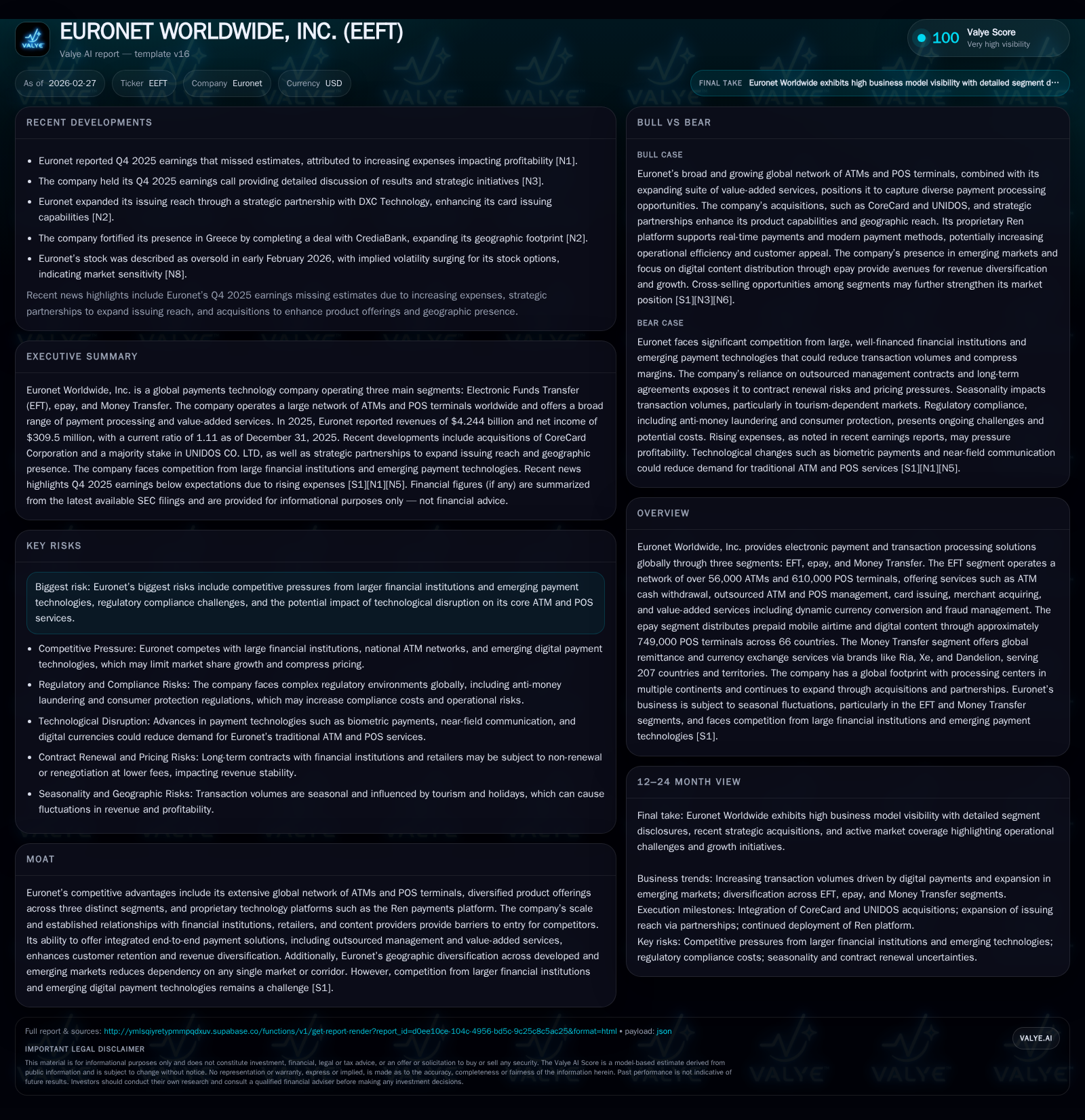
Euronet Worldwide posted 6.4% revenue growth in 2025 driven by increased transaction volumes across its EFT, epay, and Money Transfer segments, supported by acquisitions including CoreCard and strategic partnerships. Operating income grew 5.3% despite elevated expenses from technology investments and regulatory compliance. Net income rose modestly by 1.1%, while operating cash flow declined 23.6% due to working capital changes amid integration activities. Free cash flow remained healthy at approximately $434 million after disciplined capital expenditures. The company’s diversified geographic presence and proprietary platforms underpin its competitive positioning, though evolving regulation and intensifying competition pose ongoing risks.
Company Overview and Historical Performance
Euronet Worldwide, Inc. is a global leader in electronic payment and transaction processing solutions serving financial institutions, retailers, service providers, and consumers worldwide. As of December 31, 2025, Euronet operated three principal segments: Electronic Funds Transfer (EFT), epay, and Money Transfer.
The EFT segment deploys and manages a network exceeding 56,800 ATMs alongside approximately 610,000 POS terminals globally. This segment provides ATM cash withdrawal services through owned or outsourced units plus integrated transaction processing solutions including card issuing, merchant acquiring, dynamic currency conversion (DCC), fraud management, and value-added services [S1][S6].
The epay segment focuses on retail payment solutions distributing prepaid mobile airtime and digital content via about 749,000 POS terminals in over sixty countries spanning Europe, Asia Pacific, Middle East, Africa, South America, and North America [S1][S9]. Beyond mobile airtime top-ups, this segment expands offerings into digital media products such as branded music downloads and software.
The Money Transfer segment operates remittance services under brands like Ria Money Transfer—specializing in emerging markets—Xe targeting online foreign exchange users globally, and Dandelion providing real-time cross-border payments through partnerships with financial institutions and fintech platforms. Its footprint covers over 207 countries and territories [S1][S11].
Financial Summary Table
Historical performance (annual)
| FY | Rev ($bn) | Net ($mm) | CFO ($mm) | OpInc ($mm) | Rev YoY | Net YoY |
|---|---|---|---|---|---|---|
| 2025 | 4.2 | 310 | 560 | 530 | +6.4% | +1.1% |
| 2024 | 4.0 | 306 | 733 | 503 | +8.2% | +9.4% |
| 2023 | 3.7 | 280 | 643 | 433 | +9.8% | +21.1% |
| 2022 | 3.4 | 231 | 748 | 385 |
Source: SEC companyfacts cache [F1].
Capital returns and efficiency (annual)
| FY | FCF ($mm) | ROE% |
|---|---|---|
| 2025 | 434 | 23.7 |
| 2024 | 616 | 24.9 |
| 2023 | 549 | 22.4 |
| 2022 | 644 | 18.6 |
Source: SEC companyfacts cache [F1].
Revenue growth was supported by organic transaction volume increases complemented by acquisitions including CoreCard (2025) and Kyodai Remittance (2025). Operating income growth was tempered by higher expenses related to technology investments and regulatory compliance.
Segment Trends Supporting Growth
The EFT Processing Segment achieved a compound annual growth rate (CAGR) near 37% in transaction volumes over the past five years primarily due to expansion of lower-value real-time payment transactions across Asia Pacific markets [S6]. Despite transaction volumes reaching over 15 billion annually in 2025 compared to about 4.37 billion in 2021, revenue gains are moderated because these smaller transactions generate lower average fees.
Epay's extensive network processes prepaid mobile airtime “top-up” services alongside growing sales of digital media goods; approximately three-quarters of its revenue derives from non-airtime content helping defend margins against traditional mobile operator pressures [S9]. Its broad partnerships with more than one thousand leading global brands enable scalable distribution difficult for new entrants to replicate.
The Money Transfer Segment remains pivotal with significant processed transfer volumes under Ria, Xe, and Dandelion brands supporting consumer-to-consumer cross-border payouts as well as B2B account-to-account payments increasingly offered via API integrations with banks and fintechs [S15]. Its strategy includes expanding volume through corridors beyond traditional U.S.-Mexico lanes while leveraging synergies with epay and EFT channels.
Future Growth Prospects
Euronet aims to capture incremental growth by extending end-to-end payment ecosystems leveraging proprietary platforms such as Ren Payments — a modular SaaS/on-premise system supporting issuing, acquiring, switching & real-time payments targeted at financial institutions & central banks adapting to evolving digital payment trends [S17].
Strategic acquisitions like CoreCard provide issuer processing capabilities critical for fast-growing credit/prepaid card portfolios globally while Kyodai Remittance expands reach into Japan’s cross-border payments market supporting corridor diversification beyond traditional hubs [S12].
Diverse geographic presence across developed and emerging markets mitigates risks from economic downturns or regional regulatory shifts but necessitates ongoing investment for compliance with complex AML laws and payment regulations including gift voucher licensure affecting epay’s business model [S16]. Emerging technologies such as mobile wallets or direct carrier billing present both threats to legacy prepaid models and opportunities for platform adaptation.
Competitive pressures remain significant across all segments—from national bank-owned ATM networks challenging EFT outsourcing contracts to mobile operators offering direct top-up services impacting epay commission margins; Western Union’s scale overshadows Euronet’s Money Transfer business yet Euronet’s flexible platform serves digital-first entrants effectively [S14][S16][N7].
Earnings Outlook & Operational Milestones
The Q4 earnings call on February 12 highlighted an earnings miss partly due to increasing costs tied to technology investment commitments alongside inflationary wage pressures across multiple regions [N2][N4]. Management emphasized efficiency initiatives aimed at offsetting cost inflation while advancing growth initiatives including API-enabled product launches.
Key milestones include:
- Completion of CoreCard integration enhancing issuer processing pipeline;
- Expansion of Dandelion’s real-time cross-border payment capabilities;
- Geographic penetration into high-potential remittance corridors beyond established hubs;
- Scaling adoption of Ren Payments platform among banking partners seeking modern payment infrastructure.
Ongoing regulatory developments may affect pricing models or contract renewals within money transfer or epay segments where commission terms can materially impact margins [N1].
Capital Allocation & Returns Profile
Capital management remains disciplined with moderate capex increase (+7%) aligned with network expansion including upgrades to Ren Payments deployment [F1]. Operating cash flow declined approximately -23.6% reflecting working capital absorption related to integration expenses; however free cash flow remained solid at roughly $434 million after capex [F1].
Equity rose modestly alongside net income stability yielding an approximate return on equity near 23.7%, demonstrating efficient use of shareholder funds despite earnings pressure from investments expanding capabilities [F1].
Though recent dividend data is not disclosed publicly there have been historic share repurchases which have tapered off—suggesting current preference toward reinvestment over capital returns [F1].
Risks & Challenges
Key risks include:
- Intense competition driving contract renewals on less favorable terms or contract losses particularly within EFT outsourcing where financial institutions develop internal capabilities or shift vendors [S10];
- Regulatory complexity across multiple jurisdictions requiring costly compliance efforts risking license suspensions or fines especially in money transfer operations subject to U.S., state and international laws [S16];
- Technological disruption threatening legacy ATM/POS transactions through alternatives like direct carrier billing or blockchain-based remittances eroding traditional revenue bases [N9];
- Contract dependency risks due to short-duration non-exclusive agreements particularly within epay content provider relationships that could be terminated or renegotiated unfavorably without long-term guarantees [S26];
- Geopolitical risks involving currency fluctuations since about 76% of revenues derive from non-U.S dollar sources adding volatility from global macro uncertainties [S1];
- Legal contingencies including ongoing tax court disputes on withholding taxes affecting Italy operations potentially exposing the company to EUR19 million if appeals fail [S13].
Conclusion
Euronet Worldwide maintains a resilient position within the global payments ecosystem combining extensive physical networks with strategic technology platforms enabling diverse product offerings across EFT processing, prepaid retail payments through epay, and cross-border money transfer services. While margin pressure from elevated operational costs tempers bottom-line momentum amid integration activities and inflationary factors, sustained investment in scalable proprietary infrastructure provides avenues for differentiated service delivery. However vigilance is warranted around competitive pricing dynamics especially against well-capitalized incumbents or agile fintech disruptors plus evolving regulatory frameworks requiring adaptable compliance strategies. Stakeholders should monitor upcoming quarterly earnings for progress on efficiency programs alongside updates regarding new agreement wins or expansions within emerging money transfer corridors plus adoption metrics for Ren Payments platform driving medium-term potential expansion.
This analysis is based solely on publicly available data through early 2026 without offering investment advice.
Disclaimer: This is research-only, informational analysis and not investment advice. It may include AI-generated interpretation and general industry context. Always verify important details using primary sources.

Comments