
Eagle Financial Services Inc: Navigating Regional Banking with Diversified Loan Portfolio and Credit Discipline
Eagle Financial Services Inc operates as a regional bank focused on diversified lending and robust credit risk management amidst competitive pressures and macroeconomic uncertainties.
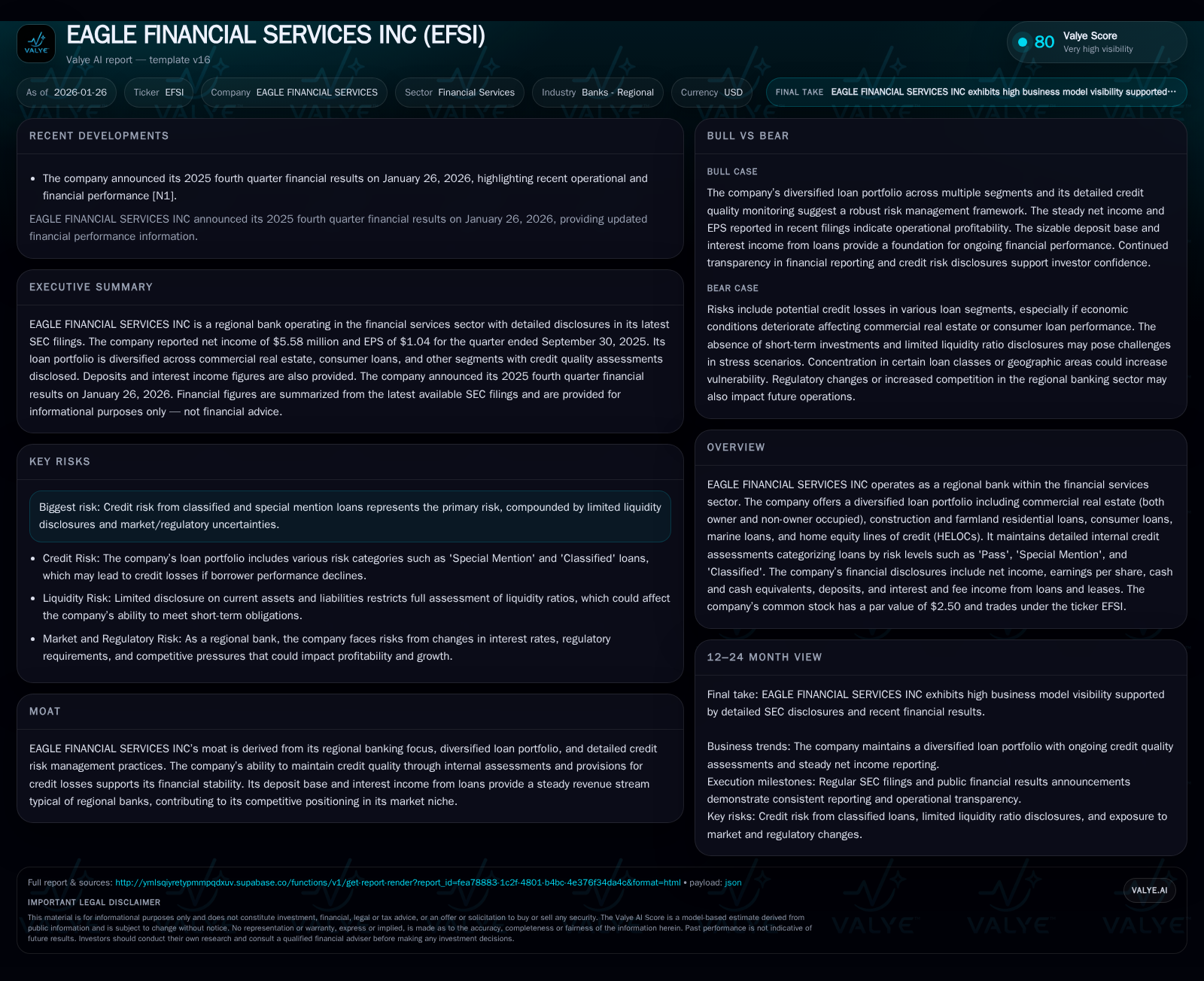
Eagle Financial Services Inc (EFSI) remains a classic regional bank balancing a diversified loan portfolio with detailed internal credit risk assessments. Recent quarterly results highlight stable earnings supported by interest income, though elevated classified loans and cautious dividend sentiments signal credit risk concerns. The company’s moat stems from its local lending expertise and deposit base, but industry-wide pressures on credit quality and interest rates remain key operational challenges. Close monitoring of asset quality metrics and liquidity disclosures will be critical to understanding future performance dynamics.
What Changed Recently
Eagle Financial Services Inc reported its 2025 fourth-quarter financial results signaling steady earnings with net income around $5.58 million and interest and fee income from loans and leases exceeding $81 million [N1, S6]. Despite operational stability, several market commentaries caution against buying the stock for its next dividend cycle, reflecting concerns over credit quality and capital preservation [N2, N4]. Insider transactions reveal bullish insider buying totaling approximately $533k in stock purchases during Q1, hinting at management's confidence in the company’s prospects [N3, N8, N10, N11]. Retail investors constitute roughly 40% of the ownership, which may influence stock liquidity and valuation volatility [N5]. These recent developments frame a complex risk-return profile amid a cautious outlook driven by credit risk and competitive dynamics.
Business Model as a System
Eagle Financial Services operates as a regional bank with a diversified lending portfolio that spans commercial real estate (both owner-occupied and non-owner-occupied), construction loans, farmland residential mortgages, consumer loans, marine loans, and home equity lines of credit (HELOCs) [S1]. The company’s revenue is primarily generated through net interest income earned on these loans, supplemented by fee income. As typical in banking, deposits form the principal funding source, underpinning liquidity and enabling loan originations.
Distinctively, EFSI implements a detailed internal credit assessment system categorizing loans into risk buckets labeled 'Pass', 'Special Mention', and 'Classified'. This internal grading informs provisioning for credit losses and risk management strategies [Valye report excerpt]. The banking model leverages this risk stratification to balance yield and risk, aiming to optimize the loan portfolio quality and minimize losses.
EFSI's common stock trades on NASDAQ under ticker EFSI with a par value of $2.50 [S1]. The company’s capital structure and liquidity disclosures are limited in public filings, constraining a full understanding of leverage and buffer adequacy. The firm maintains a stable deposit base providing a cost-effective funding source, vital in a rising interest rate environment.
Industry Map & Competitive Battlefield
Operating in the regional banking sector, EFSI competes with banks that emphasize local market knowledge and relationship banking. Regional banks typically serve SMEs, local real estate developers, and consumer segments underserved by larger national institutions. The key competitive factors include:
- Credit Quality Management: Maintaining low non-performing loan ratios and effective provisioning is critical as regional banks often have higher exposure to cyclical sectors such as commercial real estate and construction.
- Deposit Gathering: Competing for stable deposits at favorable rates is essential to fund loan growth and maintain net interest margins.
- Product Diversification: Offering a range of loan products (commercial, consumer, marine, farmland) adds resilience but also operational complexity.
- Regulatory Compliance: Increasing regulatory scrutiny and capital requirements impact operational costs and strategic flexibility.
EFSI’s moat derives from its diversified loan book and credit risk discipline, which are essential in the current macroeconomic climate marked by rising interest rates and potential credit stress [Valye report excerpt]. However, these same market conditions elevate risks around loan defaults and funding costs, intensifying competition among regional banks for creditworthy borrowers and deposits.
Where the Economics Become Real
The unit economics for EFSI hinge on net interest margins derived from the spread between loan yields and deposit costs, offset by credit loss provisions and operating expenses. Key variables include:
- Loan Yield Mix: Commercial real estate and construction loans typically command higher yields but carry elevated risk, while consumer and HELOC products offer diversification with different risk profiles.
- Credit Loss Provisions: The allowance for credit losses, which has been increasing due to classified loans, directly impacts net income and capital preservation.
- Deposit Costs: Securing low-cost deposits is vital to maintain margins; competition from other banks and market interest rates affect this dynamic.
- Fee Income: Ancillary fees from loan servicing and other services supplement interest income but are modest in scale.
EFSI reported interest and fee income from loans and leases at approximately $81.8 million recently, reflecting the scale of its earning assets [S6]. However, the loan portfolio’s credit allowance is sizeable relative to classified loans, indicating cautious provisioning [S10]. The bank’s liquidity position, as measured by cash and equivalents, was about $33.7 million as of the latest data, though full liquidity ratios are undisclosed [S14]. This cash buffer is critical for meeting unexpected funding needs.
Operational bottlenecks include the management of credit risk in cyclical sectors, potential margin compression if deposit costs rise faster than loan yields, and regulatory capital demands that may constrain growth or dividend flexibility.
Diligence Questions / Disconfirming Signals
- How has the classified loan ratio trended over the last several quarters, and what sector concentrations drive this?
- What underwriting standards have been adjusted recently in response to economic uncertainties, especially in commercial real estate and construction?
- How transparent and robust is the company’s capital adequacy and liquidity reporting beyond the limited disclosures?
- What is the stability and composition of the deposit base, especially considering retail investors’ significant ownership?
- How sensitive is the loan demand and credit quality to rising interest rates and potential recession scenarios in the regional markets served?
- Are insider buying patterns consistent with operational realities, or could they reflect timing unrelated to credit risks?
- What is the competitive response to regulatory changes that may increase compliance costs or capital requirements?
These questions remain pivotal to fully appraising the risk-return trade-offs inherent in Eagle Financial Services’ business model and its future trajectory.
This analysis is based on available public disclosures and news as of January 2026 and does not constitute investment advice or a recommendation. All facts are cited where available, and any forward-looking or speculative interpretations are identified as analysis rather than fact.
Disclaimer: This is research-only, informational analysis and not investment advice. It may include AI-generated interpretation and general industry context. Always verify important details using primary sources.

Comments