
Elite Health Systems Inc. (EHSI) Equity Research: Navigating Early-Stage Medicare Advantage Operations Amid Liquidity Concerns
Elite Health Systems is an emerging managed care organization focusing on Medicare Advantage plans, facing early operational losses, regulatory complexity, and capital challenges as it builds scale post-2026 launch and acquisition.
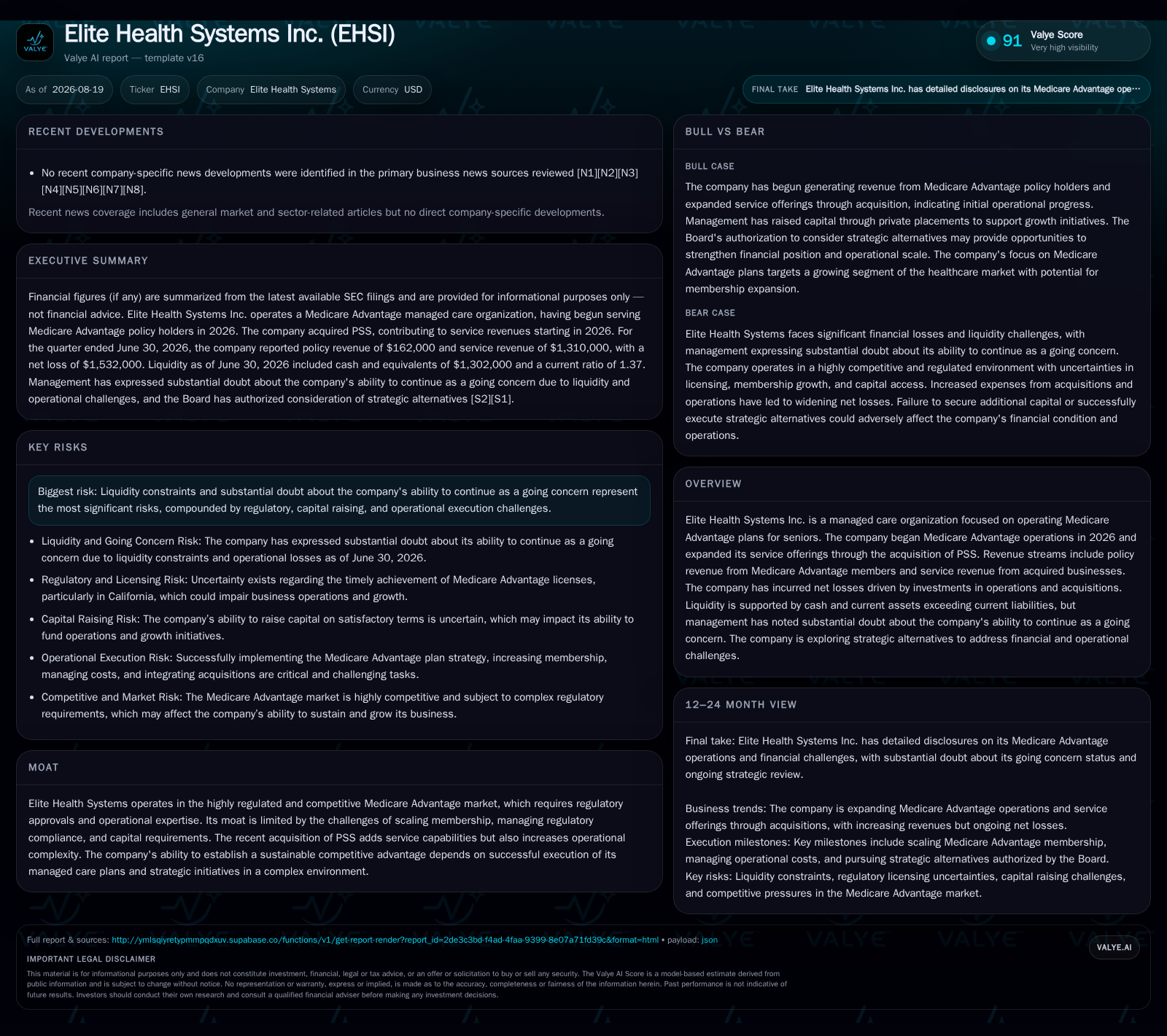
Elite Health Systems launched Medicare Advantage operations in 2026, acquiring PSS to expand service revenue. Despite initial revenue growth, the company incurred significant losses driven by acquisition and operating costs, with liquidity pressures raising substantial doubt about its going concern status. Its business model hinges on scaling Medicare Advantage membership and integrating acquisitions in a highly regulated competitive environment. Strategic alternatives are under consideration to address financial and operational risks. Key uncertainties include membership growth, licensing progress, capital access, cost management, and competitive positioning in the evolving Medicare Advantage market.
Elite Health Systems Inc. is an emerging participant in the Medicare Advantage managed care space, having initiated policyholder services in 2026 and expanded service capabilities through the acquisition of PSS. While initial revenues show progress, the company’s financials reveal significant net losses driven by operational expenses and acquisition costs. Liquidity constraints and management's expressed doubts about the company's sustainability underscore the challenges of scaling in a highly regulated, competitive market. The company’s strategic trajectory will pivot on its ability to grow membership, manage costs, secure capital, and navigate regulatory hurdles, making its near-term operating and financing milestones critical to watch.
Latest Operating Snapshot
Elite Health Systems commenced its Medicare Advantage operations in 2026, generating $162,000 in policy revenue for Q2 2026, while policy expenses exceeded revenue at $183,000, reflecting early-stage cost structures inconsistent with breakeven [S2]. Concurrently, service revenue, primarily from the recently acquired PSS, contributed $1.31 million, with an associated cost of $496,000. This acquisition expanded the company’s service revenue base but also increased operational complexity and costs.
The company reported a net loss of $1.53 million for Q2 2026, a notable increase from the $441,000 loss in Q2 2025, mainly attributable to acquisition-related spending and increased selling, general, and administrative (SG&A) expenses, which grew nearly fourfold to $1.71 million. Liquidity remains stressed, with cash and equivalents of $1.3 million and a current ratio of 1.37 as of June 30, 2026. Management has expressed substantial doubt about the company’s ability to continue as a going concern due to these financial challenges [S2].
Business Model and Unit Economics
Elite Health Systems primarily generates revenue through Medicare Advantage policy premiums (policy revenue) and service revenue from acquired businesses like PSS. Policy revenue depends on membership scale and negotiated capitation rates with CMS, which are fixed per member per month but subject to regulatory adjustments. Service revenue likely originates from administrative or care management services tied to the acquired PSS operations.
The unit economics currently appear challenged. Policy expenses exceed policy revenue, suggesting either high medical loss ratios or initial fixed costs disproportionate to membership scale. Acquisition-related costs and elevated SG&A increase overall expenses, suppressing operating leverage. Capital needs are significant given the requirement to invest in membership growth, regulatory compliance infrastructure, and integration of acquisitions. Operating leverage could emerge if membership scales sufficiently to dilute fixed costs and improve medical cost management; however, failure to grow or control costs will perpetuate losses.
Moat, Competition and Counterforces
Elite Health Systems operates in the Medicare Advantage market, which imposes substantial regulatory and operational barriers to entry, including CMS licensing and compliance obligations. These factors, along with the complexity of managing healthcare provider networks and regulatory reporting, create entry challenges that could serve as partial moat elements. However, the moat is limited by the company’s nascent scale, lack of established membership, and the operational challenges inherent in integrating acquisitions like PSS.
Competition includes established Medicare Advantage plans with large membership bases and negotiated provider networks that benefit from scale economies and regulatory experience. Counterforces include regulatory uncertainty, capital intensity, and the high fixed costs of care management infrastructure. Switching frictions for members may be moderate as Medicare Advantage beneficiaries can select plans annually, which limits customer retention leverage absent differentiated service or pricing.
Bull Case
In a favorable scenario, Elite Health Systems successfully integrates PSS, scales Medicare Advantage membership, and achieves regulatory licensing milestones efficiently, resulting in growing policy revenue that outpaces costs. Capital raised through private placements supports investments in care management and network development, enabling improved medical loss ratios and operating leverage. Strategic alternatives, if executed well, could bring in partners or capital that enhance scale and competitive positioning, propelling the company toward profitability.
Confirming evidence would include sequential membership growth, improvement in policy revenue relative to policy expenses, stable or improving medical loss ratios, and a decrease in net losses driven by operational efficiencies. Conversely, failure to achieve regulatory licenses on schedule, inability to raise follow-on capital, or stagnation in membership growth would falsify this scenario.
Base Case
The base case envisions Elite Health Systems continuing its Medicare Advantage operations with gradual membership growth but persistent net losses due to high acquisition and operational expenses. The company manages to maintain liquidity through capital raises but remains dependent on strategic alternatives for long-term viability. Service revenue from PSS provides a modest revenue cushion but does not offset policy losses fully. Operational improvements occur but are insufficient to generate positive cash flow in the near term.
In this scenario, regulatory progress is steady but slow, limiting rapid expansion. Membership growth is incremental, and medical cost management improves marginally but not enough to deliver operating leverage. Capital markets provide intermittent financing at potentially dilutive terms. This scenario would be supported by stable but negative net income trends, modest increases in policy revenue, and continued management focus on cost control and strategic evaluation.
Bear Case
The downside scenario involves Elite Health Systems failing to scale Medicare Advantage membership or secure necessary regulatory approvals, leading to sustained operating losses and cash burn. Acquisition integration challenges with PSS exacerbate cost pressures without commensurate revenue gains. Liquidity deteriorates further due to limited access to capital markets and absence of credit lines, forcing potential asset sales or distressed financing.
This scenario would be confirmed by shrinking or stagnant membership, widening losses, inability to meet regulatory requirements, and management announcements of operational retrenchment or asset divestitures. A failure to improve medical loss ratios or control SG&A expenses would exacerbate financial stress. Falsification would be evidence of meaningful membership growth, successful licensing, or capital raises sufficient to stabilize liquidity.
What Matters Next
Key performance indicators to monitor include: (1) Medicare Advantage membership growth rates, indicating market acceptance and revenue scalability; (2) policy revenue versus policy expenses to assess unit economics and medical loss ratios; (3) SG&A trends to evaluate cost control and operational efficiency; (4) cash burn rate and liquidity metrics given the going concern warning; (5) regulatory licensing progress and approvals, especially in key states; (6) capital raising activities, including timing, size, and terms of equity or debt financings; (7) integration progress and contribution of PSS service revenue and costs; and (8) any strategic alternative announcements or outcomes, such as mergers, asset sales, or partnerships.
Disclosure of membership metrics or medical loss ratios would be particularly valuable for assessing trajectory, though not currently provided. Monitoring regulatory communications or CMS approvals will provide insight into growth feasibility. Given the company’s financial condition, near-term financing developments will be critical to sustaining operations.
Disclaimer: This is research-only, informational analysis and not investment advice. It may include AI-generated interpretation and general industry context. Always verify important details using primary sources.

Comments