
Elauwit Connection’s Path to Stability After Related-Party Debt Repayment
Full repayment of related-party debts and updated credit loss policies in Q1 2026 mark a turning point for Elauwit amid persistent operational challenges.
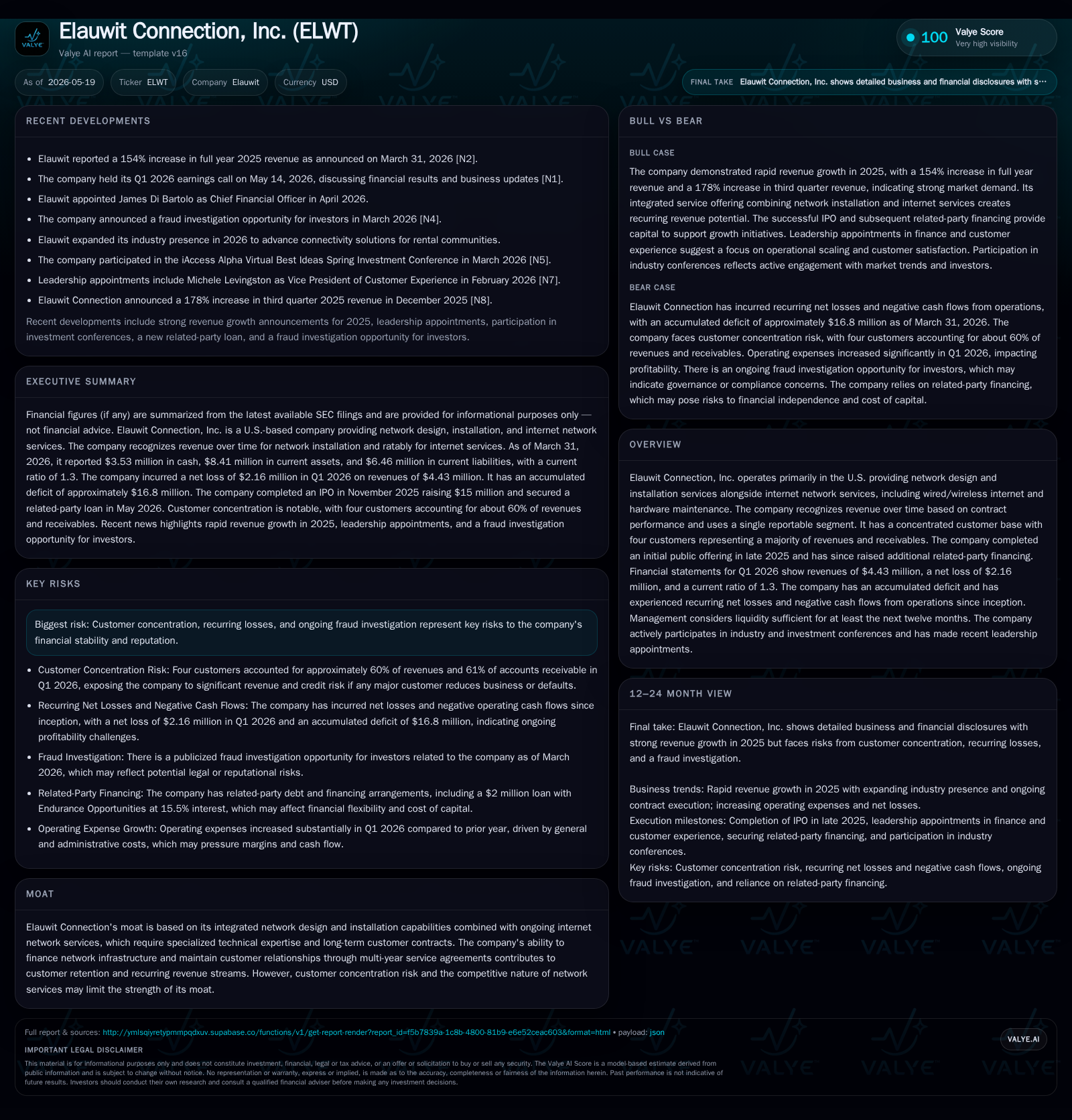
Elauwit Connection, Inc. completed repayment of all related-party debt obligations in November 2025, simplifying its capital structure and improving financial clarity. The latest quarterly filing reveals adoption of a rigorous CECL impairment model on receivables, signaling more conservative risk management practices. Despite recurring net losses and high customer concentration risk, the company benefits from integrated network design and service offerings that underpin customer retention. Management expects continued losses but projects improvement as scale builds, making monitoring contract wins and liquidity critical going forward.
Recent Quarterly Update Highlights Key Milestones
Elauwit Connection’s latest operating disclosure through its May 15, 2026 10-Q filing highlights the company’s settlement in full of all outstanding principal and accrued interest relating to multiple related-party financing instruments including the Endurance Loan family of notes and associated management agreements on November 7, 2025 [S2]. This cleanup extinguished legacy obligations that had previously obscured financial transparency and added refinancing risk.
Concurrent with this debt payoff, Elauwit introduced an enhanced expected credit loss (CECL) impairment methodology applied rigorously to trade accounts receivable (with reserves escalating steeply from 50% at 91–120 days past due to full reserve beyond 180 days), while unbilled and network financing receivables maintain historical zero-loss assumptions given consistent recoveries without write-offs since inception [S2]. These heightened provisioning standards reflect both industry best practices and prudent conservatism given the concentrated customer base.
Despite these structural improvements, the first quarter of 2026 saw the company generate $4.43 million in revenues but incur a net loss of $2.16 million along with negative operating cash flow totaling approximately $2.5 million [S2]
How Elauwit Makes Money: Business Model and Service Quality
Elauwit Connection operates a single consolidated segment comprising two highly integrated revenue streams: network design and installation services paired with internet network services encompassing wired/wireless access solutions plus hardware maintenance [S1][S2]. Revenue recognition follows ASC 606 principles based on contract performance over time.
The business model hinges on winning large-scale contracts that combine bespoke network infrastructure deployment with multi-year service agreements for internet connectivity supported by ongoing hardware support. Customers typically finance network infrastructure through payment schedules amortized over five to seven years concurrent with service delivery.
This dual offering requires specialized technical expertise spanning civil engineering for physical network design through IT-managed wireless installations. The ongoing service component fosters stickiness through long-term contracts ensuring recurring revenue streams [S2]. However, customer concentration remains significant with four customers accounting for roughly 60% of Q1 revenues and accounts receivable—a reliance that underscores both strategic client dependence and risk exposure should any major contract lapse
Competitive Environment and Industry Positioning
In the fragmented U.S. network services industry dominated by regional integrators and national ISPs, Elauwit's moat rests on its combined capability to deliver end-to-end network solutions—installing complex infrastructures while providing tailored internet services under long-duration contracts [S1]. This integration differentiates it from companies focused solely on connectivity or standalone installation.
Switching costs are elevated for customers due to significant upfront capital investments in customized networks plus operational risks tied to service disruption during provider changes. Nonetheless, Elauwit's smaller scale relative to tier-1 providers means competitive pressure remains intense—with bidding power limited by client concentration—and pricing constrained by regulatory environments governing telecommunications pricing fairness.
Capacity constraints do not currently appear material due to outsourced financing arrangements for network receivables with Endurance Opportunities; however, regulatory scrutiny or changes around financing structures could impact future growth dynamics or pricing flexibility.
Drivers of Future Growth: Scaling Network Services
Growth hinges primarily on expanding the number of customers beyond the top four while deepening penetration within those existing contracts through bundling extended internet services alongside routine hardware maintenance [S2][S3]. Management has signaled that operating losses are expected to persist in the near term due to expansion investments but should narrow as revenue scales leverage fixed operating costs.
Specifically, increasing contracted backlog measured by signed agreements for new installations or service renewals will be critical KPIs indicating demand traction. Scaling infrastructure finance further via controlled increases in network financing receivables also supports capacity growth without immediate balance-sheet strain given participation agreements with funding partners.
Capitalizing on technology shifts such as rising enterprise demand for faster wireless architectures or smart-city deployments could provide additional market tailwinds if successfully penetrated.
Risks and Constraints: Customer Concentration and Financial Headwinds
Revenue reliance on four key clients introduces significant risk volatility; any contract non-renewal or delayed payments could materially impact cash flow sustainability given Elauwit's recurring net loss profile [S1][S2]. Moreover, despite improvements post IPO in late 2025 and removal of related-party complexities through debt repayments, accumulated deficits exceed $16 million highlighting an ongoing need for capital discipline.
Negative free cash flow velocity complicates operating flexibility—forcing dependence on capital markets or related party loans absent positive earnings turnaround. The company's legal disclosures also note ongoing fraud investigations which could impair reputation or highlight internal control vulnerabilities if substantiated [S1]. Such issues exacerbate investor caution while underscoring critical governance watchpoints.
Competitive pressures from larger established service providers could cap pricing power or erode margins if additional scale benefits diminish.
Catalysts to Monitor: Liquidity, Contract Wins, and Margin Trends
Key indicators to observe include sequential quarterly improvements in revenue mix favoring higher-margin internet network services alongside reduced net losses signaling operational leverage gains [N1][S2][S3]. Broader contract wins outside existing top customers would materially lower concentration risk.
Trends in accounts receivable aging reports will reveal effectiveness of tightened credit policies under CECL provisions impacting allowance balances—a leading signpost on credit health. Controlling discretionary spending while maintaining enough investment in sales pipeline expansion is essential for sustaining momentum without liquidity shocks.
Margin expansions driven by improved utilization of deployed networks coupled with renegotiated vendor terms or higher hardware maintenance attach rates would strengthen profitability outlooks.
Financial Condition Overview: Liquidity and Cash Flow Dynamics
As of March 31, 2026, Elauwit reported $3.53 million in cash and equivalents against current liabilities totaling approximately $6.46 million yielding a current ratio near 1.3—which is moderate but not robust enough to fully cushion adverse short-term shocks without planned inflows or spending cuts [F1][S2]. Total debt stood near $2 million (inclusive primarily of non-related party notes), positioning the company effectively at a net cash stance when offsetting cash balances are considered [F1].
However, recurring quarterly net losses ($2.16 million in Q1 alone) alongside negative operating cash flows indicate continued burn requiring execution on growth plans or external capital access to maintain operations beyond the medium term absent profitability improvements [S2]. Management’s confidence in funding sufficiency over twelve months rests on proceeds from recent equity raises plus a newly established $2 million term loan facility executed May 2026 from an existing lender alliance partnering closely with their financing structure [S2].
In summary, Elauwit's recent related-party debt clearance paired with enhanced credit loss modeling provides improved financial clarity and marks stabilization efforts amid challenging results driven by growth investments and concentrated revenues. Going forward, performance hinges critically on expanding contract footprint while narrowing losses through scale efficiencies within a competitive network services landscape.
Disclaimer: This is research-only, informational analysis and not investment advice. It may include AI-generated interpretation and general industry context. Always verify important details using primary sources.

Comments