The Ensign Group: A Localized Leader in Post-Acute Healthcare with Integrated Real Estate Strategy
Ensign Group operates a large network of skilled nursing and senior living facilities with a distinctive local empowerment model and owns a substantial healthcare real estate portfolio via its captive REIT.
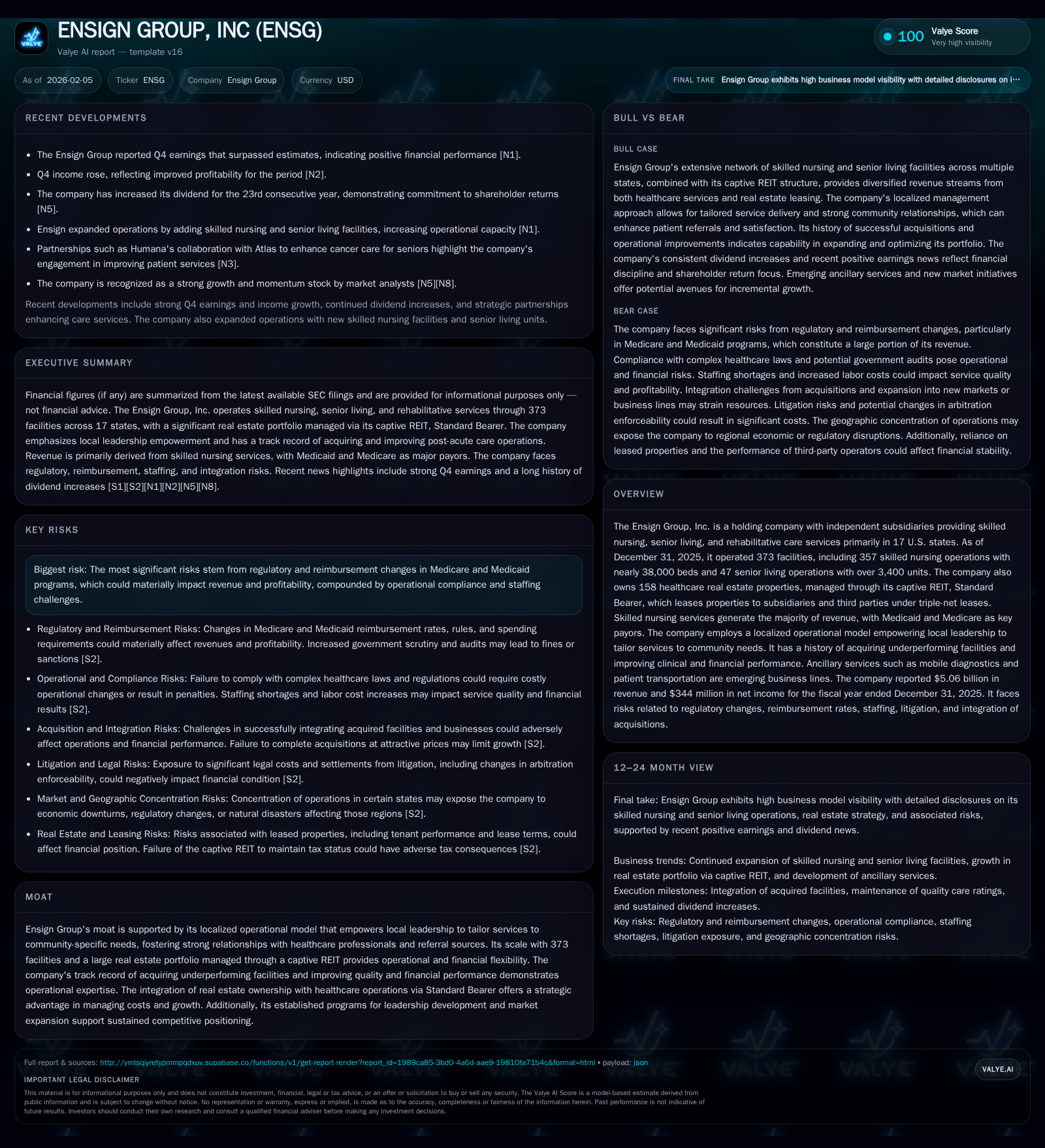
The Ensign Group, Inc. is a holding company primarily engaged in skilled nursing, senior living, and rehabilitative care across 17 U.S. states, operating 373 facilities and managing 158 healthcare real estate properties through its Standard Bearer REIT. Its business model emphasizes local leadership autonomy to tailor services to community needs, underpinning a competitive moat alongside scale and integration of healthcare operations with real estate ownership. The bulk of revenue derives from Medicaid and Medicare payors, exposing the company to regulatory and reimbursement risks. Recently reported strong financial results highlight operational resilience, though ongoing challenges include compliance complexity, staffing shortages, and reimbursement pressures that pose material risks to growth and profitability.
Company Overview
The Ensign Group, Inc., founded in 1999, has established itself as a leading holding company in the post-acute healthcare sector by operating a network of independent subsidiaries across 17 U.S. states. As of December 31, 2025, the company manages 373 facilities encompassing skilled nursing (357 facilities) with close to 38,000 beds and senior living (47 operations) totaling over 3,400 units [S1]. Additional ancillary services such as mobile diagnostics complement its core care offerings.
A critical structural component is its ownership of a substantial real estate portfolio consisting of 158 healthcare properties managed through its captive REIT entity, Standard Bearer. This structure allows Ensign to integrate property ownership with operational control—leasing many locations on favorable triple-net terms both to its own subsidiaries and third parties [S1].
Business Model & Differentiation
Central to Ensign’s competitive positioning is its localized operational model that grants significant autonomy to facility-level leadership teams. These local managers are given latitude to tailor services according to their community’s unique healthcare environment and stakeholder preferences. This degree of decentralization fosters nimble decision-making, allowing for more effective patient engagement and stronger ties with referral sources such as hospitals, physicians, and families [S1].
Leadership is organized into portfolio companies each headed by leaders who focus on talent recruitment, acquisitions, quality improvement initiatives, and operational expansion within their clusters. This decentralization contrasts with many healthcare chains' centralized models which may overlook nuanced local demand variations.
Ensign’s historical expertise lies in identifying underperforming skilled nursing assets, acquiring them swiftly, then applying clinical excellence protocols alongside operational improvements to raise care standards while enhancing profitability — replicating a proven turnaround playbook.
Scale & Financial Footprint
As reported in its latest Annual Report for fiscal year ended December 31, 2025 [F1], Ensign generated approximately $5.06 billion in total revenue with net income of $344 million.
The skilled nursing segment accounts for roughly 95.6% of the company’s revenue stream dominated by government payors Medicare and Medicaid.
Balance sheet highlights include cash reserves near $504 million against current liabilities of approximately $894 million giving a current ratio around 1.42 [F1], indicating sufficient liquidity to manage near-term obligations.
Long-term debt stands at about $144 million consisting primarily of mortgage loans insured through HUD with terms ranging from 25 to 35 years at fixed interest rates averaging between approx. 2.4%–4.2% annually [S1]. Moreover, operating lease commitments for facilities extend beyond $3 billion reflecting substantial capital tied up in property operations.
Captive REIT & Real Estate Strategy
Standard Bearer REIT plays a formative role by owning physical properties under which subsidiaries operate either owned or leased facilities [S1]. Leveraging triple-net master leases provides predictable rent payments indexed to consumer price inflation capped at defined levels with options for extended renewals — structurally insulating rent expenses from excessive volatility.
This integrated ownership model offers several advantages: strategic flexibility for expansion or disposition decisions; operational cost management via stable lease arrangements; hedging against occupational cost inflation; and generally improving bargaining power relative to external landlords.
While many healthcare providers outsource real estate entirely or rely on external landlords limiting agility or increasing costs unpredictably.
Industry Context & Competitive Moat
Within the broader post-acute care industry characterized by regulatory scrutiny and reimbursement pressures, Ensign’s moat comprises its scale balanced by local market relevance.
Strong ties between locally empowered leadership teams and community referral sources translate into stable patient volumes even amidst competitive headwinds. Sharing best practices across portfolios promotes clinical improvement while preserving decentralized execution agility. The geographic footprint spanning multiple states reduces concentration risk yet remains focused enough for operational oversight.
The combination of operational expertise turning around struggling nursing homes coupled with proprietary real estate integration distinguishes Ensign from more fragmented or purely asset-light competitors.
Risks & Challenges
Ensign’s dependency on Medicare and Medicaid revenues inherently exposes it to shifting political landscapes — adjustments to reimbursement formulas or eligibility criteria could materially impact revenue streams [S2]. Continued regulatory complexity demands significant investment in compliance infrastructure including audits risking penalties or sanctions for deficiencies.
Labor market constraints have intensified competition for qualified nurses and health professionals nationally; labor shortages contribute upward pressure on wages affecting margins [S2]. Failure to maintain minimum staffing could trigger fines while deteriorating quality scores degrade reputation amongst payors.
The intricate nature of multiple master leases covering many subsidiaries incorporates cross-default risk — poor performance at one facility could jeopardize rent agreements across a broader lease pool potentially triggering liquidity stress under adverse scenarios [S1].
Cybersecurity remains a growing concern given personal healthcare data sensitivity; however, Ensign demonstrates mature governance practice aligned with NIST frameworks mitigating potential cyber threats through dedicated personnel oversight [S1].
Inflationary pressures also pose headwinds increasing operating costs though some mitigation occurs via contractual escalation clauses embedded in leases tied closely to consumer price indices [S1].
Recent Operational & Financial Developments
According to recent earnings reports disclosed February 4, 2026, Ensign reported Q4 results surpassing analyst estimates evidencing underlying demand resilience despite ongoing macro uncertainties [N1][N2]. The company continues expanding selectively—targeting strategic acquisitions of underperforming facilities aligned with their operational turnaround model while maintaining strict discipline over balance sheet leverage.
Dividend policy remains consistent with a long track record of increases spanning over two decades [N14], signaling commitment to returning value amid reinvestment opportunities.
Ensign also participates indirectly in evolving care delivery innovations such as partnerships enhancing cancer care services tailored for seniors through collaboration frameworks seen elsewhere in the sector [N3], indicating openness toward leveraging complementary ancillary services beyond core post-acute offerings.
Conclusion: An Integrated Operator Navigating Complexity
The Ensign Group represents a sophisticated model combining healthcare service provision deeply rooted in community engagement with an integrated real estate ownership structure rarely seen at scale within its niche industry segment. This blend affords it both operational flexibility locally and financial stability via property control.
Nonetheless, the company's future trajectory remains closely tethered to complex regulatory environments governing Medicare/Medicaid reimbursements alongside labor market evolutions shaping the availability and cost of caregiving staff. Effective risk management — particularly adherence to compliance standards alongside proactive workforce strategies — will be paramount.
Ensign’s demonstrated ability historically to elevate quality metrics at acquired facilities offers assurance regarding management capability navigating these headwinds strategically rather than reactively.
Disclaimer: This analysis is for informational purposes only based on publicly available data as of early February 2026. It does not constitute investment advice or recommendations regarding any securities. Readers should conduct their own research or consult professional advisors before making any decisions related to securities mentioned herein.
Disclaimer: This is research-only, informational analysis and not investment advice. It may include AI-generated interpretation and general industry context. Always verify important details using primary sources.

Comments