
Ernexa Therapeutics: Roadmap of Synthetic iMSC Innovation and Financial Resilience
Ernexa advances preclinical synthetic iMSC therapies while managing capital constraints and preparing for clinical milestones.
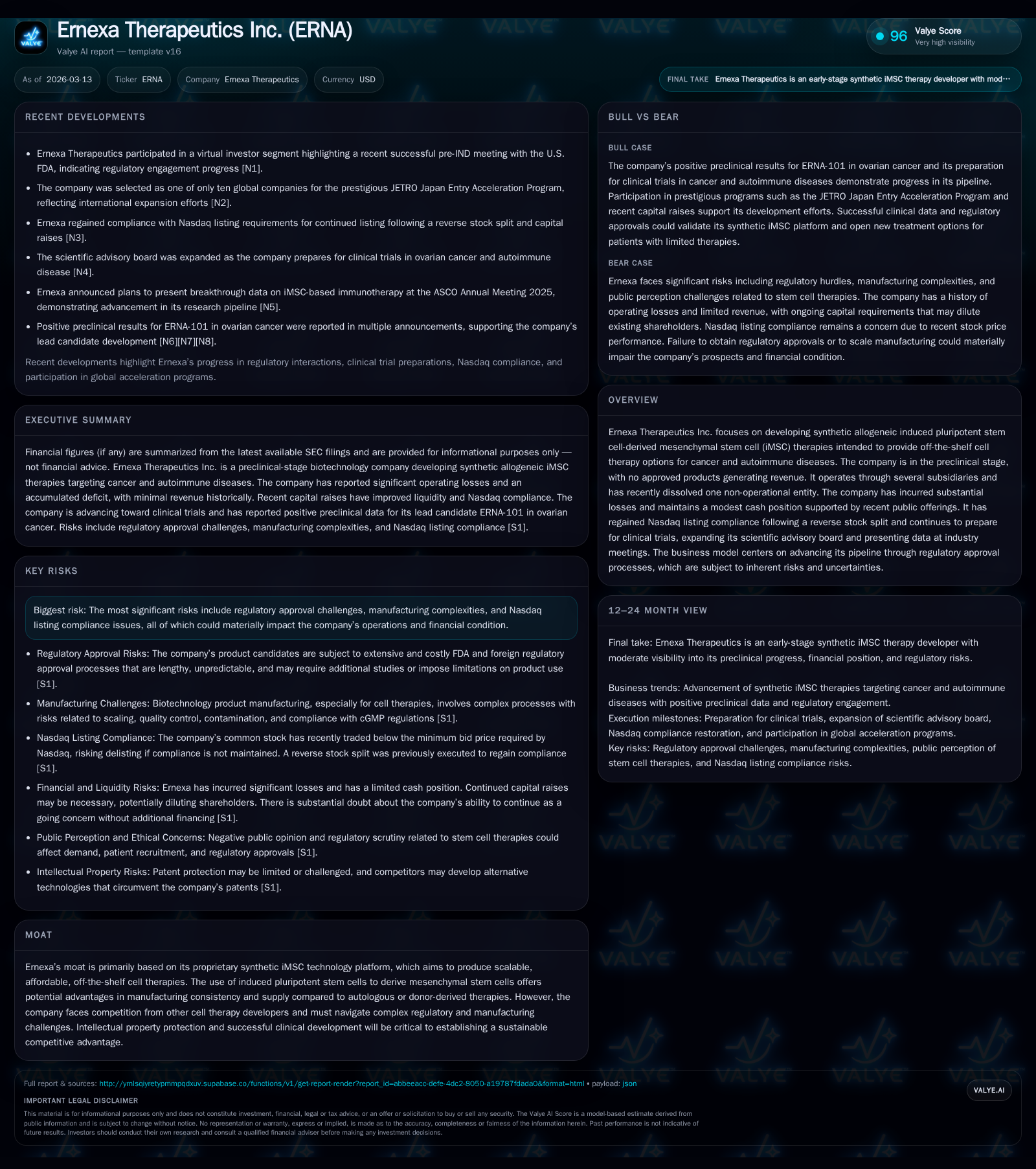
Ernexa Therapeutics Inc. harnesses its proprietary synthetic induced pluripotent stem cell-derived mesenchymal stem cell (iMSC) platform to develop off-the-shelf treatments targeting cancer and autoimmune disorders. Despite operating preclinically with no revenue growth over recent years, the company has narrowed operating losses and improved cash flow metrics, supported by multiple equity financings including a $10.5 million raise in early 2026. Crucial near-term catalysts center on FDA interactions, Phase 1 trial readiness, and navigating manufacturing complexities under cGMP standards. Risks persist around regulatory approval, manufacturing scale-up, and intellectual property protection amid a competitive cell therapy landscape.
Tracing Ernexa’s Revenue and Loss Trajectory Through Early Development Stages
Ernexa Therapeutics operates at the frontier of synthetic allogeneic cell therapy but remains firmly in the preclinical development phase. This status is reflected clearly in its financials where revenue stood flat at approximately $582,000 in both fiscal years 2024 and 2023, coming off a notably lower figure of $68,000 in 2023 [F1]. The source of this revenue is limited and non-recurring given the absence of approved products or ongoing commercial contracts.
Despite stagnant top-line growth, Ernexa has successfully reduced its operating loss by over 40% from -$15.7 million in FY2024 to -$9.3 million in FY2025 [F1]. This tightening burn rate signals management’s active efforts at cost optimization as the company channels resources into focused R&D rather than broad operational scaling prematurely. Net income also improved significantly, narrowing loss by nearly 70% year-over-year to -$14.1 million [F1]. Notwithstanding these improvements, the company's return on equity remains deeply negative at around -587%, typical of high-burn preclinical biotech firms [F1].
Historical performance (annual)
| FY | Rev ($) | Net ($mm) | CFO ($mm) | OpInc ($mm) | Rev YoY | Net YoY |
|---|---|---|---|---|---|---|
| 2025 | 582000 | -14 | -7 | -9 | 0.0% | +68.4% |
| 2024 | 582000 | -45 | -16 | -16 | +755.9% | -105.6% |
| 2023 | 68000 | -22 | -20 | -21 | +11.8% | |
| 2022 | -25 | -21 | -33 |
Source: SEC companyfacts cache [F1].
Capital returns and efficiency (annual)
| FY | FCF ($mm) | ROE% |
|---|---|---|
| 2025 | -7 | -586.6 |
| 2024 | -16 | -2618.4 |
| 2023 | -20 | -970.4 |
| 2022 | -21 | -203.0 |
Source: SEC companyfacts cache [F1].
Financial data reflect the years ended December 31 per [F1]
Synthetic iMSC Platform: Technology Advantages and Industry Positioning
Ernexa's core technological moat lies in its proprietary synthetic allogeneic platform producing induced pluripotent stem cell-derived mesenchymal stem cells (iMSCs). Unlike autologous therapies which require harvesting and reprocessing a patient’s own cells—incurring variability and high costs—the synthetic iMSC approach allows for standardized 'off-the-shelf' cell products manufactured at scale under controlled conditions [S1]. This enables potentially greater batch-to-batch consistency critical for cGMP-compliant commercialization.
The advantage of an induced pluripotent stem cell source permits infinite expansion and differentiation without relying on donor variability or logistical complexity inherent to primary MSCs sourced directly from patients or donors. However, this nascent field faces intense competition from other cellular therapy developers also working on scalable allogeneic solutions [S1]. Regulatory expectations involving rigorous validation of manufacturing processes represent a significant hurdle; companies must demonstrate immunological safety and consistent therapeutic activity across production lots under current Good Manufacturing Practices.
Ernexa’s efforts to protect intellectual property surrounding its synthetic biology techniques will be central to maintaining defensibility against competitors leveraging similar iPSC-based methods [S6]. The scalable nature combined with the ability to engineer functional attributes into these synthetic MSCs situates Ernexa strategically among emerging players focusing on next-generation regenerative medicine for oncology and autoimmunity indications.
Interpreting FDA Interaction and Clinical Trial Preparations
A notable milestone underpinning near-term value inflection was Ernexa's successful pre-Investigational New Drug (pre-IND) meeting with the U.S. Food & Drug Administration disclosed in February 2026 [N1][S3]. This interaction serves as a critical regulatory checkpoint enabling alignment on clinical protocol design elements required before submitting formal IND applications to initiate human trials.
The company has concurrently strengthened its scientific advisory board by recruiting experts specialized in translational cell therapy development—a move aimed at bolstering clinical readiness for the impending Phase 1 study of ERNA-101 [N1][S3]. These preparatory activities indicate that Ernexa is transitioning from discovery-driven research toward regulated clinical validation.
The data from the first patient cohort are not only pivotal clinically but also trigger exercise windows for milestone warrants introduced during recent financing rounds—a factor that influences both capital planning and shareholder value considerations [S1]. Any delay or unfavorable FDA feedback could cascade into extended timelines affecting operational runway.
Capital Structure Evolution: Recent Financings and Cash Position Analysis
To sustain operations amid significant R&D expenditures without product-generated revenues, Ernexa has relied on equity financings. The latest public offering closed in February 2026 yielded approximately $10.5 million gross proceeds from issuing roughly 19 million common shares paired with 'milestone warrants' exercisable upon clinical data readouts [S1][S14][S22].
This transaction included placement agent fees totaling about $0.5 million plus legal expense reimbursements of $125,000 paid upfront; also issued were close to 200,000 agent compensation shares representing roughly 1.5% of sold units [S1]. The funded cash infusion boosts mid-2025 cash reserves estimated at around $4.3 million per latest disclosures [F1].
Despite this injection, liquidity remains tight—with current assets barely exceeding liabilities resulting in a current ratio near parity at about 1.01—reflecting limited buffer for operational contingencies [F1]. Ownership dilution pressures stem both from common stock issuance alongside relatively complex warrant structures capped by expiration terms linked to clinical milestones that could impact stock float dynamics during future capital raises.
Operational Spend and Research Intensity: Insights from R&D and Capex Trends
R&D remains Ernexa's dominant expenditure category reflective of its developmental stage; spending totaled approximately $4.2 million in FY2025 down modestly from prior years which indicates disciplined prioritization within ongoing programs [S18][F1][S29]. Licensing and study fees comprise material components signaling paid access to technological platforms as well as advancing experimental therapies through required toxicology studies.
Capex outlays have sharply contracted year-over-year dropping about 90% to a nominal $37,000 consistent with little expansion in fixed assets typical for small biotechs focused on preclinical pipelines [F1]. Meanwhile operating cash flow improved significantly but remains negative near $7 million annually highlighting steady consumption of investor funds ahead of any product commercialization prospects [F1][S18].
General & administrative expenses show efficiencies gained especially related to occupancy costs following facility adjustments executed throughout FY2025 [S18]. Nevertheless professional fees remain material as outside counsel is necessary to manage licensing negotiations alongside regulatory submissions.
Risks Ahead: Regulatory, Manufacturing Complexity, and Intellectual Property Guardrails
Ernexa operates within a well-known high-risk domain where the regulatory environment presents multiple obstacles from initial cGMP validation for clinical-grade product manufacturing through marketing approval pathways overseen by FDA and equivalent international bodies [S4][S5].[S6] Manufacturing challenges specific to biologics impact scalability due to raw material sourcing difficulties and process variation risks requiring extensive validation cycles before commercial launch.[S1]
Public perception risks tied to ethical debate over stem cell technologies coupled with healthcare reform measures that may constrain drug pricing add layers of uncertainty around commercial viability.[S8][S9] Intellectual property risks constitute another sizable threat vector where patent disputes or failure to secure broad protection could erode competitive positioning or force costly licensing arrangements restricting freedom-to-operate.[S6][S20]
Failure to manage these intersecting risk areas may delay clinical timelines or increase capital requirements materially impacting shareholder value.[S12][S13]
What to Watch Next: Clinical Milestones, Capital Raises, and Nasdaq Compliance
Key upcoming events focus squarely on successful commencement of Phase 1 trials for ERNA-101 following the recent FDA engagement.[N1] The timing of initial cohort data release also activates milestone warrant exercisability with attendant capital implications outlined during February’s securities offering.[S1]
Given current cash runway constraints even post-February financing net proceeds,[F1][S14] additional capital raises might become necessary within the next twelve months contingent on clinical progress speed and regulatory feedback.[S16] Maintaining Nasdaq listing compliance remains essential after a reverse stock split was implemented during mid-2025 addressing previous delisting threats.[S22]
Investors should monitor announcements related to IND filings progress updates alongside capital structure changes driven by warrant exercises or new equity sales that can materially influence share dilution profiles.[N1][S3]
Evaluating Capital Allocation: Dividends, Preferred Stock, and Buyback Absence
Ernexa does not distribute dividends on common stock aligning with industry norms of reinvesting scarce cash into R&D until later-stage development or commercialization achievements justify returns.[S7]
However it maintains Series A Cumulative Convertible Preferred Stock incurring a fixed annual dividend obligation of $0.10 per share payable semi-annually either via cash or common shares issued in kind.[S7] Dividend payments have been partially made by issuing approximately 7,000 common shares recently reflecting tight liquidity.
There have been no share repurchase programs executed through recent fiscal periods evidencing prudent conservation of capital given continued operating losses and investment needs.[S7]
This conservative allocation strategy underscores management focus on extending operational runway pending crucial proof-of-concept milestones which ultimately enable access to more diversified funding sources if validated therapeutics emerge.
This analysis synthesizes publicly available SEC filings dated through March 13, 2026 ([F1], [S#]) combined with verified corporate news releases ([N#]). It endeavors to present factual historical context without forward-looking forecasts beyond explicitly stated company guidance or milestone announcements.
Disclaimer: This is research-only, informational analysis and not investment advice. It may include AI-generated interpretation and general industry context. Always verify important details using primary sources.

Comments