
Ernexa Therapeutics: Advancing Synthetic iMSC Therapies Amid Regulatory and Capital Pressures
Ernexa Therapeutics is pushing its synthetic allogeneic iMSC platform toward clinical validation, with ERNA-101 targeting cancer and a pivotal IND filing expected in late 2026. As the company navigates regulatory milestones and expands its scientific advisory board, it must contend with manufacturing, capital, and operational constraints typical of early-stage biotech, while maintaining Nasdaq listing compliance.
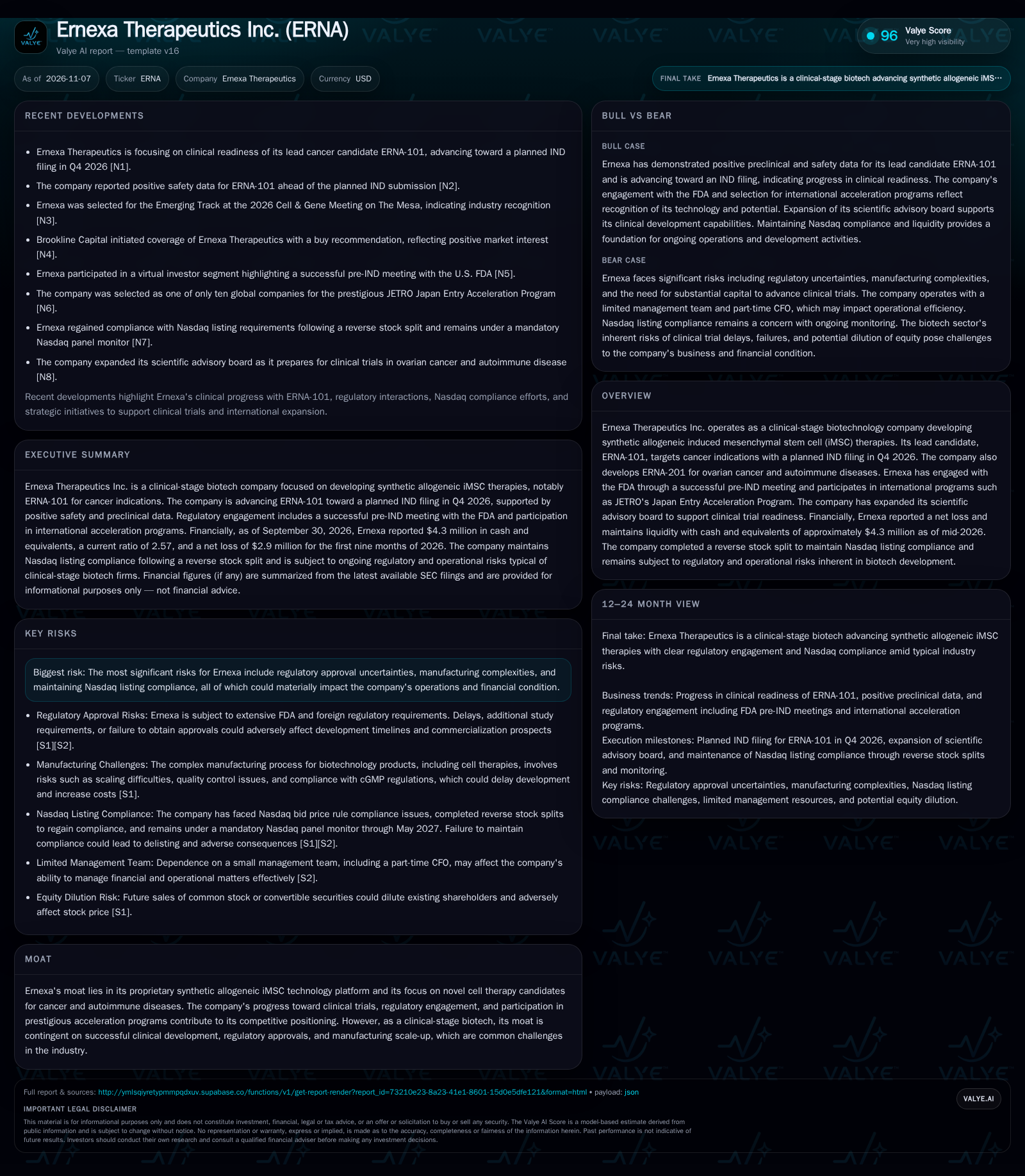
Ernexa Therapeutics is preparing for a Q4 2026 IND filing of its lead synthetic iMSC cancer candidate, ERNA-101, following positive preclinical data and a successful FDA pre-IND meeting. The company has expanded its scientific advisory board and regained Nasdaq compliance, but faces persistent risks around regulatory approval, manufacturing scale-up, and capital sufficiency as it transitions toward clinical development. [N1] [N2] [N7] [N8] [S2]
Ernexa Therapeutics is approaching a critical transition from preclinical discovery to early-stage clinical development, with its synthetic allogeneic iMSC platform positioned at the intersection of cell therapy innovation and capital market scrutiny. The next 12–18 months will be defined by Ernexa’s ability to secure regulatory clearances, sustain investor confidence, and demonstrate translational relevance for its cell therapy candidates. [N1] [N2] [N7] [N8] [S2]
Clinical Milestones and Financial Position Set the Stage for Ernexa’s Next Phase
Ernexa Therapeutics is advancing its lead candidate, ERNA-101, toward a planned Investigational New Drug (IND) filing in Q4 2026, following a successful pre-IND meeting with the FDA. This regulatory engagement signals tangible movement toward first-in-human studies—a critical inflection for any clinical-stage biotech. The company has also reported positive preclinical data for ERNA-201, expanding its pipeline into ovarian cancer and autoimmune indications. Financially, Ernexa reported $4.3 million in cash and equivalents as of September 30, 2026, and a net loss of $2.9 million for the first nine months of the year. The company completed a 1-for-25 reverse stock split in May 2026 to maintain Nasdaq listing compliance, and as of September 30, remained under a mandatory Nasdaq panel monitor through May 2027. The expansion of the scientific advisory board further indicates an operational pivot toward clinical readiness. [N1] [N2] [N7] [N8] [S2]
The Economics of Synthetic Allogeneic Cell Therapy: Capital Intensity and Scalability Questions
Ernexa’s business model is predicated on the successful clinical development and eventual commercialization of synthetic allogeneic induced mesenchymal stem cell (iMSC) therapies. The economics of such a platform are inherently capital intensive, with high upfront R&D and regulatory costs, low near-term revenue, and a long path to potential cash flows. Once in the clinic, unit economics could benefit from the scalability of allogeneic (off-the-shelf) cell products compared to autologous approaches, as a single batch can serve multiple patients. However, manufacturing scale-up introduces significant fixed costs, including cGMP facility requirements, quality control, and regulatory compliance. Variable costs—such as raw materials and labor—may be manageable at scale, but only after successful clinical validation and regulatory approval. Until then, the company is likely to incur recurring operating losses and will need to access additional equity or partnership capital to fund successive clinical phases. The company reported cash and liquidity metrics for the period; these figures do not by themselves establish operating runway, investment capacity, financial flexibility, or financing capacity. [S2]
Proprietary iMSC Platform: Differentiation Versus the Realities of the Cell Therapy Race
Ernexa’s proprietary synthetic allogeneic iMSC platform targets oncology and autoimmune indications—fields crowded with both emerging and established cell therapy developers. The theoretical competitive edge lies in the scalability and potential immunomodulatory advantages of synthetic allogeneic iMSCs, which could offer manufacturing and clinical deployment benefits over autologous therapies or small-molecule competitors. However, the competitive landscape includes large pharmaceutical companies, specialty biotech firms, and academic spinouts with deep pipelines and established clinical infrastructure. Barriers to entry are high, but so is the risk of technological obsolescence or clinical setbacks. If Ernexa’s candidates demonstrate meaningful clinical signals and safety in early trials, the company could position itself as a partner or acquisition target. Conversely, failure to differentiate on efficacy, safety, or cost could relegate the platform to a crowded field with limited pricing power or commercial prospects. The company’s international recognition—such as selection for the JETRO Japan Entry Acceleration Program—suggests some external validation, but the ultimate competitive position will be determined by clinical and regulatory milestones. [N6] [N8]
What Clinical Validation Could Unlock: From IND to Strategic Interest
In a favorable scenario, Ernexa’s ERNA-101 demonstrates safety and preliminary efficacy in early-phase oncology trials following a timely IND clearance in late 2026. Positive clinical signals would not only validate the synthetic iMSC approach but could also attract strategic partnerships or licensing interest from larger biopharma players seeking to expand their cell therapy portfolios. This could lead to non-dilutive funding, milestone payments, or even acquisition interest, dramatically improving Ernexa’s capital position and de-risking future development. Expansion of the pipeline (ERNA-201) into additional indications would provide further optionality and diversify risk. What would confirm this scenario is evidence of successful IND clearance, initiation of clinical trials, partnerships or collaborations with established biotech/pharma companies, and sustained regulatory progress. Falsification would come from clinical holds, adverse safety signals, or failure to secure follow-on funding after early data.
Translational Progress, Capital Constraints, and the Slow March to Clinical Proof
The most likely outcome is that Ernexa achieves its near-term milestone of an IND filing for ERNA-101 in Q4 2026, with first patient dosing potentially occurring in 2027. Manufacturing and regulatory hurdles may extend timelines, and dilution risk remains elevated absent significant non-dilutive capital inflows. Clinical data, if positive, may be incremental at this stage, with commercial prospects several years away. This scenario would be confirmed by timely IND submission, announcements of new financing, and incremental clinical progress. It would be challenged by delays in regulatory filings, inability to raise additional capital, or turnover among key scientific or management personnel.
Regulatory, Financial, or Operational Setbacks Could Derail Momentum
The primary adverse scenario involves delays or failures in regulatory milestones—such as a clinical hold on the IND, requests for additional preclinical data, or manufacturing quality issues—that push back clinical timelines and erode investor confidence. With only $4.3 million in cash as of September 2026 and ongoing losses, a setback could force Ernexa to pursue capital raises under distressed conditions, compounding dilution or risking Nasdaq delisting if the share price deteriorates. Operationally, the company’s reliance on a limited management team and part-time CFO could exacerbate execution risks, particularly if key personnel depart or if the organization is unable to meet the demands of clinical trial initiation. This scenario would be confirmed by negative regulatory news, inability to close financing, or announcements of operational disruptions. It would be challenged if Ernexa secures additional funding, maintains regulatory momentum, or brings in experienced operational leadership.
Milestones and Metrics That Will Define Ernexa’s Trajectory
Progress and outcome of the planned IND filing for ERNA-101 in Q4 2026, including FDA feedback and any clinical holds.
Initiation and enrollment of first-in-human trials for ERNA-101, if disclosed, and early clinical safety/efficacy readouts.
Manufacturing readiness, including cGMP compliance status and ability to scale production for clinical trial supply.
Retention and expansion of the management team and scientific advisory board, with any changes in key personnel.
Nasdaq listing status, including compliance updates and the outcome of panel monitoring through May 2027.
Expansion or advancement of the ERNA-201 pipeline and any additional preclinical or clinical data disclosures.
Evidence of strategic interest, such as partnership announcements, licensing deals, or inbound acquisition inquiries.
Disclaimer: This is research-only, informational analysis and not investment advice. It may include AI-generated interpretation and general industry context. Always verify important details using primary sources.

Comments