
Myriad Genetics After the Prenatal Sale: Strategic Refocus, Revenue Gaps, and the Test for Sustainable Growth
Myriad Genetics’ $210 million Prenatal Health divestiture marks a pivotal shift, freeing capital but exposing the company to revenue loss, operational complexities, and renewed competitive pressures. The next phase hinges on execution in cancer diagnostics, margin discipline, and proof that innovation can outpace market headwinds.
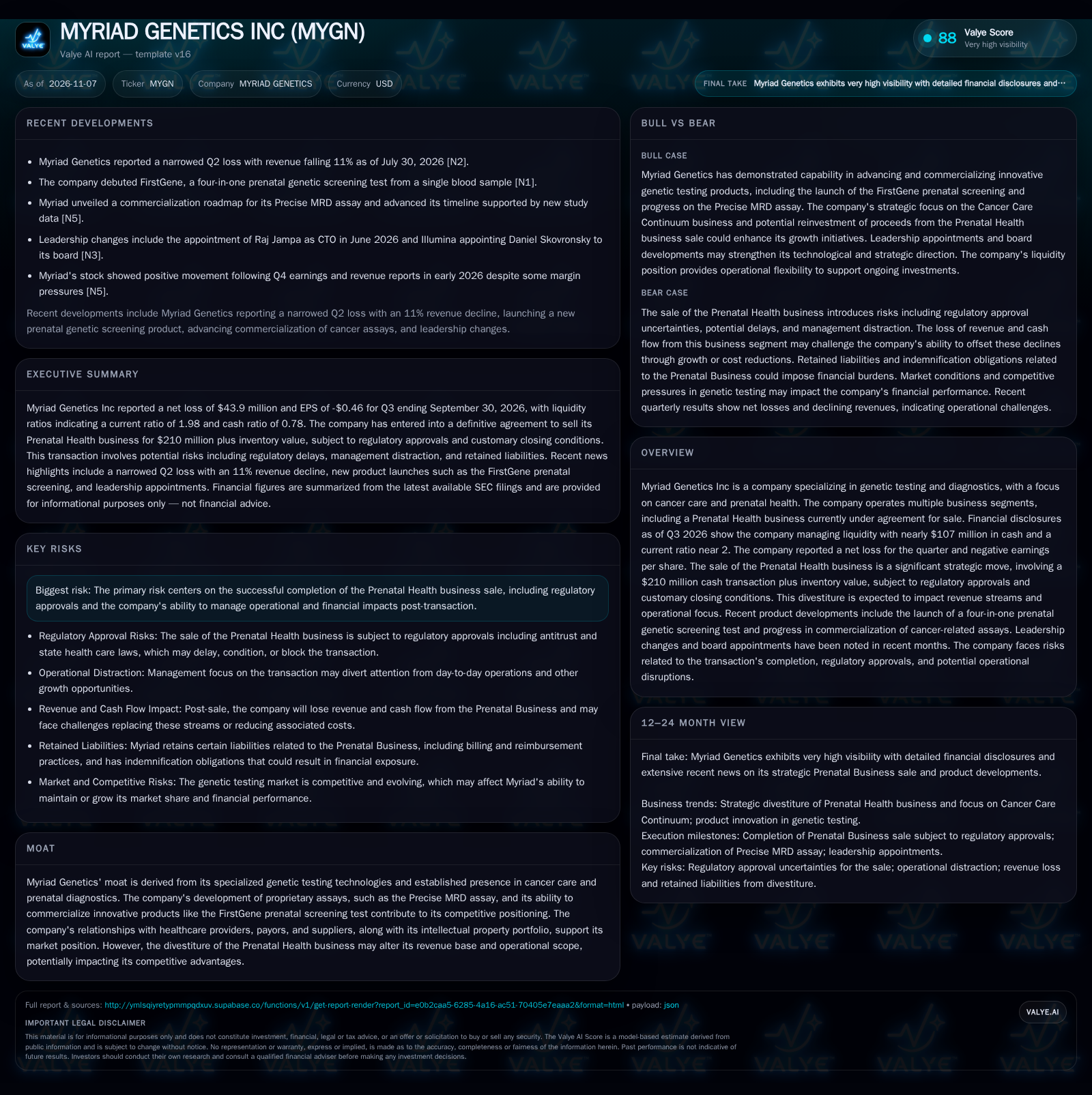
Myriad Genetics is selling its Prenatal Health business for $210 million, a move that will reshape its revenue base and operational focus. While the deal boosts cash, it removes a significant income stream and introduces new liabilities and transition costs. The company’s future now rests on its ability to drive growth from cancer diagnostics, manage retained risks, and leverage new product innovations like the Precise MRD assay. Regulatory approvals, cost alignment, and successful reinvestment will be critical to validating this strategic pivot. [S2]
Myriad Genetics’ decision to divest its Prenatal Health business for $210 million signals a high-stakes strategic transformation. This move will provide a substantial cash infusion but at the cost of a major revenue source, shifting operational focus squarely onto the Cancer Care Continuum and new product launches. The company faces the challenge of filling the impending revenue gap, restructuring its cost base, and proving that its innovations—such as the Precise MRD assay—can drive sustainable growth. Regulatory hurdles, retained liabilities, and the risk of operational distraction add layers of complexity, making the next 12–24 months a critical proving ground for Myriad’s future as a focused diagnostics leader.
Why the Prenatal Health Sale Reshapes Myriad’s Risk–Reward Equation
Myriad Genetics has entered a definitive agreement to sell its Prenatal Health business to Laboratory Corporation of America for $210 million in cash plus inventory, pending regulatory approvals that include Hart-Scott-Rodino antitrust clearance and state health care law reviews. This transaction introduces a fundamental shift: the company will no longer receive revenue or cash flow from the Prenatal Health segment, which has been a core part of its business mix. At the same time, Myriad will retain certain pre-closing liabilities—particularly related to billing and reimbursement practices—and is obligated to provide transition services post-sale. The company reported cash and liquidity metrics for the period; these figures do not by themselves establish operating runway, investment capacity, financial flexibility, or financing capacity. The fate of the deal remains subject to regulatory delays or even blocking, and if approvals are not obtained, a $10.5 million termination fee may be payable to Myriad. [S2]
Revenue Rebuild, Cost Structure, and the Economics of a Focused Portfolio
The sale of the Prenatal Health business creates a discontinuity in Myriad’s revenue and margin profile. The company must now contend with the loss of a significant income stream while still covering corporate overhead, transition service costs, and any retained liabilities. Unless costs are tightly aligned with the new, smaller revenue base, margin compression or ongoing losses are likely.
The commercial mechanics of Myriad’s remaining business—particularly in cancer diagnostics—typically involve a mix of test reimbursement by payors, negotiated provider contracts, and, in some products, out-of-pocket payments by patients. Pricing power is often constrained by reimbursement schedules and competitive alternatives, while volume growth depends on adoption by clinicians and integration into clinical guidelines. The launch of new assays like Precise MRD could improve average revenue per test if adoption is strong, but the associated R&D and commercialization costs are front-loaded, making near-term operating leverage elusive without substantial uptake. Capital needs in diagnostics are generally moderate compared to therapeutics, but commercial success still relies on ongoing investment in clinical studies, payer negotiations, and salesforce productivity. [S2] [N5]
Strategic Positioning Amid Intensifying Diagnostics Competition
Post-divestiture, Myriad’s focus on oncology and specialty diagnostics places it squarely in competition with established genetic testing companies, large reference labs, and emerging precision medicine platforms. Its moat has historically rested on proprietary assays, clinical integration, and payer relationships, but the loss of the Prenatal segment reduces business diversification and could expose Myriad to more concentrated reimbursement and innovation risks. The company’s ability to maintain or expand its competitive position will rely on the perceived clinical utility and differentiation of new offerings like FirstGene and Precise MRD, as well as its ability to convert recent study data into real-world adoption.
Switching costs for providers and health systems are moderate, as genetic testing platforms are often evaluated on accuracy, turnaround time, and payer coverage. Rapid innovation cycles and the entry of new competitors—especially those leveraging AI or broader multi-omics platforms—can erode pricing and share. Strategic reinvestment and operational discipline will be required for Myriad to defend its position and capitalize on any first-mover advantages in new assay categories. [S2] [N5]
If Cancer Diagnostics Growth and New Product Adoption Surpass Expectations
In a favorable scenario, Myriad successfully closes the Prenatal Health sale on schedule, deploys the proceeds into high-impact R&D and targeted commercial expansion, and rapidly scales its cancer diagnostics business. The Precise MRD assay, supported by compelling new study data, gains traction with oncologists and payors, leading to above-market volume growth and improved pricing. Cost structure is realigned quickly to the new business scale, preserving or even expanding margins. The transition services agreement with the buyer is executed smoothly, minimizing operational disruption.
Confirmation of this scenario would come from sequential revenue stabilization or growth in the core oncology business, expanding gross margins, and robust adoption metrics for new assays. Regulatory approval of the transaction without major delay or penalty, and evidence of successful cost reduction or operating leverage, would further validate the bull case. [S2] [N5]
Realistic Outcomes: Revenue Gap, Cost Pressure, and Incremental Progress
The most plausible outcome is that the Prenatal Health sale closes with moderate regulatory delay, and Myriad experiences a near-term revenue decline that is only partially offset by cancer diagnostics growth. Cost reductions lag the pace of revenue loss, resulting in continued net losses or margin compression for several quarters. The company uses some proceeds for R&D and commercial support, but faces headwinds from payer pushback and slow uptake of new assays.
Evidence supporting this scenario would include continued quarterly net losses, only gradual improvement in gross margins, and modest revenue growth in the Cancer Care Continuum segment. Any operational hiccups in transition services or unexpected retained liabilities would reinforce the challenges of this base case. [S2] [N5]
How Delays, Disruption, or Underwhelming Innovation Could Compound Losses
In an adverse scenario, regulatory clearance for the Prenatal Health sale is delayed or denied, resulting in a failed transaction and the requirement for Myriad to pay the $10.5 million termination fee. Management distraction and transition resource drain impair execution in the core business, while legacy liabilities or indemnification claims from the Prenatal segment generate unexpected financial outflows. Meanwhile, new product launches underperform, with slow adoption of the Precise MRD assay and stagnation in cancer diagnostics revenue.
Confirmation of this scenario would be a material miss on revenue or margin guidance, increased SG&A or legal costs, and further widening of net losses. A failed deal or major regulatory setback, coupled with negative adoption trends for new assays, would signal that the thesis of a successful strategic pivot is not playing out. [S2]
What Will Prove Whether Myriad’s Strategic Pivot Is Working?
Quarterly revenue trends in the Cancer Care Continuum segment, as the main driver of post-sale growth. [S2]
Gross margin progression, especially as cost structure is realigned to the new revenue base. [S2]
Regulatory milestones and timing for closing the Prenatal Health sale, including any delays or conditions. [S2]
Net cash position and use of sale proceeds, particularly R&D and commercial investments versus retained liabilities. [S2]
Adoption rates and payer coverage for new assays such as Precise MRD and FirstGene—if disclosed.
Transition services costs and operational disruptions during the handoff to the buyer. [S2]
Material indemnification claims or legacy liability outflows related to the Prenatal business—if disclosed.
Leadership stability and management bandwidth to execute core business objectives during and after the transaction.
Disclaimer: This is research-only, informational analysis and not investment advice. It may include AI-generated interpretation and general industry context. Always verify important details using primary sources.

Comments