
Terra Property Trust: Navigating Middle Market CRE Credit with Portfolio Diversification and Liquidity Uncertainty
Terra Property Trust operates in the competitive and cyclical middle market commercial real estate credit space, leveraging conservative underwriting and portfolio diversification.
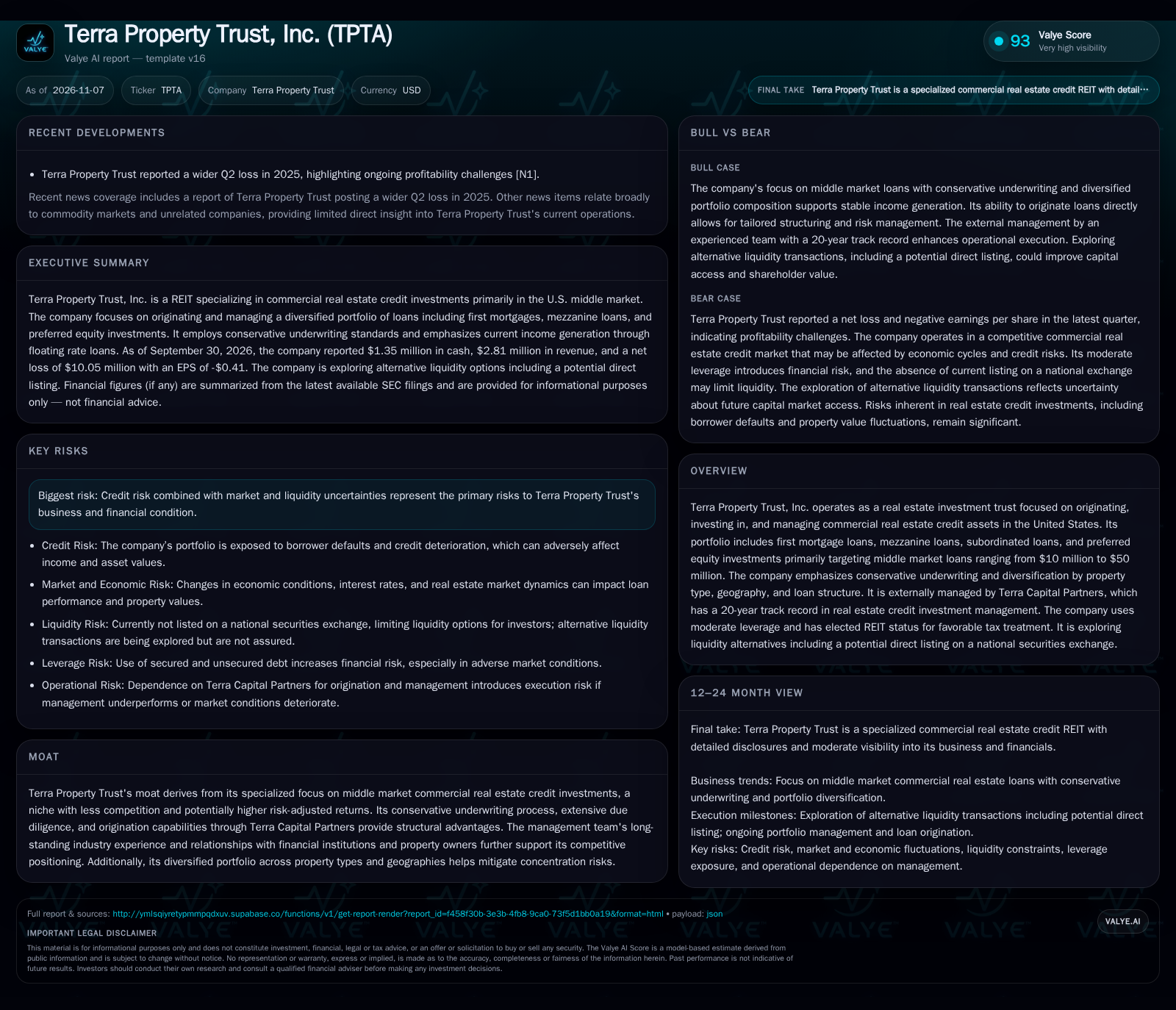
Terra Property Trust, a REIT specializing in U.S. middle market commercial real estate credit, reported a $10.05 million net loss on $2.81 million in revenue as of September 30, 2026, and is exploring direct listing or other liquidity alternatives. Its diversified portfolio spans first mortgages, mezzanine, and preferred equity, but persistent losses and limited cash underscore the importance of credit performance, market stability, and successful execution of liquidity plans. The company's externally managed structure and moderate leverage add both operational strengths and risk factors to watch going forward. [S1] [S2]
Terra Property Trust, Inc. sits at the intersection of opportunity and risk in commercial real estate credit, focusing on the underserved U.S. middle market with a diversified CRE loan portfolio. Despite its disciplined underwriting and experienced management, the company faces mounting profitability pressures, reported cash balance, and the need to clarify its long-term liquidity pathway. As it weighs options like a direct listing or business combination, Terra’s ability to navigate credit cycles, manage leverage, and deliver consistent income streams will determine its capacity to create durable shareholder value in an evolving real estate and capital markets environment.
Wider Net Loss and Liquidity Exploration Reshape the Near-Term Thesis
Terra Property Trust reported a net loss of $10.05 million on $2.81 million in revenue for the quarter ended September 30, 2026, with cash and equivalents totaling just $1.35 million [S2]. This marks a continuation of profitability challenges and heightens scrutiny on both expense discipline and loan performance. The company remains unlisted on a national exchange and is actively exploring alternative liquidity transactions, including a potential direct listing, share repurchases, liquidation, sale, or strategic combinations [S1]. Portfolio composition as of December 31, 2025, was split among first mortgages (44.9%), mezzanine loans (12.8%), and preferred equity (42.2%) [S1]. Moderate leverage is in place, with $118.8 million in unsecured notes and $62 million in secured financing outstanding at year-end 2025 [S1]. These facts signal a business at a crossroads—balancing a diversified portfolio strategy against persistent losses and the urgent need for a viable liquidity event.
Income Streams, Leverage, and the Volatility of CRE Credit Economics
Terra Property Trust’s business model is predicated on originating and holding a diversified mix of commercial real estate loans and preferred equity investments, primarily in the $10–50 million middle market segment [S1]. Revenue is generated through interest income from first mortgages, mezzanine loans, and preferred equity, often structured as floating rate instruments with terms of one to five years [S1]. This floating rate exposure can help mitigate some interest rate risk, but also exposes the company to potential borrower stress if rates rise sharply or if property cash flows weaken.
The fixed cost base is shaped by external management fees (paid to Terra Capital Partners) and interest expense on both secured and unsecured borrowings. With $118.8 million in unsecured notes and $62 million in secured financing as of December 2025, leverage amplifies both upside and downside outcomes [S1]. Operating leverage is further influenced by credit costs: even modest increases in non-performing loans or impairments can quickly erode profitability, as evidenced by the recent net loss [S2].
Capital needs are ongoing, driven by requirements to fund new loans, maintain distributions for REIT status, and service debt. With only $1.35 million in cash as of the latest quarter, the company’s ability to originate new assets or weather further losses is constrained unless a liquidity event materializes or external capital is raised [S2].
Middle Market Niche: Structural Advantages Meet Intense Headwinds
Terra Property Trust’s competitive positioning is rooted in its focus on the middle market CRE credit segment, which often faces less competition from large banks and institutional lenders. This can allow for more attractive risk-adjusted returns and flexible loan structuring. The company’s diversification by property type, location, and loan structure helps mitigate concentration risk, and its external manager, Terra Capital Partners, brings a 20-year track record and established industry relationships [S1].
However, several counterforces weigh on this positioning. The commercial real estate credit market is highly cyclical and sensitive to both macroeconomic conditions and property-specific fundamentals. Rising interest rates, declining property valuations, and increased borrower defaults can rapidly undermine portfolio performance. The company’s moderate leverage amplifies these risks. Additionally, as a smaller, unlisted REIT, Terra may face higher funding costs and less access to attractively priced capital compared to larger, listed peers or non-bank lenders.
Technology-driven lenders, direct lending platforms, and alternative asset managers also compete for middle market deals. The question is whether Terra’s origination relationships, underwriting discipline, and portfolio diversity are sufficient to offset these structural disadvantages in volatile market conditions.
A Successful Liquidity Event and Credit Outperformance Could Reset the Narrative
An upside scenario for Terra Property Trust hinges on two reinforcing dynamics: first, the company executes a successful liquidity transaction—such as a direct listing or strategic combination—that improves access to capital and broadens its investor base; second, credit performance stabilizes or improves, with low defaults and healthy loan repayments supporting steady cash income.
If Terra is able to list on a major exchange or otherwise create secondary market liquidity, this could lower its cost of capital, attract institutional investors, and provide resources to scale its portfolio or repurchase shares at a discount to net asset value. Credit outperformance—evidenced by minimal impairments, high interest collection rates, and robust property-level cash flows—would reinforce the company’s ability to distribute income and comply with REIT requirements.
Evidence supporting this scenario would include a formal announcement of a direct listing or completed liquidity event, a return to positive net income and/or cash flow, increased origination activity, and stable or declining non-performing loan rates. Conversely, delays in liquidity execution or renewed credit deterioration would undermine this path.
Portfolio Diversification Offsets Some Pressure, but Profitability Remains Challenged
The most plausible near-term scenario is one in which Terra Property Trust continues to manage its diversified CRE credit portfolio amid a mixed operating environment, with ongoing profitability challenges but no acute credit crisis. The company may originate new loans selectively, using repayments to recycle capital, while maintaining a cautious approach to risk and leverage.
Without a near-term liquidity event, cash constraints could limit growth and force a focus on portfolio optimization rather than expansion. Interest income may remain stable if credit performance holds, but external management fees and debt service costs could continue to pressure margins. Modest improvements in borrower health or capital markets sentiment could incrementally improve performance, but the company may remain in a holding pattern until a liquidity transaction is consummated.
This scenario would be confirmed by relatively stable quarterly revenue, limited changes in portfolio composition, and continued exploration of liquidity alternatives without a definitive transaction. Material changes in loan impairment rates or a sharp increase in cash reserves would suggest a deviation from this base case.
Credit Deterioration and Delayed Liquidity Could Amplify Losses
The most adverse outcome for Terra Property Trust would involve a combination of worsening credit conditions and failure to execute a liquidity event. Rising borrower defaults, declining property values, or sector-specific shocks (e.g., distress in office or retail segments) could lead to loan impairments, reduced interest income, and further net losses.
If the company is unable to access new capital or complete a direct listing, it may be forced to sell assets at depressed prices or consider more drastic actions such as liquidation. This scenario would likely be accompanied by rising non-performing loan rates, declining net asset value, and possible suspension or reduction of distributions to maintain solvency and REIT status.
Indicators confirming this downside path would include a spike in loan impairments, further declines in cash reserves, missed or reduced distributions, and the absence of progress on strategic alternatives.
Signals That Will Clarify Terra Property Trust’s Path Forward
Announcement or progress toward a direct listing, sale, or other liquidity transaction; timing and structure would materially impact capital access and valuation.
Quarterly net income trends and return to profitability; a sustained improvement would indicate better credit performance and expense control.
Changes in the portfolio’s non-performing loan rate or realized credit losses; rising impairments would signal increased risk to income and capital.
Cash and equivalents balance in future filings; increases would suggest improved liquidity or asset sales, while further declines could constrain flexibility.
New loan origination volume and asset recycling activity; a useful metric would be origination pace relative to repayments and redemptions, if disclosed.
Updates on REIT distribution coverage and compliance; reductions or suspensions would highlight cash flow pressure.
Disclosure of asset sales, portfolio rebalancing, or joint venture initiatives; these actions could reveal management’s approach to managing risk and capital in a constrained environment.
Management commentary on market conditions, borrower health, and credit outlook in filings or communications; qualitative signals would help anticipate asset quality shifts.
Disclaimer: This is research-only, informational analysis and not investment advice. It may include AI-generated interpretation and general industry context. Always verify important details using primary sources.

Comments