
Elite Express Holding’s Growth Under FedEx Reliance Highlights Customer Concentration Risks
Elite Express Holding operates as a last-mile logistics provider almost exclusively for FedEx, leveraging a unique ISP agreement while grappling with operational and financial challenges.
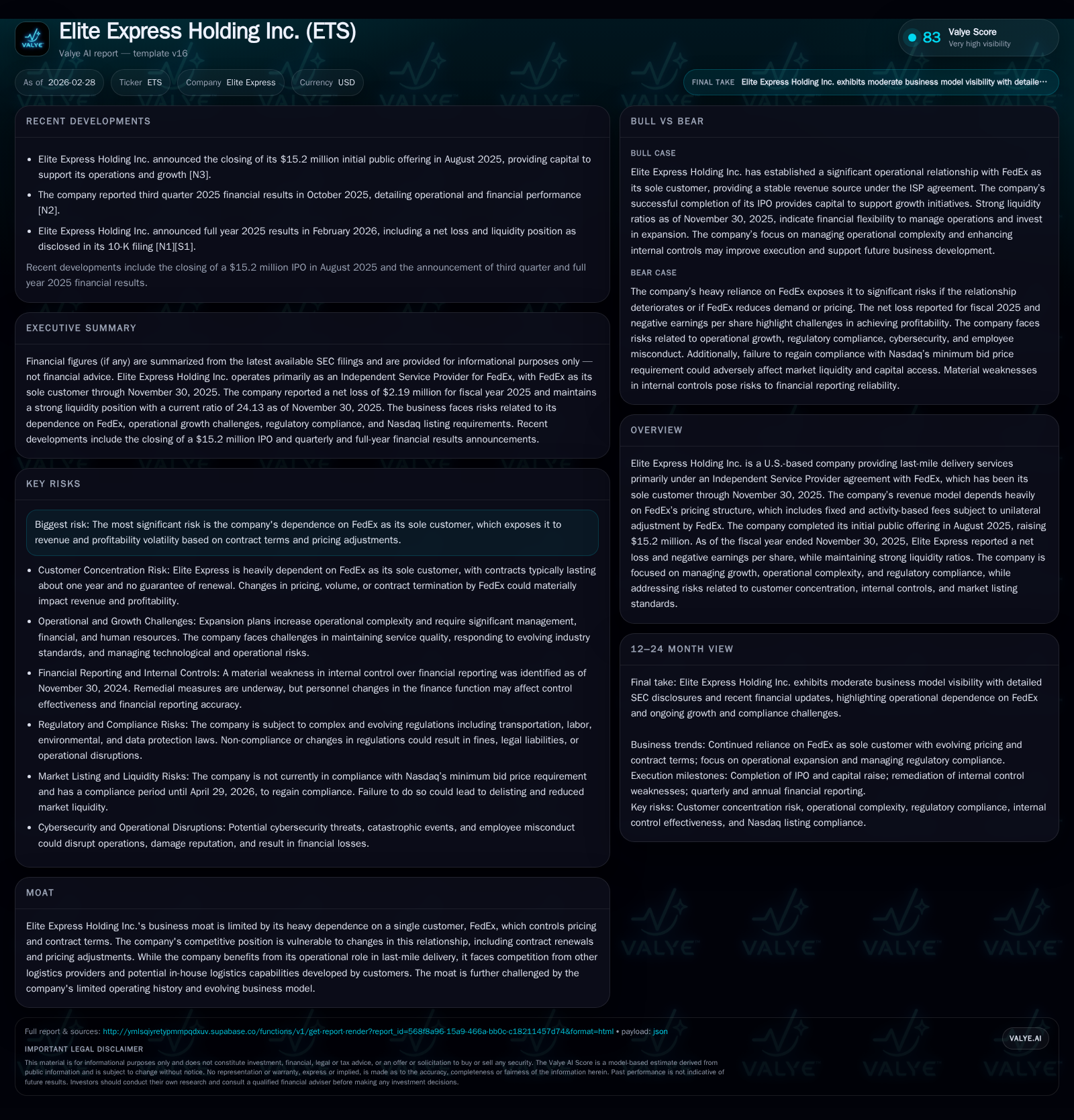
Elite Express Holding Inc. (ETS) is a U.S.-focused last-mile delivery company relying solely on FedEx for revenue under an Independent Service Provider model. Since its IPO in August 2025, ETS has reported net losses rooted in its dependence on FedEx’s pricing discretion and limited contract duration, which impose volatility risks. Despite solid liquidity and current asset positioning, the company faces regulatory compliance, operational complexity, and market competition constraints as it seeks future growth beyond its single-customer footprint. Monitoring contract renewals with FedEx and progress in customer diversification will be key to evaluating ETS’s trajectory.
Business Overview and Historical Performance
Elite Express Holding Inc. (ETS) provides last-mile delivery services primarily under a contractual framework with FedEx acting as its sole customer through November 30, 2025 [S1][S4]. The business model centers on an Independent Service Provider Agreement that outlines both fixed weekly fees and activity-based charges controlled unilaterally by FedEx. These arrangements typically have one-year durations without renewal guarantees or minimum volume commitments [S1]. ETS's initial public offering in August 2025 raised $15.2 million to capitalize on the growing e-commerce logistics sector but the company incurred operating losses during this inaugural full fiscal year [F1][N1].
Financial Summary Table
Historical performance (annual)
| FY |
|---|
| 2025 |
Source: SEC companyfacts cache [F1].
ETS's reported operating loss of approximately $2.5 million alongside a net loss near $2.19 million highlights early-stage scaling challenges under fixed overhead and integration costs [F1]. Cash & equivalents of about $1.3 million combined with a substantial excess of current assets over liabilities yields an exceptionally strong current ratio (~24x), reflecting working capital strength rather than profitability [F1]. Negative free cash flow estimated near $2.9 million signals ongoing investment outlays exceeding operating cash inflows during this period [F1].
Operational Drivers and Risks
ETS's dependence on FedEx for nearly all revenue introduces material concentration risk. Pricing adjustments such as the October 2024 reduction in fixed weekly fees by approximately 10% directly impact revenue streams—dynamics outside ETS’s control [S1][S4]. Contracts typically span about one year with no guaranteed renewal or minimum volume commitments increasing exposure to sudden business disruptions or unfavorable renegotiations [S1].
Revenue recognition relies heavily on data from FedEx systems; limitations in obtaining assurances around these controls present material internal control deficiencies that may affect audit reliability and revenue timing [S22][S25].
The company faces multifaceted regulatory challenges encompassing transportation safety standards, evolving labor laws, cybersecurity threats including ransomware risks, data privacy regulations such as the California Privacy Rights Act, environmental compliance related to vehicle emissions, and other governmental mandates imposing incremental operational costs [S7][S8][S9][S13][S24][S26].
Growth Prospects and Challenges
While ETS expresses intent to diversify its customer base beyond FedEx by targeting other last-mile delivery clients, no definitive agreements had been secured as of early 2026 [S1][N1]. Scaling growth necessitates managing increased organizational complexity including workforce expansion and maintaining consistent service quality amid operational challenges [S11]. Competitive pressures from large logistics entities like Amazon Logistics, DHL, UPS, USPS alongside regional operators intensify demands on pricing strategies and technological innovation adoption [S21][S26].
Capital investments to support expansion depend on improving cash flows or external financing availability—both uncertain given current negative free cash flow trends [F1][S23]. Failure to execute growth strategies effectively or adverse contract developments with FedEx could materially impact financial condition.
Capital Allocation Outlook
As an emerging growth company post-IPO with no dividends declared or share repurchases initiated to date, ETS has allocated capital primarily toward operational scaling and working capital needs [F1][S20]. The negative free cash flow near $2.9 million underscores ongoing investment outflows surpassing operating cash generation [F1]. The approximate return on equity at -16.6% further reflects initial inefficiencies common among companies transitioning to public markets under concentrated customer dependency [F1].
Legal Proceedings and Contingencies
The company is subject to routine legal exposures including workers’ compensation claims related to pre-acquisition employment matters within subsidiaries; indemnification arrangements generally mitigate direct financial impact for ETS management currently deems these immaterial [S14]. Broader litigation risks may increase as company scale expands alongside heightened regulatory scrutiny particularly in labor-related areas [S12][S18].
Competitive Environment and Strategic Positioning
ETS operates primarily within California but competes against national-scale logistics providers such as Amazon Logistics, DHL, UPS, USPS plus regional players leveraging technology like GPS route optimization critical during peak demand periods [S21][S26]. Emerging AI-driven logistics solutions implemented by competitors illustrate innovation risks; ETS acknowledges these factors while incrementally investing in technological improvements within budgetary constraints [S21][S26].
Diversifying beyond sole reliance on FedEx remains a pivotal strategic challenge amid competitive pricing pressures driven by scale economies enjoyed by major rivals.
Conclusion: Metrics To Monitor And Industry Bearings
Key metrics for monitoring moving forward include: (a) outcomes of contract renewals with FedEx including fee structures; (b) progress securing new customers converting revenue dependence into diversified streams; (c) improvement toward positive cash flow reflecting operational leverage; (d) management effectiveness in scaling operations without quality erosion; (e) impacts from evolving regulatory requirements affecting cost structure; alongside overall economic conditions influencing parcel volumes.
ETS exemplifies tradeoffs faced by small-cap delivery providers tightly linked to dominant logistics partners yet aspiring for expansion into fragmented but highly competitive last-mile delivery markets.
This report synthesizes publicly filed information without providing investment recommendations or price opinions. Proprietary analysis is grounded strictly in provided disclosures from Elite Express Holding Inc.'s SEC filings dated February 27, 2026.[N1][S1–S29] Financial figures are from the latest fiscal year ended November 30, 2025 [F1]. Market dynamics context is derived solely for analytical perspective without conjecture on future outcomes.
Disclaimer: This is research-only, informational analysis and not investment advice. It may include AI-generated interpretation and general industry context. Always verify important details using primary sources.

Comments