
EVERTEC Harnesses Network Effect and Service Integration to Power Growth
EVERTEC's expansive transaction processing footprint and integrated service model fuel scalable revenue growth and operational efficiency across Latin America and the Caribbean.
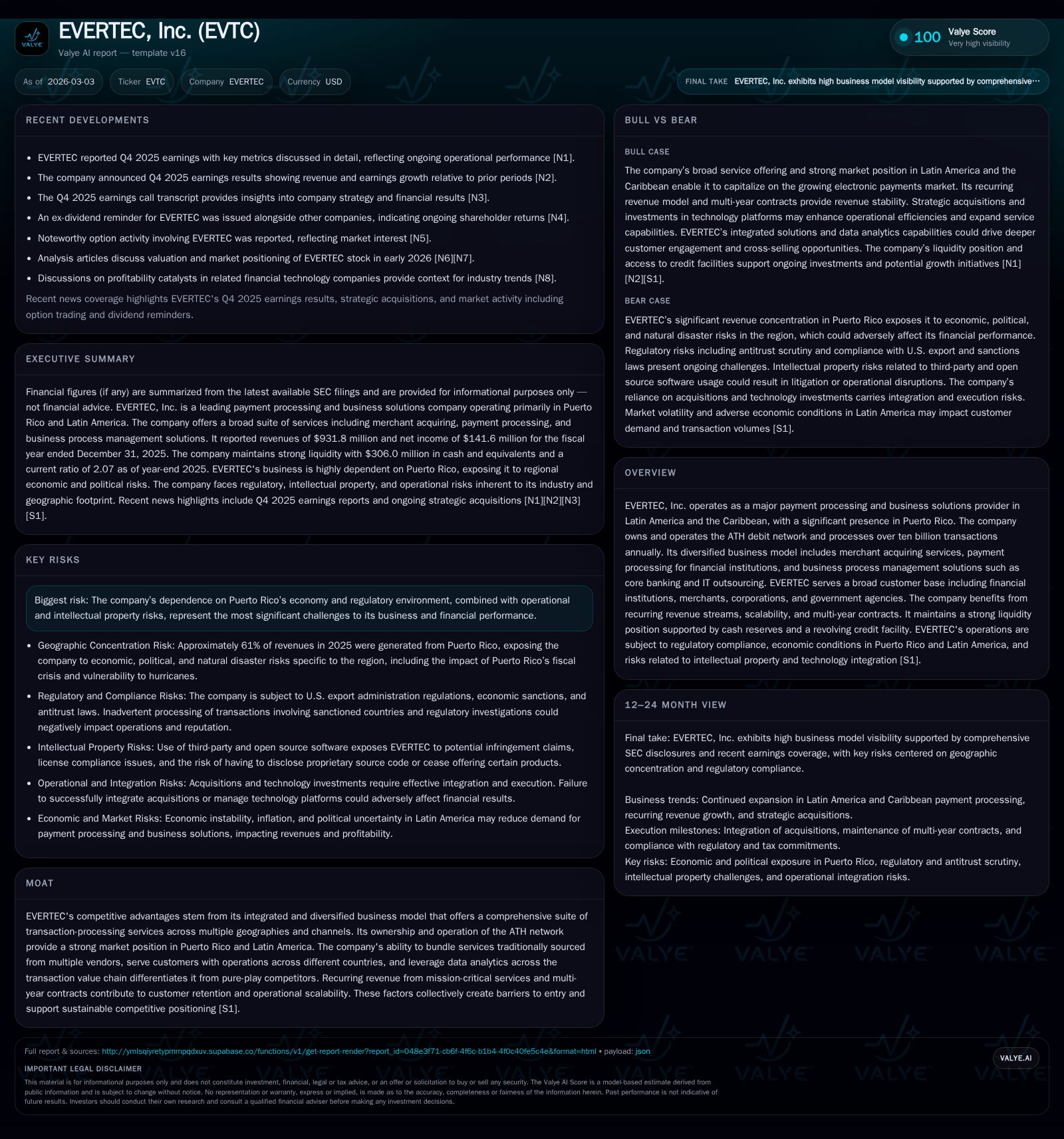
EVERTEC, a leading payment processor in Latin America and the Caribbean, has demonstrated robust financial performance driven by its ownership of the ATH debit network and diversified business segments spanning merchant acquiring, payment processing, and business solutions. Fiscal year 2025 saw an 11.5% revenue increase alongside significant net income growth of 25.7%, supported by scalable recurring revenues and multi-year contracts. The company faces regulatory complexities tied to its geographic concentration, especially in Puerto Rico, but continues to pursue regional expansion. Capital allocation remains disciplined with steady dividends and a $150 million buyback authorization powering shareholder returns while maintaining manageable leverage.
A Broad Transaction-Processing Backbone: EVERTEC’s Historical Performance
EVERTEC’s financial trajectory through fiscal year 2025 illustrates steady expansion reinforced by its large transaction-processing scale across Latin America and the Caribbean. The company reported revenues rising from $1.06 billion in 2024 to approximately $1.18 billion in 2025, representing an 11.5% year-over-year increase fueled primarily by merchant acquiring volume growth and enhanced consulting services execution [F1][N1][S1]. Operating income followed suit with a 12.5% advance to nearly $186 million, underscoring disciplined operating leverage amidst some cost pressures.
Net income posted a marked jump of 25.7% to $141.6 million in FY2025 compared to prior year results—a reflection of margin expansion supported by scalable recurring revenues anchored in mission-critical contracts and integrated offerings [F1]. Despite this positive earnings momentum, operating cash flow saw a modest decline of roughly 12.7% to $227 million driven largely by working capital shifts rather than organic performance deterioration [F1]. Capital expenditure requirements trended slightly lower to an estimated $23 million from the previous level of about $25 million illustrating controlled reinvestment into hardware, software development, and related infrastructure upgrades essential for maintaining competitive technology platforms.
Historical performance (annual)
| FY | Net ($mm) | CFO ($mm) | OpInc ($mm) | Capex ($mm) | Net YoY |
|---|---|---|---|---|---|
| 2025 | 142 | 227 | 186 | 23 | +25.7% |
| 2024 | 113 | 260 | 166 | 25 | +41.3% |
| 2023 | 80 | 224 | 136 | 21 | -66.6% |
| 2022 | 239 | 223 | 157 | 27 |
Source: SEC companyfacts cache [F1].
Capital returns and efficiency (annual)
| FY | Div ($mm) | Buybacks ($mm) | FCF ($mm) |
|---|---|---|---|
| 2025 | 13 | 69 | 204 |
| 2024 | 13 | 82 | 235 |
| 2023 | 13 | 36 | 203 |
| 2022 | 14 | 97 | 196 |
Source: SEC companyfacts cache [F1].
The table displays key annual financial metrics emphasizing strong top-line growth in fiscal year ending December 2025 along with improving profitability metrics consistent with underlying operational scale[F1].
Strategic Drivers Behind Recent Revenue and Profit Growth
Underlying EVERTEC’s fiscal momentum are dynamic forces shaping revenue composition and margin profile. Merchant acquiring revenues increased due to higher point-of-sale transaction volumes, improved spreads, as well as elevated non-transactional fees associated with value-added services [N1][S18]. Business Solutions segment grew moderately via network service enhancements alongside consulting engagements realized during the periods spanning both current and prior years [N2][N3][S18]. These multi-year contracts underpin recurring revenue streams that add visibility.
Counterbalancing these were operational cost headwinds including higher cloud infrastructure expenditure and professional fees linked to strategic initiatives supporting digital transformation endeavors [N2][S5]. Despite adjusted EBITDA contraction in the Business Solutions vertical—down approximately $8.7 million sequentially—the overall enterprise retained strong profitability supported by balanced segment performance.
Management commentary highlighted ongoing investments into analytics capabilities applied across the transaction value chain which differentiate EVERTEC versus pure-play vendors constrained to narrower service scopes such as isolated merchant acquisition or payment processing functions alone [S1]. This integrated approach facilitates customer retention by embedding deeply into client operations across disparate geographies.
The Role of ATH Network Ownership in Building Competitive Moats
A cornerstone competitive advantage is EVERTEC’s ownership and operation of the ATH debit network—Puerto Rico’s premier electronic payment infrastructure accounting for a substantial majority of daily debit transactions locally [S1][S20]. This asset forms the crux of its moat enabling seamless bundling of services ranging from merchant acquiring through back-end clearing settlement processes.
The company’s integrated platform supports front-end capture of both card-present and card-not-present transactions alongside core banking solutions—including asset management, pensions administration—and IT outsourcing managed services enhancing mission-critical reliance among top-tier financial institutions—clients who are less likely to switch providers given the scale and scope involved [S23].
Further differentiation arises from data analytics capabilities embedded within this value chain allowing insights-based monetization opportunities absent for more narrowly focused competitors confined either to acquirer or issuer-side functionalities exclusively.
Regulatory Complexities and Geographic Exposures Shaping Business Risks
Geographically concentrated revenue generation—61% emanating from Puerto Rico—exposes EVERTEC materially to local macroeconomic cycles, regulatory regimes, political considerations, and compliance risks which merit consideration when assessing future stability [S13][S20].
Key regulatory challenges include adherence to anti-bribery rules under the Foreign Corrupt Practices Act (FCPA) alongside export controls governing software/hardware transfers internationally limiting transaction scope in sensitive jurisdictions [S1][S3]. Card association mandates such as Contactless payments necessitate ongoing investments for timely technology adoption; failure could result in penalties or business losses from fraud exposure imposed by networks including Visa or Mastercard.
Payment Card Industry Data Security Standard (PCI DSS) imposes stringent requirements on data security involving storage/transmission of cardholder data imposing compliance costs; lapses here risk fines or expulsion from acceptance programs impacting revenue continuity.
Moreover, investigations pertaining to antitrust compliance arising from market dominance within Puerto Rico heighten reputational risk further complicating operating landscapes domestically while Latin American jurisdictions add additional layers of legal/regulatory nuances restricting flexibility.
Growth Catalysts and Constraints Looking Ahead
Future prospects identified by management emphasize leveraging joint ventures plus acquisitions in fast-growing Latin American locales expanding footprints beyond Puerto Rico’s dominance [N3][S1]. The push into consulting services alongside technology platform enhancements aims at deepening wallet share across client enterprises boasting multi-country presence.
Conversely regulatory uncertainty coupled with macroeconomic volatility—including currency fluctuations affecting cross-border transactions—pose restraint on unabated scaling ambitions particularly regarding investments linked with payment industry structural shifts such as contactless mandates adoption pace.
Investment community focus remains trained on how effectively EVERTEC can balance regional expansion against preserving its lucrative recurring revenue business model entrenched through multi-year contracts without disproportionate increases in capital intensity.
Capital Allocation Strategies: Dividends, Buybacks, and Debt Management
EVERTEC sustains disciplined capital stewardship reflected in regular dividend payments ($0.05 per share quarterly throughout calendar year 2025) complemented by opportunistic share repurchases totaling approximately $69.3 million funded via cash reserves subject to board approval with remaining program authorization near $84 million scheduled through end-2026 [F1][S11].
Debt structure comprises secured term loans totaling roughly $1.1 billion supported by revolving credit capacity close to $200 million with availability exceeding $180 million at end-2025 providing operational liquidity buffers while interest rate swaps hedge variability inherent to floating rate borrowings at favorable spreads commensurate with investment grade profiles [S4][S6][S10].
Covenants enforce leverage ceilings around four times EBITDA levels constraining dividend flexibility but enabling prudent reinvestment options balanced against shareholder return expectations.
Key Financial Metrics: Profitability, Cash Flow, and Returns on Equity
Operational efficiency is illustrated through an approximate return on equity near 22.8% derived from latest fiscal net income relative to shareholder equity nearing $622 million indicating effective capital utilization amidst incremental acquisition spending such as the Tecnobank purchase valued at over $140 million contributing strategic growth assets to the portfolio [F1][S17].
Although operating cash flow experienced a sequential dip (-12.7%), robust free cash flow generation (~$204 million after capital expenditures) comfortably supports dividend payout ratios below historical norms alongside buyback funding without pressuring liquidity reserves or imposing undue leverage stress points (current ratio ~2x indicative of sound short-term solvency) [F1][S8][S9].
Market Expectations and Key Milestones to Watch
While explicit forward guidance remains conservatively framed within official channels absent detailed consensus forecasts owing partly to macro uncertainties, notable market signals include recent technical oversold conditions flagged by analysts underscoring transient investor sentiment dynamics warranting close observation [N6].
Key milestones encompass contracted renewal timelines within client arrangements critical for sustaining high recurring revenue portions plus adherence deadlines surrounding Contactless rollout across geopolitical territories representing meaningful compliance risk-reward tradeoffs influencing customer retention dynamics.
Remaining attentive to macroeconomic shifts within key Latin American markets where EVERTEC aims continued traction also forms essential monitoring criteria given potential impacts over transactional volume trends tied directly to economic activity levels affecting consumer spending patterns influencing payment volumes ultimately processed through EVERTEC platforms.
This analysis incorporates factual data exclusively drawn from publicly available SEC filings ([F1], [S#]) and reputable news sources ([N#]) without extending into speculative territory or investment recommendations. Readers are advised that all forward-looking statements contained herein should be considered within context of articulated risks disclosed by the company regularly updated via official filings.
Disclaimer: This is research-only, informational analysis and not investment advice. It may include AI-generated interpretation and general industry context. Always verify important details using primary sources.

Comments