
Expand Energy Advances Scale and Portfolio with $1.25 Billion Twin Eagle Acquisition
EXE reports Q2 2026 results amid transformative asset acquisition and maintains financial discipline in a volatile commodity environment.
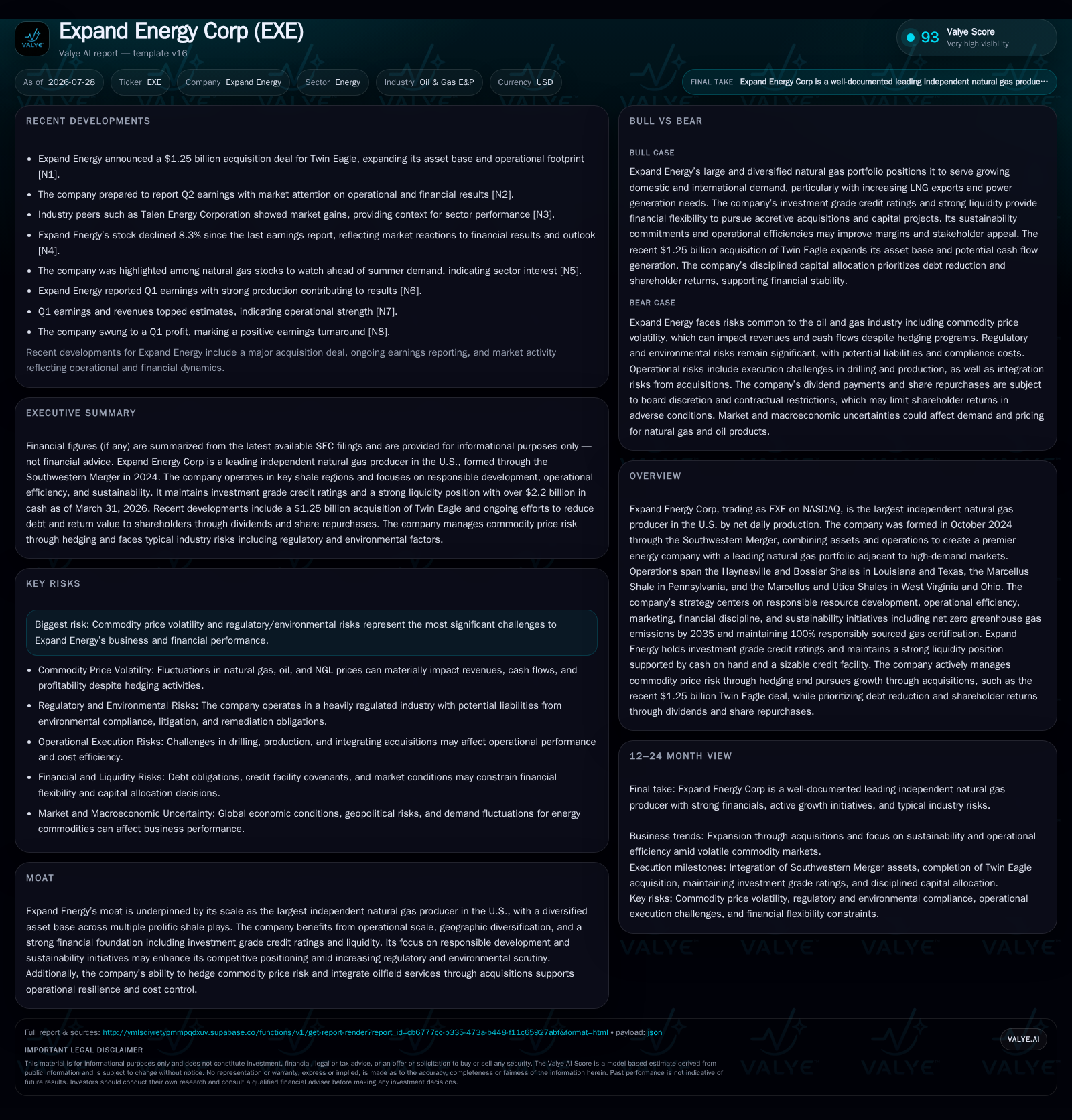
Expand Energy Corp (EXE), the largest independent U.S. natural gas producer, reported its second-quarter 2026 operating results emphasizing integration of a $1.25 billion Twin Eagle acquisition alongside continued capital discipline and sustainability efforts. The company leverages its diversified asset base across major shale plays to sustain resilient cash flows amid commodity price volatility, supported by comprehensive hedging. EXE’s strategy focuses on scaling production through organic development and accretive acquisitions while targeting net-zero emissions by 2035, backed by solid liquidity and investment grade credit ratings.
Recent Operating Update: Acquisition and Q2 Results
Expand Energy Corp (NASDAQ: EXE) announced on July 28, 2026, a definitive agreement to acquire Twin Eagle Holdings N.A., LLC for approximately $1.25 billion [S3][N3][N5]. This strategic transaction expands EXE’s position within its core operating regions across major U.S. shale plays, reinforcing scale advantages essential for operational leverage and cost efficiencies. The acquisition complements EXE’s existing diversified portfolio covering the Haynesville/Bossier shales on the Gulf Coast as well as the Marcellus/Utica shales in the Appalachian Basin.
In its Q2 2026 Form 10-Q filing dated July 28, EXE emphasized ongoing efforts to enhance margin profiles by optimizing drilling and completion operations alongside commercial strategies amidst persistent commodity price fluctuations [S2]. The company continues to deploy capital prudently while advancing sustainability initiatives aligned with long-term value creation.
Business Model: Integrated Independent Producer Leveraging Scale and Diversification
EXE operates as a leading upstream natural gas exploration and production company generating revenues primarily through sales of natural gas liquids (NGL), oil, and associated natural gas extracted from prolific shale reservoirs. Its multi-basin footprint provides geographic diversification that reduces exposure to localized geological or regulatory risks inherent in single-play operators [S1]. This diversity underpins stable net daily production volumes—a critical driver of revenue visibility.
The company employs comprehensive commodity price hedging strategies covering over 60% of anticipated natural gas production through costless collars that provide downside price protection with upside participation potential [S1][S14]. This approach enhances revenue predictability while allowing some benefit from favorable market conditions.
Following the Southwestern Merger completed in October 2024, EXE integrated complementary assets including an oilfield services segment that supports vertical integration benefits such as reduced lifting costs and improved operational control [S1][S14]. This positions EXE competitively among independent upstream peers by enabling scale efficiencies in rig deployment, enhanced drilling success rates through technology application, and optimized midstream logistics partnerships.
Industry Positioning & Competitive Dynamics
As an independent upstream producer distinct from integrated majors like ExxonMobil or Chevron, EXE competes principally on operational efficiency metrics such as lifting costs per barrel of oil equivalent (BOE), finding and development costs per BOE, reserve replacement ratios, and net production growth potential [S4][S21]. Peers include other large independents with extensive shale portfolios such as Cabot Oil & Gas or Range Resources; however, EXE’s multi-basin presence confers resilience against region-specific regulatory or operational disruptions.
Sophisticated hedging programs employing three-way collars reflect industry best practices among well-capitalized independents by balancing risk case mitigation with upside price participation.
Growth Drivers
Growth is expected from both organic development—targeting approximately 205-235 gross well completions in 2026 utilizing around 11-12 drilling rigs—and inorganic expansion via accretive acquisitions like Twin Eagle [S19][N3]. Capital expenditures are forecast at $2.75 billion to $2.95 billion for the full year with a focus on projects delivering superior free cash flow returns.
Technological advancements aimed at improving recovery rates reduce decline curves characteristic of shale wells, thus lowering reinvestment intensity needed to sustain production levels.
Environmental regulations targeting methane emissions increase compliance costs; however, EXE’s commitment to achieve net zero Scope 1 and Scope 2 greenhouse gas emissions by 2035 reflects proactive risk management aligned with evolving ESG expectations [S1][S24]
Legacy litigation inherited from Southwestern merger-related exposures pose contingent risks; management currently assesses these as unlikely to materially impact financial results but acknowledges inherent uncertainty [S12][S22].
Operational risks include potential delays or cost inflation in drilling activities which could affect capital efficiency or project timelines.
Long-term contractual commitments for midstream gathering and transportation services totaling approximately $9.6 billion require steady production volumes to maintain economic viability [S13]
What To Watch Next
- Execution of Twin Eagle acquisition integration including synergy realization and impact on production volumes.
- Third-quarter production results relative to planned rig activity indicating operational momentum.
- Adjustments in hedge portfolio coverage reflecting late-2026 commodity market outlooks.
- Capital expenditure pacing versus guidance signaling disciplined financial stewardship.
- Progress toward sustainability goals such as expanded responsibly sourced gas certification across assets.
This analysis synthesizes information from Expand Energy's SEC filings through Q2 FY26 supplemented by recent news releases without speculative forecasts or investment advice. It highlights Expand Energy’s strategic positioning within the upstream energy sector focusing on resilient operations amid cyclical commodity markets balanced against identifiable risks typical for large independent producers.
Disclaimer: This is research-only, informational analysis and not investment advice. It may include AI-generated interpretation and general industry context. Always verify important details using primary sources.

Comments