
How First Advantage Scaled Revenue While Managing Persistent Net Losses
First Advantage significantly expanded its revenue and operating income in FY2025, yet continues to wrestle with net income deficits amid strategic financial management.
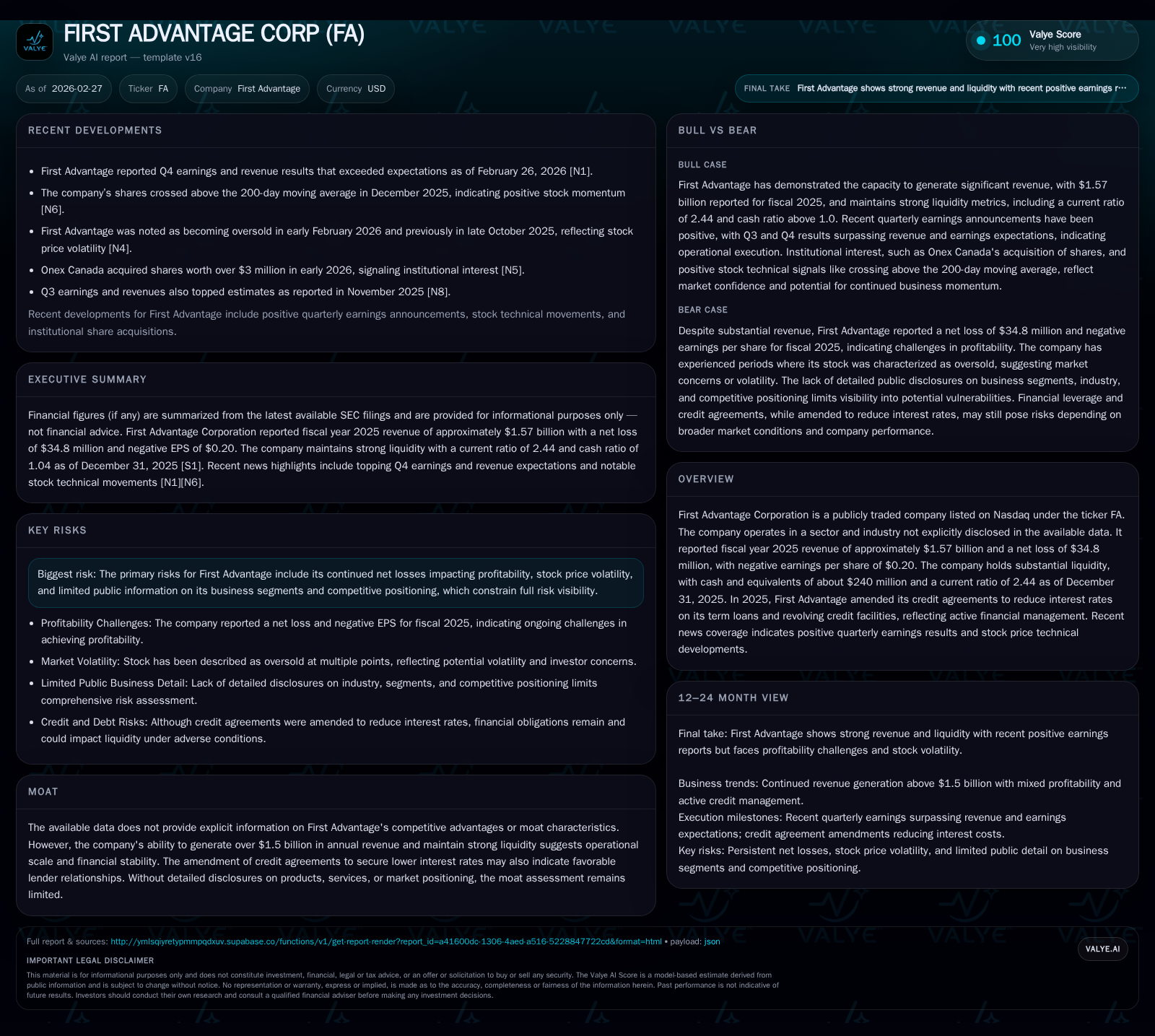
First Advantage Corporation achieved an 83% surge in annual revenue to $1.57 billion in FY2025, driving operating income from a prior loss into positive territory of $132 million. However, net losses persisted at $34.8 million, reflecting ongoing profitability pressures and resulting in a modest negative return on equity of approximately -2.7%. The company strengthened liquidity with a cash buffer nearing $240 million and a strong current ratio of 2.44, supported by amended credit agreements that reduced interest costs. Despite negative earnings, substantial share repurchases and markedly improved operating cash flow signal management’s focus on capital efficiency and operational turnaround. Legal and regulatory risks remain material factors to monitor alongside performance milestones.
Scaled Revenue Growth Fuels Operational Turnaround
First Advantage's fiscal trajectory in the recent year demonstrated a striking reversal in growth dynamics. After delivering revenues around the $860 million mark in FY2024 and experiencing volatile results over previous years—including a dip from $810 million in FY2022 to $764 million in FY2023—the company surged to approximately $1.57 billion in FY2025, reflecting an impressive 83% year-over-year increase [F1]. This leap substantially boosted scale economies, evidenced by operating income catapulting from a negative $62.4 million in FY2024 into positive territory at $132.5 million—a gain exceeding 300% [F1]. This swing underscores effective operational leverage even as the company worked through legacy challenges.
Operational benefits from increased revenue scale helped First Advantage move past earlier losses at the operating level seen during the pandemic and transitional phases.
Profitability Pressures and Net Income Volatility
Despite improvements at the operating margin level, net earnings results continued lagging expectations with a net loss of $34.8 million reported for FY2025 [F1]. This marks a clear progress from the deeper $110.3 million loss recorded in FY2024 but still indicates underlying pressures suppressing bottom-line profitability. Analyst-calculated return on equity stands near -2.7%, signaling residual drag on shareholder value creation [F1].
These persistent net losses reflect factors beyond core operations such as financing charges or impairment expenses detailed within risk disclosures [S4][S5], elevating volatility concerns for stock performance which was noted as oversold in recent market commentary [N4]. Investors remain cautious given this uneven profit recovery juxtaposed with top-line strength.
Navigating Interest Rate Reductions and Liquidity Strength
Strategic financial stewardship is apparent through First Advantage's executed Amendment No.5 to its first lien credit agreement mid-2025 that lowered interest rates on term loans due through October 2031 by half a percentage point (to approximately 2.50%-2.75% plus SOFR) while equivalently reducing revolver rates on its $250 million facility expiring October 2029 [S9][S16]. This proactive adjustment alleviates cost pressures amid the rising-rate environment helping preserve margin expansion potential.
Complementing this is robust liquidity positioning: the firm ended FY2025 with nearly $240 million cash & equivalents against current liabilities just over $230 million—yielding a strong current ratio of 2.44 [F1]. These capital resources provide flexibility for both operational investments and debt servicing amid evolving market conditions.
Capital Allocation: Buybacks Amid Negative Earnings
A notable feature of First Advantage's capital strategy is sustained share repurchases totaling about $59.48 million annually despite lackluster net profitability [F1]. This approach signals management confidence in intrinsic business value or reflects structural capital return priorities possibly designed to offset dilution or optimize capital structure.
Such buyback activity amid ongoing losses is uncommon without clear profit recovery visibility but may be aligned with medium-term strategic objectives or shareholder return philosophies within the industry.
Operational Cash Flow and Free Cash Flow Expansion
Much like operating income gains, the firm’s cash flow profile turned distinctly more favorable in FY2025 with operating cash flow ballooning to roughly $195 million—a staggering +592% increase versus just over $28 million generated the prior year [F1]. After accounting for capital expenditures totaling about $6.6 million—a threefold rise from FY2024 levels—the resulting free cash flow approximates near $188 million indicating solid underlying operational health.
This divergence between accounting profitability and actual cash generation emphasizes improved working capital management or non-cash adjustments aiding liquidity despite net losses.
Key Legal and Regulatory Risks Influencing Outlook
Extensive filings articulate material legal proceedings alongside regulatory risk factors that materially influence First Advantage’s risk profile [S4][S5][S13][S14]. These encompass ongoing litigation exposures which may incur contingent liabilities or constrain business operations.
Investors must weigh these factors carefully as they could affect earnings volatility, capital allocation flexibility, or necessitate additional provisions affecting future cash flows.
Future Growth Potential: What Investors Should Monitor
In absence of explicit forward guidance or detailed segment forecasts from management disclosures [N1][S1], monitoring future milestones will rely on key data points: the ability to sustain elevated revenue run-rates post-FY2025 acceleration; achieving consistent margin gains supporting transition from net losses to net profits; continued success at managing interest expenses especially under volatile SOFR-linked borrowing costs; maintenance of robust liquidity buffers; and resolution pathways for ongoing litigation or regulatory matters.
Given recent quarterly results exceeding estimates [N1], sustaining these trends will be critical to fully realize operational turnaround promises and stable shareholder returns.
Historical performance (annual)
| FY | Rev ($mm) | Net ($mm) | CFO ($mm) | OpInc ($mm) | Rev YoY | Net YoY |
|---|---|---|---|---|---|---|
| 2025 | 1574 | -35 | 195 | 132 | +83.0% | +68.4% |
| 2024 | 860 | -110 | 28 | -62 | +12.6% | -395.7% |
| 2023 | 764 | 37 | 163 | 82 | -5.7% | -42.3% |
| 2022 | 810 | 65 | 213 | 94 |
Source: SEC companyfacts cache [F1].
Capital returns and efficiency (annual)
| FY | Buybacks ($mm) | FCF ($mm) | ROE% |
|---|---|---|---|
| 2025 | 59 | 188 | -2.7 |
| 2024 | 59 | 26 | -8.4 |
| 2023 | 59 | 161 | 4.1 |
| 2022 | 207 | 5.7 |
Source: SEC companyfacts cache [F1].
Source: Company-reported annual figures per SEC filings [F1]. Percent changes are year-over-year comparisons between FY25 and FY24.
Disclaimer: This analysis is based exclusively on disclosed financials, SEC filings, and publicly available news reports as of February 27, 2026. All forward-looking statements are labeled as analysis and do not constitute investment advice or recommendations.
Disclaimer: This is research-only, informational analysis and not investment advice. It may include AI-generated interpretation and general industry context. Always verify important details using primary sources.

Comments