
First American Financial Outperforms on Commercial Segment Strength
Q1 2026 results emphasize commercial title insurance growth, driven by proprietary data assets and digital innovation.
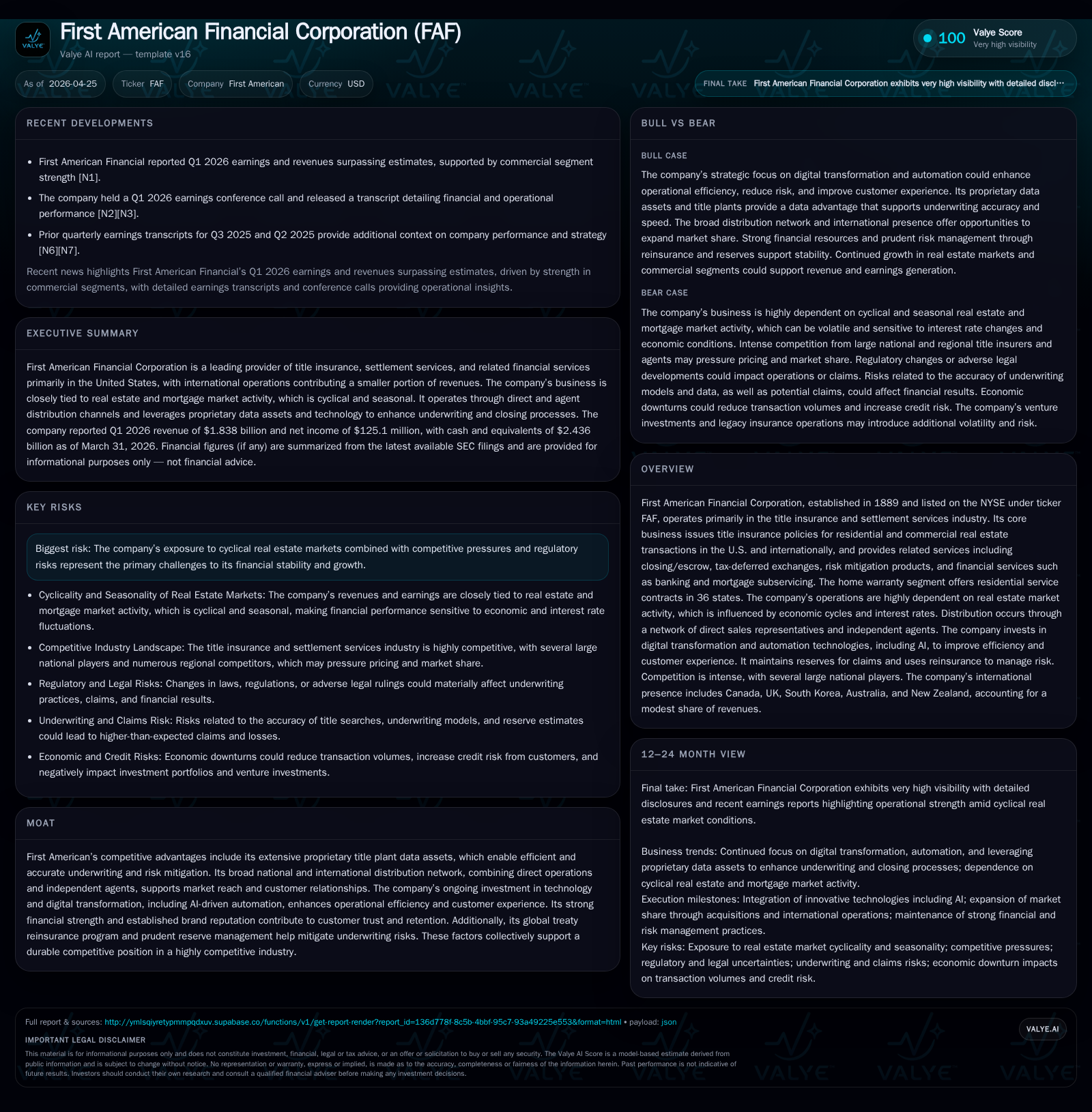
First American Financial reported a robust first quarter in 2026, with revenue and earnings surpassing estimates largely due to strength in its commercial title insurance segment. This performance reflects the growing relevance of its proprietary title plant data and ongoing investments in AI-powered automation that improve underwriting precision and operational efficiency. While residential real estate volumes show signs of cyclical fluctuation, First American's diversified services, including settlement, escrow, banking, and mortgage subservicing, provide resilience amid market variability. The company’s extensive agent network and digital transformation initiatives support competitive differentiation and the path to sustainable growth.
Q1 2026 Operating Update and Commercial Segment Momentum
First American Financial’s latest quarterly filing for Q1 2026 reveals a marked acceleration in the company’s commercial title insurance business, lifting overall revenue and net income beyond analyst expectations. According to the April 24, 2026 quarterly report [S2] and corroborated by the April 22 event filing [S3], this surge stems from increased deal volumes in the commercial real estate sector combined with improving underwriting margins fueled by the company’s proprietary title plant data and enhanced risk assessment capabilities.
Revenue growth outpaced broader residential market fluctuations as FAF capitalized on specialty product demand and diversified service lines such as closing/escrow fees and mortgage subservicing. Margin pressure prevalent in slower residential segments was largely offset by operational efficiencies stemming from internal digital initiatives. The absence of material changes in risk factors compared to prior filings reinforces confidence in stable regulatory conditions for now [S2].
Earnings calls following the release highlighted management's emphasis on leveraging technology investments to accelerate title search workflows while maintaining rigorous reserve discipline amid volatile market cycles [N2][N3]. This strategic focus is pivotal given ongoing macro uncertainty affecting housing affordability yet a more robust appetite for commercial property transactions.
Business Model: Title Insurance and Integrated Settlement Services
First American operates predominantly within the title insurance sector but distinguishes itself through a comprehensive suite of affiliated services. Core revenue arises from title insurance premiums issued to both residential and commercial clients underpinned by underwriting models that integrate extensive proprietary title plant datasets encompassing deed histories, liens, easements, and other encumbrance records across multiple jurisdictions [S1].
Complementing this are settlement services—including closing agents facilitating escrow accounts—as well as tax-deferred exchanges designed to optimize client transaction tax outcomes. FAF also delivers ancillary financial offerings such as banking trust services, warehouse lending facilities for mortgage originators, mortgage subservicing operations that handle loan administration post-origination, plus wealth management products targeted at institutional investors.
The home warranty division supplements these activities by selling service contracts covering critical household systems in 36 states. This diversification aids in smoothing revenue volatility typical of cyclical real estate markets. The integration of these service streams enhances FAF’s value proposition, improving cross-selling opportunities among existing customers while bolstering switching costs tied to its expansive operational footprint [S1][F1].
Importantly, underwriting profits derived from premium yields are increasingly supported through technology-enabled efficiency gains—reducing manual labor on title examinations via automation—and prudent risk mitigation practices reinforced by reinsurance treaties.
Competitive Positioning and Industry Dynamics
FAF occupies a leading position within a highly fragmented yet competitive industry landscape dominated by sizable peers including Fidelity National Financial (FNF), Old Republic International (ORI), and Stewart Title Guaranty Company. Competition is especially acute within metropolitan real estate hubs where multiple agencies vie for transaction volume.
Switching costs manifest notably through FAF’s proprietary national title plant databases—a unique asset base providing enhanced accuracy in identifying hidden risks or gaps—plus relationships nurtured through a nationwide agent network encompassing direct sales teams and independent brokers. These factors contribute durable barriers against smaller competitors lacking comparable data infrastructure or geographic reach [S1].
Regulatory oversight around title insurance premiums varies regionally but is generally stable; however evolving compliance standards necessitate continual investment in internal controls. FAF’s active embrace of digital technology differentiates it further: compared to peers slower to innovate, the company's AI-enhanced underwriting tools streamline closures while improving risk prediction accuracy—a meaningful competitive advantage during tightening margin environments.
Key Growth Drivers and Potential Constraints
Macro drivers remain tethered to real estate industry trends shaped heavily by interest rate policies impacting mortgage origination volumes. While residential sales face headwinds due to affordability constraints amid elevated rates, commercial real estate markets show signs of cyclical recovery benefiting FAF’s specialty lines with longer-duration contracts yielding higher margins.
Company-specific growth hinges on executing its digital transformation journey—measured progress in automating traditionally manual steps such as document review reduces cycle times which can attract clients prioritizing speed and transparency. Expansion into mortgage subservicing leverages fixed income streams resistant to home-sale volumes dips.
Constraints primarily arise from exposure to cyclical residential downturns coupled with potential regulatory shifts affecting premium approval processes or capital requirements. Pricing competition remains fierce given overlapping service offerings across providers. Nevertheless, FAF's balanced portfolio of product lines helps buffer such headwinds while prudent reserve management protects against underwriting losses [S1][N2].
Strategic Digital Innovations Enhancing Efficiency and Customer Experience
Investments into AI-driven process automation represent a cornerstone of FAF's strategy to streamline core operations—converting labor-intensive manual searches into algorithmic workflows that both reduce processing costs and elevate accuracy levels. This diminishes error rates associated with human oversight while enabling faster transaction closings appreciated by customers requiring timely property settlements.
Additionally, advanced analytics applied to vast historical property data enhance underwriting precision allowing tailored risk pricing that can improve margin profiles without sacrificing coverage quality.
Digital portals facilitate improved transparency for end-users throughout transactions boosting satisfaction rates; such enhancements are vital given rising customer expectations within fintech-enabled real estate ecosystems. FAF has also pursued acquisitions aimed at augmenting market share alongside technology capabilities—positioning it effectively for future scale benefits [S1][N2].
What to Watch: Upcoming Milestones and Market Signals
Investors should closely monitor Q2 earnings updates for indications that commercial segment momentum sustains alongside further margin improvements from tech deployment. Progress reports on technology integration initiatives—including potential new AI platform rollouts or process automation milestones—will be key execution markers highlighted during forthcoming analyst calls scheduled after latest quarterly disclosures [N3][S2].
Real estate market indicators such as mortgage origination rates from federal agencies will provide early signals around transaction volume trajectories affecting revenue streams.
Any regulatory developments impacting title insurance pricing or compliance norms remain critical overhangs warranting periodic reassessment.
Financial Summary: Capital Deployment and Balance Sheet Strength
Historical performance (annual)
|
| FY | Rev ($bn) | Net ($mm) | CFO ($mm) | Capex ($mm) | Rev YoY | Net YoY |
|---|---|---|---|---|---|---|
| 2025 | 7.5 | 622 | 951 | 188 | +21.6% | +374.3% |
| 2024 | 6.1 | 131 | 898 | 218 | +2.1% | -39.5% |
| 2023 | 6.0 | 217 | 354 | 263 | -21.1% | -17.6% |
| 2022 | 7.6 | 263 | 780 | 260 |
Source: SEC companyfacts cache [F1].
Capital returns and efficiency (annual)
|
| FY | Div ($mm) | Buybacks ($mm) | FCF ($mm) |
|---|---|---|---|
| 2025 | 223 | 122 | 763 |
| 2024 | 221 | 69 | 679 |
| 2023 | 217 | 73 | 91 |
| 2022 | 217 | 441 | 520 |
Source: SEC companyfacts cache [F1].
The trailing twelve months ending FY2025 underscore First American’s capacity to convert top-line growth into robust net income of approximately $622 million representing a substantial increase year-over-year (+374%) against FY2024 results [$F1$]. Operating cash flow reached roughly $951 million supporting an ample cushion for capital expenditure needs ($188 million) dedicated mainly toward technology infrastructure enhancements.
Capital returns remain balanced; dividends paid approximated $223 million maintaining payout continuity while share repurchases accelerated moderately totaling around $122 million signaling confidence in long-term fundamentals [$F1$].
Cash on hand at end-2025 stood near $1.39 billion furnishing solid liquidity headroom though no explicit current debt or leverage metrics were disclosed in the recent quarter filings beyond modest negative total debt historical figures signaling negligible gross borrowings [$F1$].[S2]
This conservatively financed balance profile affords flexibility for incremental acquisitions or sustained R&D investments essential for maintaining FAF’s competitive edge amidst challenging real estate cycles.
|
| FY | Revenue (USD bn) | Net Income (USD m) | Op Cash Flow (USD m) | Capex (USD m) | Dividends (USD m) | Buybacks (USD m) |
|---|---|---|---|---|---|---|
| 2025 | 7.45 | 622 | 951 | 188 | 223 | 122 |
| 2024 | 6.13 | 131 | 898 | 218 | 221 | 68 |
| 2023 | 6.00 | 217 | 354 | 263 | 217 | 73 |
| Q1'26 (est.)* | -- | -- | -- | -- | -- | -- |
- Quarterly breakdown not available publicly yet.
Overall, First American Financial demonstrates how mastery over proprietary data assets paired with strategic digitalization efforts fuel resilience in a cyclical real estate ecosystem while positioning the company for sustained industry leadership.
This analysis synthesizes public SEC filings as of April 24-25, 2026 ([S1], [S2], [S3]) alongside recent market commentary ([N1]-[N4]) without offering investment advice or price forecasts.
Disclaimer: This is research-only, informational analysis and not investment advice. It may include AI-generated interpretation and general industry context. Always verify important details using primary sources.

Comments