
Fortress Biotech's Multi-Subsidiary Model Bolsters Drug Development Momentum
Recent disclosure highlights capital constraints tied to dividend pauses alongside strong liquidity supporting biopharma subsidiary growth.
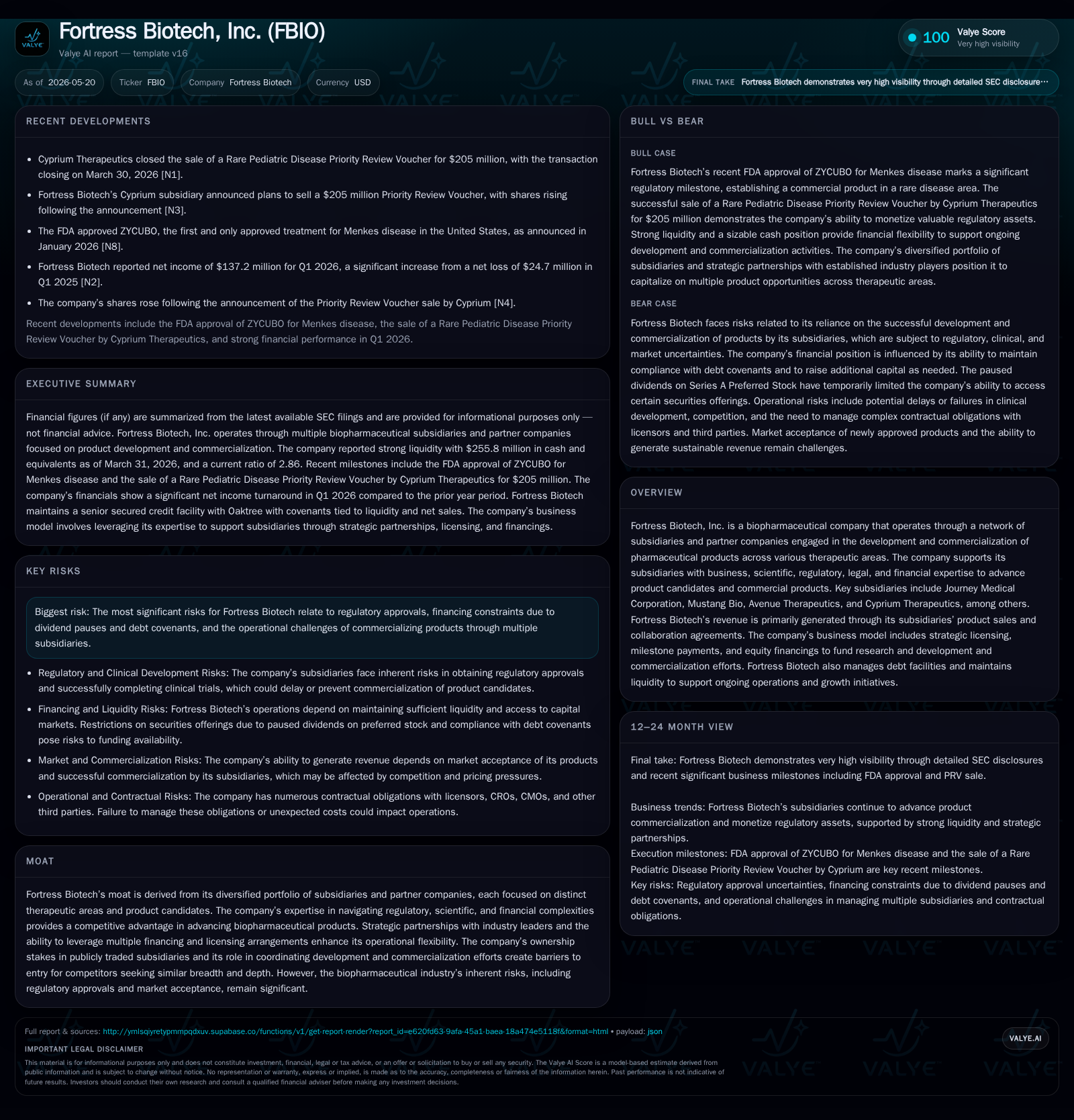
Fortress Biotech’s latest 10-Q filing reveals near-term financing limitations due to paused Series A Preferred Stock dividends, restricting access to its primary equity shelf. Nonetheless, Fortress maintains a robust cash position and diversified capital strategies via subsidiaries such as Journey Medical’s sizeable shelf registration and ATM sales programs. The holding company’s multi-subsidiary structure provides operational flexibility and strategic depth across distinct therapeutic areas, balancing clinical development risk with multiple growth vectors. Key risks include regulatory approval uncertainty and compliance with tightening loan covenants amid this complex operating model.
Latest Quarterly Operating Update Highlights
Fortress Biotech’s May 14, 2026 10-Q filing marks a pivotal update on the company's near-term capital dynamics [S2]. The board's decision on July 5, 2024 to pause dividends on Series A Preferred Stock has materially impacted Fortress's ability to utilize its main $42.1 million Form S-3 shelf registration ("2024 Shelf") due to regulatory restrictions linked to dividend arrears. This pause effectively suspends equity offerings at the parent level under Form S-3 until the next annual report confirms settled accrued dividends [S2].
In response, Fortress amended prior S-3 registrations to maintain access to share issuances underlying outstanding warrants held by certain stockholders and affiliates [S2]. Meanwhile, key subsidiaries exhibit greater capital flexibility. Journey Medical Corporation (Journey), a prominent subsidiary within the portfolio, holds a separate $150 million shelf registration with an active At-The-Market (ATM) sales agreement allowing dynamic equity sales through agents [S2]. Journey refreshed this facility with a 2026 shelf replacing its prior 2022 registration, underpinning ongoing fundraising capacity independent of parent limitations.
The filings also reveal stable liquidity metrics at the parent level with $256 million in cash and equivalents against $40 million total debt and a current ratio of approximately 2.86 [F1]. However, ongoing loan covenants require careful cash management; these include minimum liquidity thresholds ranging from $7 million down to $2 million contingent on debt balances and proceeds from asset monetizations in subsidiaries like Cyprium Therapeutics [S10], [S26]. As such, Fortress is positioned with adequate short-term financial resources but must navigate regulatory shelving rules restricting immediate capital raises.
Fortress Biotech’s Diversified Business Model and Subsidiary Ecosystem
Fortress employs a distinctive holding company model centered on operating several wholly owned or controlled subsidiaries specializing across therapeutic classes [S1]. This multi-subsidiary approach spreads scientific development risk while enabling targeted commercialization efforts through specialized teams per entity.
Revenue generation primarily stems from subsidiary product sales—particularly dermatology products through Journey—as well as licensing fees, milestone payments tied to regulatory or development achievements, royalties on partnered products, and equity financings [S1]. Licensing agreements often carry contingent obligations requiring milestone payments subject to regulatory approvals or commercial success milestones. This complex revenue mechanics structure requires Fortress management involvement in scientific guidance, regulatory strategy coordination, legal negotiations, and centralized financial oversight.
Subsidiaries like Mustang Bio focus on oncology assets while Avenue Therapeutics targets specialty indications such as lysosomal storage diseases via its recent exclusive license from Duke University for ATX-04 [S18]. Cyprium Therapeutics generates value through specialty metals-based therapies and successfully monetized priority review vouchers recently [S12]. Together these operating units form a biotech incubator/accelerator structure providing inherent portfolio diversification that creates operational moats around Fortress by complicating competitor replication.
Industry Structure and Competitive Positioning in Biopharma Holdings
Within the biopharmaceutical landscape, holding companies managing portfolios via subsidiaries represent an asset-light platform strategy balancing pipeline diversity with capital efficiency. Unlike traditional integrated pharma giants bearing full commercialization infrastructure costs upfront, firms like Fortress leverage external partnerships for marketing distribution while focusing internal resources on clinical advancement and IP management [S1].
Regulatory hurdles remain omnipresent; each subsidiary faces distinct trial phases, NDA submissions, or FDA approvals that determine progression timelines. This structural dispersion reduces single-point failure risk but amplifies managerial complexity. Compared to peer pure-play clinical-stage biotechs solely dependent on equity raises concomitant with trial milestones, Fortress supplements equity financing via milestone-triggered payments and royalty streams that partially offset dilution pressures.
Competitively, subsidiaries like Journey gain strength from developing dermatology therapeutics—with direct product revenues supporting cash flow stability—while cutting-edge research entities Mustang or Avenue target niche orphan indications where regulatory pathways may offer accelerated review [S1]. These strategic allocations illustrate Fortress’s competitive positioning along both commercialized products for predictable income plus high-potential R&D pipelines.
Key Growth Drivers: Subsidiary Progress, Financing Strategies, and Partnerships
Growth prospects hinge fundamentally on advancing subsidiary pipelines toward regulatory approvals that unlock milestone payments or drive commercial revenue scale [S2], [S3], [S1]. Journey Medical’s consistent ATM offering program supports tactical funding while preserving long-run upside potential through stock price appreciation tied to product sales expansion.
Licensing deals continue playing a pivotal role; Avenue's February 2026 ATX-04 license from Duke reflects an intent to accelerate late-stage development leveraging pre-existing human data for lysosomal storage diseases—a segment attracting favorable orphan designation benefits [S18]. Similarly, Cyprium’s recent Priority Review Voucher (PRV) sale for $205 million after NIH obligations bolstered group liquidity substantially while enabling aggressive pipeline funding without traditional equity dilutions [S12], [S26].
Strategic utilization of variable shelf registrations by subsidiaries collectively enables staging of capital raises bespoke to subsidiary developmental stages rather than relying solely on parent-level fundraising restricted due to dividend status. Until accrued dividends are paid in full at next annual filing cycles—which enable requalification—parent-level direct securities offerings remain constrained [S2], limiting available cash injection avenues absent alternative transactions.
Loan covenants under the New Oaktree Agreement impose minimum liquidity requirements ($7 million reducing incrementally post-Cyprium monetization) alongside escalating minimum net sales thresholds based chiefly on Journey subsidiary performance. Failure in these metrics could precipitate defaults subject to cure periods but also restrict further borrowing or force asset liquidations if unmet [S11], [S26].
Operationally, managing multiple subsidiaries engaged simultaneously in early-to-late stage drug development introduces integration challenges: aligning clinical trial progressions, coordinating regulatory submissions across varying jurisdictions, synchronizing milestone revenue recognition timing—and calibrating requisite resource allocations amid fluctuating developmental priorities [S1]. This complexity risks execution delays or cost overruns diminishing net proceeds available for reinvestment.
Additionally, dependency on external CROs/CMOs coupled with stringent pharmaceutical regulations heightens uncertainties over successful FDA approvals or market penetration levels necessary for milestone realizations or royalty scaling—hindering precise growth forecasting.
Upcoming Milestones and Monitoring Points
Key upcoming company-specific markers are anchored around the next annual report lodging that might restore Form S-3 eligibility following dividend clearance—opening parent-level capital markets again without sole dependence on subsidiaries’ shelves [S2],[S1]. Investors should monitor dividend accrual settlement progress closely as it dictates fundamental fundraising capacity shifts.
Clinical updates from pivotal trials conducted within subsidiaries such as Avenue’s ATX-04 candidate progression or Mustang Bio’s oncology portfolio advancement will serve as critical inflection points triggering new milestones or partnership opportunities underpinning growth projections [S18],[S1].
Journey Medical’s quarterly reporting will reveal adherence to established minimum net sales covenants crucial for maintaining loan agreement compliance—any shortfall could trigger renegotiations or defaults demanding prompt treasury actions [S11],[S26].
Ongoing ATM offering efficacy via regulators' approvals at journey-level will indicate sustained readiness to rapidly raise funds aligned with evolving pipeline needs beyond parent company limits imposed by paused dividends mechanism.
Supporting Financial Overview
As of March 31, 2026 quarter-end Fortress reported strong liquidity with cash & equivalents approximating $256 million against total debt near $40 million; this results in a net cash position reflective of prudent balance-sheet management despite ongoing operating losses typical of biotech developmental firms [F1],[S2].
Debt maturities are extended out to June 2028 under the amended Oaktree facilities bearing interest rates averaging approximately 11.6%, facilitating an interest-only period until late 2027 before principal repayments commence - underscoring the necessity for continuing revenue ramp-up primarily via subsidiary commercialization success to meet future amortization schedules responsibly without stressing liquidity buffers further [S10],[S11],[F1].
This analysis integrates disclosures solely from publicly filed SEC reports through May 14th 2026 alongside recognized financial data snapshots per policy guidance. It does not offer investment advice but provides an informed perspective into Fortress Biotech's unique portfolio-driven business model amidst complex financing landscapes shaping its future growth trajectory.
Disclaimer: This is research-only, informational analysis and not investment advice. It may include AI-generated interpretation and general industry context. Always verify important details using primary sources.

Comments