
Four Corners Property Trust: Stability and Growth Anchored in Net-Lease Restaurant and Retail Real Estate
Four Corners Property Trust leverages a focused net-lease model across a broad portfolio to deliver predictable revenue while navigating tenant concentration and market risks.
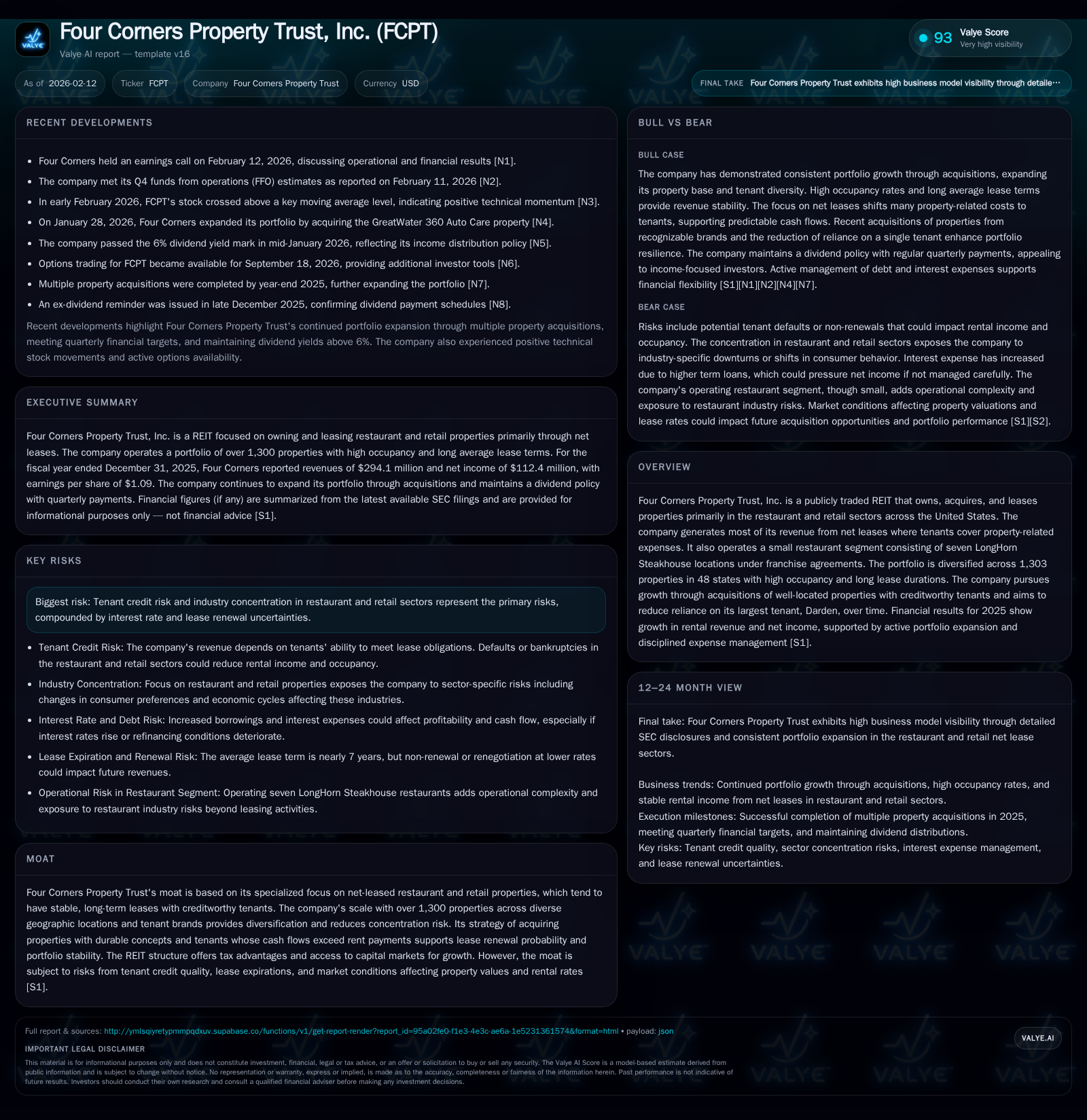
Four Corners Property Trust, Inc. (FCPT) operates a specialized REIT with a portfolio of 1,303 net-leased restaurant and retail properties across 48 U.S. states, generating stable income with high occupancy and long lease terms. The company's disciplined acquisition strategy and tenant diversification efforts have driven rental revenue growth and net income expansion in 2025. Despite inherent risks tied to tenant concentration—especially reliance on Darden—and sensitivity to economic conditions impacting retail and restaurant sectors, FCPT’s governance framework, dividend consistency, and active market engagement highlight its operational resilience. Moving forward, management aims to steadily reduce concentration risk while sustaining portfolio growth and financial discipline.
Niche Net-Lease Model: Anchoring Stability
At the heart of Four Corners Property Trust’s operation lies a focused net-lease business model dominated by the restaurant and retail sectors. This approach entrusts tenants with most property-related expenses—including taxes, insurance, and maintenance—thereby insulating FCPT from many traditional landlord operational risks [S1]. The company’s revenue primarily flows through these net leases, underpinned by long-duration contracts that provide consistent income visibility. Interestingly, FCPT also maintains controlled diversification via its ownership of seven LongHorn Steakhouse locations operated under franchise agreements — blending real estate investment with a modest direct restaurant segment presence [S1]. This strategic nuance complements the core portfolio without substantially increasing operating complexity or volatility.
Such structuring translates into a stable revenue base buffered from short-term fluctuations typical in commercial real estate. Tenants assume considerable operational responsibility, reducing lease-default line items on FCPT’s books. Moreover, the focus on restaurateurs and retailers historically recognized for durable cash flows enhances immunity against transient sector volatility.
Portfolio Scale and Tenant Quality: Strengths in Diversification
FCPT commands an extensive footprint comprising 1,303 properties strategically dispersed across 48 states [S1]. This breadth curtails localized economic shocks or sector-specific downturns from overly impacting overall performance. Importantly, occupancy rates remain high — reflecting effective leasing management suited to maintaining asset utilization.
Tenant quality emerges as a core moat feature. FCPT prioritizes securing tenants with strong credit profiles whose operating cash flows comfortably exceed rent obligations. Such dynamics increase lease renewal probabilities and longevity inherent in contractual agreements [S1]. While Darden Restaurants represents the largest tenant—significant enough to draw concentrated attention—management is actively pursuing diversification initiatives aimed at gradually lowering the proportionate exposure to any single entity [S1]. This evolution is pivotal given the cyclical intricacies faced by the restaurant industry.
These tenants’ solid underlying economics offer dual benefits: sustained rental payments under current leases plus improved bargaining power for renewals or escalations. By diligently vetting tenant financial health during acquisition underwriting phases, FCPT arguably reduces downside vacancy risks.
Growth through Strategically Selected Acquisitions
Recent portfolio expansion showcases FCPT’s methodical acquisition strategy focused on well-located properties coupled with creditworthy tenants [N4][N7][S1]. Notably, the addition of GreatWater 360 Auto Care marks an incremental diversification beyond strictly restaurant/retail assets — signaling management’s calibrated openness toward complementary niches that align with stable net-lease fundamentals [N4].
These acquisitions reflect prudence rather than volume-driven growth; FCPT appears committed to disciplined capital deployment harnessed for earnings accretion rather than indiscriminate expansion. Multiple property transactions at year-end bolster this narrative — enabling scale benefits without diluting core asset quality [N7]. Such selectivity aids in maintaining both yield metrics and credit profile integrity within the investment portfolio.
Financial Performance Snapshot: Revenue and Income Trends
The firm’s FY2025 financials reveal encouraging topline progression: total revenues advanced to $294.1 million accompanied by net income reaching $112.4 million [F1][S1]. These figures manifest the combined effects of organic rental income growth plus accretive contributions from acquisitions conducted during the fiscal period.
Operational expense discipline has been emphasized consistently; managerial commentary highlights tight cost controls supporting bottom-line stability even amid inflationary headwinds prevalent across broader commercial real estate markets [N2][N5]. FCPT’s ability to sustain or grow distributable cash flow underpins reliable dividend payments which recently crossed a notable 6% yield milestone [N5].
Quarterly dividends have remained steady — underpinning shareholder value propositions centered on dependable income streams [S1][N5]. Such distribution consistency is especially attractive within today’s low-yield environment where income reliability commands premium valuation multiples.
Risk Landscape: Tenant Concentration and Market Sensitivities
Despite many strengths, risk vectors persist notably around tenant credit concentration. Darden remains the largest single tenant group; although management targets gradual dilution here, any deterioration in Darden’s operations could ripple across FCPT’s rent collections [S1]. Restaurant sector health is often vulnerable to economic cyclicality influenced by consumer discretionary spend trends.
Another layer involves interest rate exposure inherent in real estate capital structures. However, FCPT manages this prudently through fixed-rate indebtedness totaling approximately $1.19 billion complemented by hedging strategies designed to stabilize interest costs versus market fluctuations [S1]. Management reports that hypothetical interest rate declines would not materially sway financial outcomes — indicating effective interest rate risk mitigation.
Lease expiration timing poses periodic renewal uncertainties but is partly offset by longstanding tenant relationships backed by robust cash flow coverage metrics [S2]. Transparency in risk disclosures demonstrates no significant shifts since prior filings affirming steady operating environments yet warrants vigilance given evolving macroeconomic factors.
Governance, Controls, and Transparency Framework
Corporate governance standards within FCPT reinforce confidence in operational integrity. Management has validated effective disclosure controls as per SEC Rule 13a-15(e) requirements with no material control weaknesses reported through December 31, 2025 [S1].
Internal audits adhere to established frameworks including criteria from COSO (Committee of Sponsoring Organizations of the Treadway Commission), ensuring comprehensive oversight over financial reporting processes [S1]. Independent auditor KPMG LLP has confirmed internal control effectiveness through its annual review — a critical endorsement for stakeholders relying on reported data accuracy.
Policies governing insider trading comply strictly with NYSE regulations promoting transparent practices preventing material nonpublic information misuse [S1]. Such governance rigor supports investor trust vital for capital market access intrinsic to REIT structures.
Dividend Profile and Shareholder Returns
Four Corners sustains quarterly dividend payments grounded in cash flows generated primarily from its net-leased assets [S1]. For fiscal year 2025 dividends totaled $1.42 per share distributed evenly across quarters demonstrating payout stability essential for income investors [S1].
Tax characterization data indicates a majority classified as ordinary taxable dividends with qualified dividend components benefiting favorable tax treatment — an aspect improving after-tax returns for shareholders receiving distributions [S1].
Recent market commentary highlights that FCPT shares surpassed a 6% yield threshold amidst prevailing equity income searches enhancing its appeal among yield-sensitive investor cohorts [N5]. This dividend reliability contrasts beneficially against more volatile direct property ownership returns or secular challenges faced by other retail-oriented REITs.
Recent Market Moves and Technical Momentum
FCPT shares exhibited positive technical momentum crossing significant moving average levels early February 2026 — implying strengthening investor confidence or shifting sentiment favoring accumulation patterns [N3]. The introduction of September options trading further reflects increased market engagement allowing sophisticated instruments for hedging or tactical positioning around stock movements [N6].
This growing liquidity footprint may attract additional institutional participation supporting longer-term price discovery aligned with fundamental strength exhibited by recent earnings delivery [N3][N6].
Outlook and Strategic Priorities Moving Forward
Management's recent earnings calls reinforce strategic priorities centered on managing tenant concentration particularly reducing exposure to large single entities like Darden while sustaining acquisition discipline targeting high-quality assets enhancing portfolio resilience [N1][S1].
A focus on balancing growth against leverage ratios combined with continued cost controls remains evident underscoring commitment towards accretive expansion without compromising balance sheet flexibility.
Investor messaging signals confidence in ongoing demand for well-located net-leased restaurant/retail assets supported by structural leasing advantages — even as competitive dynamics evolve within commercial real estate markets [N1]. Future endeavors will likely include opportunistic asset purchases complementing existing holdings alongside active lease renewals designed to lock-in rental escalations fitting inflationary backdrops.
Overall though challenges stemming from sector cyclicality and macroeconomic variability persist; Four Corners’ comprehensive approach positions it favorably to sustain steady cash flow generation amid these headwinds.
This report provides an analytical overview based on publicly available filings, recent news releases, and financial data without offering investment recommendations or price forecasts.
Disclaimer: This is research-only, informational analysis and not investment advice. It may include AI-generated interpretation and general industry context. Always verify important details using primary sources.

Comments