
Fresh Del Monte’s Strategic Control and Brand Challenges Shape 2025 Financial Outcome
Fresh Del Monte’s vertical integration supports operational stability but brand licensing risks and tariff pressures compress margins in 2025.
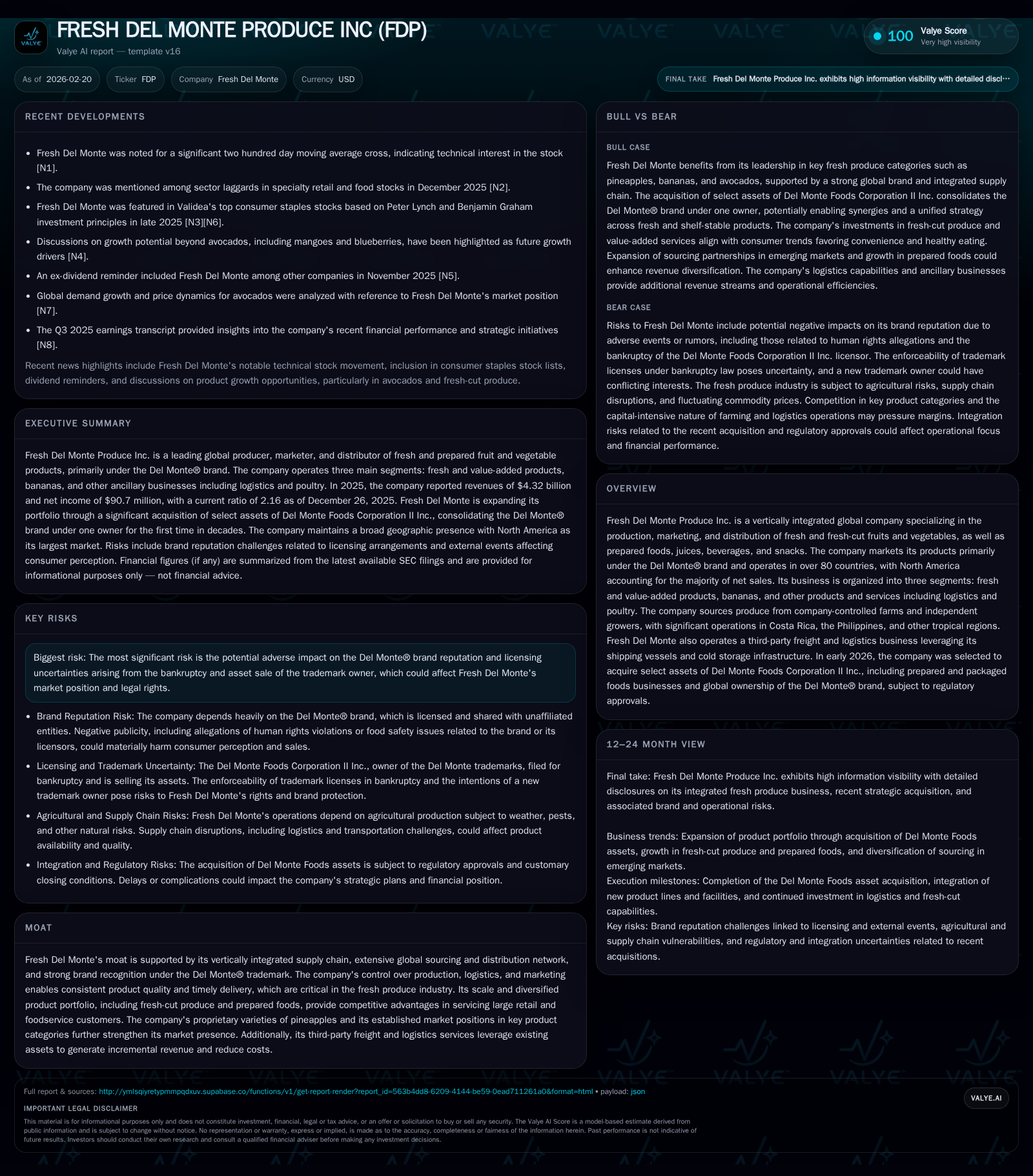
Fresh Del Monte Produce Inc. operates a vast vertically integrated global network for fresh and prepared produce, maintaining product quality through controlled sourcing and extensive logistics. In fiscal year 2025, revenues remained stable, reflecting modest pricing power offset by tariff-related cost inflation and adverse weather impacts on volumes, leading to a steep decline in operating income and net income. The company faces renewed brand risks from the licensor’s bankruptcy filing, potentially affecting consumer perception amid complex trademark licensing. Despite earnings pressure, operating cash flows grew strongly, supporting capital expenditures and a return to share repurchases while maintaining credit facility compliance. Going forward, Fresh Del Monte must monitor tariff developments and successfully integrate its acquisition of canned food assets to leverage unified control over the Del Monte® brand.
Global Reach Anchored by Vertically Integrated Operations
Fresh Del Monte Produce Inc. is a leading vertically integrated producer and marketer of fresh and fresh-cut fruits and vegetables as well as prepared foods across Europe, Africa, the Middle East, Asia, North America, Central and South America [S1][S8]. Its operations span more than 80 countries with major production hubs in tropical regions such as Costa Rica and the Philippines. The company derives approximately 58% of its net sales from North America where it operates a network of 20 distribution centers offering ripening capabilities and cold storage alongside four port facilities [S8][S16].
The company's three main reportable segments include Fresh & Value-Added Products (encompassing pineapples, fresh-cut fruit/vegetables, melons, avocados, prepared foods), Bananas as a standalone segment, and Other Products & Services (including third-party freight/logistics and specialty ingredient businesses) [S1][S21]. This vertical integration enables control over quality throughout production and distribution stages.
Segment Performance Trends: Revenue Stability Amid Profitability Challenges
For fiscal year ended December 26, 2025, Fresh Del Monte reported consolidated revenues of $4.32 billion—a slight increase of roughly 1% compared to $4.28 billion in 2024—reflecting resilience amid inflationary pressures [F1]. Segment-wise:
- Fresh & Value-Added Products generated approximately $2.62 billion (61% of total revenue), with growth driven by pineapples (+7%) and stable fresh-cut fruit sales offsetting declines in fresh-cut vegetables volumes.
- Bananas contributed about $1.49 billion (34%), relatively flat year-over-year despite volume headwinds due to adverse weather [S14][F1].
- Other Products & Services increased to $210 million (5%), benefiting from higher freight service volumes and the March 2025 acquisition of a Ugandan avocado oil producer [S14][S21].
However, profitability was pressured: operating income decreased approximately 30% to $137 million from $196 million the prior year while net income declined by over one-third to $90.7 million [F1]. Margin compression stemmed from tariff-driven cost escalations impacting sourcing countries like Costa Rica plus adverse weather effects including Black Sigatoka crop disease reducing yields [S14][S1]. Price increases implemented in North America mitigated some tariff impact but were insufficient to fully preserve margins.
Tariffs Impact: Managing Cost Inflation Amid Trade Uncertainty
Throughout 2025 tariffs affected imports from key sourcing countries supplying North American markets such as Costa Rica, Guatemala, Ecuador—with Mexico representing around 11% of North American sales exposed to potential trade policy shifts under USMCA exceptions [S1][S2]. These tariffs increased costs significantly.
Fresh Del Monte raised selling prices during Q2 2025 to offset incremental tariff charges while maintaining customer demand [S1]. The company’s vertically integrated logistics network provided some flexibility via cold storage buffers enabling staggered shipments that partially alleviated supply chain disruption risks exacerbated by geopolitical uncertainties [S18][S21]. Nonetheless, ongoing tariff unpredictability remains a material risk.
Brand Licensing Risks: Trademark Owner Bankruptcy Creates Market Uncertainty
In July 2025 the licensor owning the Del Monte® trademark filed Chapter 11 bankruptcy along with affiliates [S2], creating market confusion despite Fresh Del Monte being unaffiliated with this entity. This situation poses reputational risks amplified by social media dynamics given the brand's century-plus heritage.
The bankruptcy proceedings involve asset sales including trademarks globally [S2][S23], raising uncertainty around future licensing arrangements. Additionally, co-branding overlaps with unaffiliated companies producing canned or shelf-stable products under similar branding may dilute brand clarity. Negative publicity or consumer misperceptions could adversely affect product acceptance within competitive retail channels reliant on brand trust [S2].
Financial Summary FY2025
Historical performance (annual)
| FY | Rev ($bn) | Net ($mm) | CFO ($mm) | OpInc ($mm) | Rev YoY | Net YoY |
|---|---|---|---|---|---|---|
| 2025 | 4.3 | 91 | 245 | 137 | +1.0% | -36.2% |
| 2024 | 4.3 | 142 | 183 | 196 | -0.9% | +1347.4% |
| 2023 | 4.3 | -11 | 178 | 59 | +315.5% | -162.3% |
| 2022 | 1.0 | 18 | 62 | 156 |
Note: Omitted columns lack sufficient annual XBRL coverage in the provided tags (need ≥2 annual points): Capex, Div, FCF. Source: SEC companyfacts cache [F1].
Capital returns and efficiency (annual)
| FY | Buybacks ($mm) | ROE% |
|---|---|---|
| 2025 | 30 | 4.5 |
| 2024 | 0 | 7.1 |
| 2023 | 12 | -0.6 |
| 2022 | 0 | 1.0 |
Source: SEC companyfacts cache [F1].
Note: Capital expenditure data for recent years is not fully available in provided tags.
While revenue remained broadly stable driven by solid customer retention across regions including Europe (+7%) and Middle East (+12%), operating income declined due mainly to cost inflation pressures particularly tariffs combined with agricultural challenges impacting yields [F1][S14]. Net income contraction also reflects increased interest expenses due to refinancing activities.
Operating leverage constraints limit ability to reduce fixed costs or fully pass through input price increases amid competitive retail pricing.
Capital Structure & Liquidity Position
The company amended its credit facility in February 2024 extending maturity to February 21, 2029 with a reduced revolving credit limit of $750 million plus an accordion feature permitting up to an additional $300 million subject to leverage tests capped at a Consolidated Leverage Ratio no greater than ~3.75x [S4][S5][S6]. Interest rates are variable tied to Term SOFR plus margins ranging from ~1.00% to ~1.625%, with fees on unused commitments between ~0.15%-0.25% based on leverage levels.
Covenants require maintenance of minimum Interest Coverage Ratio above ~2.25x quarterly alongside restrictions on capital investments/dividends/share repurchases designed for prudent risk management under volatile macroeconomic conditions [S6][S7]. As of December 26, 2025 Fresh Del Monte was compliant with all financial covenants:
- Borrowing availability stood at approximately $605 million under working capital facilities,
- Net long-term debt totaled about $173 million after amortization,
- Current ratio measured roughly at a healthy ~2.16, ensuring liquidity flexibility while balancing shareholder returns against investment needs [F1][S9][S13].
Returns Profile: Strong Cash Flow Generation Amid Earnings Pressure
Despite net income declining over one-third year-over-year due to margin pressures and higher interest expense, operating cash flow rose by more than +34% reaching approximately $245 million—reflecting disciplined working capital management including receivables collection and inventory controls [F1][S20].
Stockholders’ equity approximated $2 billion yielding an implied return on equity near ~4.5%, below historical norms indicative of current earnings challenges requiring monitoring pending margin recovery efforts given agricultural cyclicality inherent in produce merchandising [F1].
Estimated free cash flow approximates $182 million after accounting for expected capital expenditures projected between $60-$70 million for fiscal year ending December 2026 focused on upgrading pineapple/banana production infrastructure in Central America alongside European fresh-cut/prepared foods operations enhancements plus global ERP system implementation supporting operational efficiency improvements [S11][S20][S29].
Capital Allocation: Dividends Resumed Alongside Share Repurchases
Dividend payments totaled approximately $57.4 million during FY 2025—a moderate increase aligned cautiously with earnings trends ensuring compliance under amended credit agreements restricting excess payout relative to net income/leverage ratios [F1][S6]. Share repurchase programs restarted in early FY 2025 deploying nearly $29.8 million aimed at supporting equity valuation without compromising liquidity buffers.
Outlook Considerations: Monitoring Trade Policies and Integration Progress
While explicit forward guidance is not provided within current filings or news citations,[N/A] critical focus areas include:
- Evolution of U.S.-centric trade policies affecting tariffs on raw materials which may necessitate further pricing adjustments or supply chain reconfiguration,
- Successful integration of acquired Del Monte Foods assets consolidating canned fruit/vegetable businesses potentially unlocking operational synergies,
- Macroeconomic factors such as inflation stabilization influencing cost volatility and consumer demand,
- Geopolitical tensions potentially disrupting sourcing continuity especially within tropical growing zones vulnerable to climate-related events or regulatory changes [S1][S2].
This analysis is based solely on publicly available filings as of February 20th 2026 without predictive statements or investment advice intended. All data points are cited accordingly.
Disclaimer: This is research-only, informational analysis and not investment advice. It may include AI-generated interpretation and general industry context. Always verify important details using primary sources.

Comments