
Starfighters Space Advances Supersonic Launch Services With STARLAUNCH Progress
The company’s latest quarterly report highlights technical validation of its air-launched rocket system alongside financial and operational challenges typical of early-stage aerospace ventures.
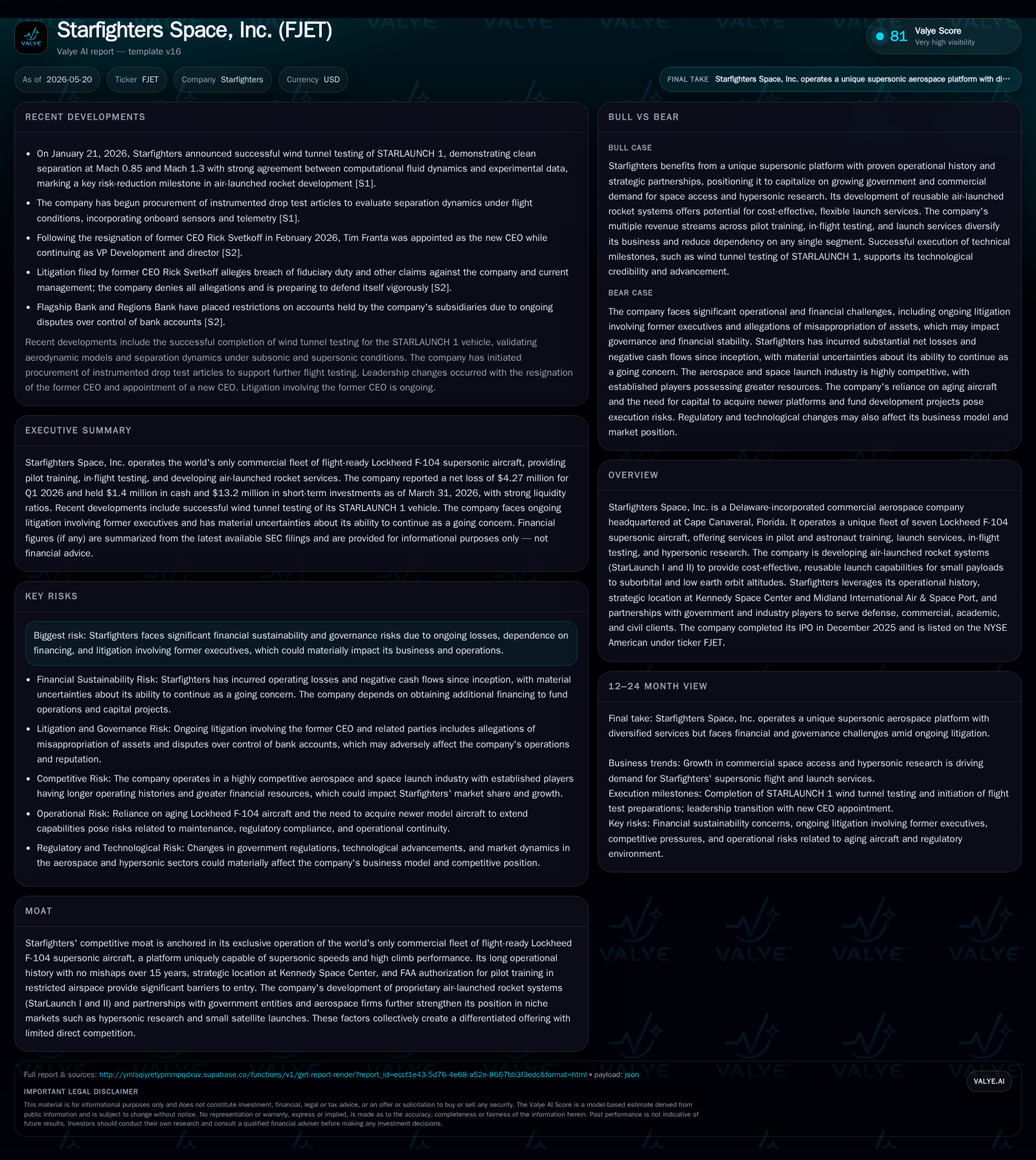
Starfighters Space reported successful wind tunnel testing of its STARLAUNCH 1 air-launched rocket in its most recent quarterly filing, confirming aerodynamic separation at supersonic speeds—a key milestone supporting its niche in hypersonic research and small satellite launch services built around its exclusive Lockheed F-104 fleet. Despite technical advances, the company faces financial headwinds including shrinking ancillary revenues, increased listing costs post-IPO, ongoing litigation, and material uncertainties about sustaining operations without additional financing. Growth depends on progressing the STARLAUNCH program and securing capital amid a competitive and evolving aerospace landscape.
Latest Quarterly Operating Landscape And Key Updates
Starfighters Space's Q1 2026 Form 10-Q filed May 20 reveals a nuanced operational environment marked by notable technological progress alongside financial caution. The company reported a significant reduction in "other income," which primarily comprises ancillary revenues from pilot training and equipment testing services. This declined to $15,000 in Q1 2026 from $87,900 in the year-ago quarter [S2]. Grant income also decreased to $24,000 from $40,000 over the same periods. These declines reflect constraints related to airspace availability, personnel deployment, or fluctuating client demand impacting short-term commercial activity.
Concurrently, listing fees surged by over $230,000 year-over-year to $233,149 for the quarter as Starfighters adjusts to public company obligations following its December 2025 IPO [S2]. The filing reiterates material uncertainties about the company's ability to continue as a going concern without securing additional funding [S2], despite maintaining positive working capital with current assets of approximately $18.2 million against current liabilities near $3.5 million and holding about $1.4 million in cash at quarter-end [F1]. Litigation-related restrictions on roughly $1.2 million of cash further constrain financial flexibility [S2][S7].
On May 15, the company announced the appointment of Jose Arias as Vice President of Space Operations. Mr. Arias brings aerospace manufacturing and space operations expertise from Blue Origin's New Glenn launch program [S3]. His responsibilities encompass leading spaceflight operations, mission execution, integration activities, and cross-functional coordination critical for scaling complex flight operations
Business Model: Leveraging Exclusive Supersonic Aircraft Capabilities
Starfighters operates the world's only commercial fleet of seven flight-ready Lockheed F-104 supersonic jets. These aircraft deliver unique capabilities—Mach 2+ speeds with exceptional climb rates—that underpin specialized aerospace service offerings unavailable elsewhere commercially [S1].
The company’s revenue streams include:
- Pilot and Astronaut Training: Utilizing supersonic flight profiles for defense and commercial spaceflight preparation.
- Launch Services & Access to Space: Employing F-104s as airborne platforms for launching suborbital rockets targeting microgravity research missions.
- Research & Development / Test & Evaluation: Providing aerodynamic test beds supporting hypersonic vehicle development for government and industry clients.
- Defense, Civil & Academic Services: Offering tailored flight hours for advanced aerospace projects across diverse sectors.
Pricing is influenced by flight hours flown, mission complexity involving multi-disciplinary teams, aircraft availability constrained by vintage maintenance requirements, and contractual arrangements predominantly centered at NASA Kennedy Space Center and Midland Air & Space Port hubs.
Ancillary income volatility highlights sensitivity to client demand cycles and regulatory airspace access limitations. High fixed costs related to maintaining legacy supersonic aircraft create margin pressures but reinforce significant switching costs for customers relying on these unique capabilities.
Industry Positioning: A Strong Competitive Moat Around Legacy Supersonics
Starfighters' exclusive control over the only commercial fleet of flight-ready Lockheed F-104 aircraft constitutes a meaningful competitive barrier. Unlike peers operating subsonic jets or ground-based launch systems exclusively (e.g., Blue Origin or Rocket Lab), Starfighters uniquely offers rapid air-launch capabilities with validated supersonic separation dynamics essential for certain hypersonics research programs [S1][S23]
Operating bases within federally regulated spaces such as NASA's Kennedy Space Center provide privileged access to restricted airspace vital for training and testing without typical delays faced elsewhere [S1]. FAA licensing aligned with these restricted zones further consolidates operational authority that new entrants find difficult to replicate.
While larger competitors benefit from broader resources or diversified launch portfolios, they lack this specific platform capability. Starfighters’ long operational history supports safety credentials crucial for sensitive research collaborations.
However, reliance on aging aircraft imposes scalability constraints until newer "Platform II" acquisitions materialize [S1], capping growth unless complemented by innovations like STARLAUNCH extending market reach beyond traditional services.
Growth Trajectory: STARLAUNCH Program as a Strategic Catalyst
The STARLAUNCH program represents Starfighters’ primary growth engine beyond legacy pilot training and test flights. In January 2026, the company completed pivotal wind tunnel testing validating aerodynamic separation of its STARLAUNCH 1 air-launched rocket at Mach 0.85 (subsonic) and Mach 1.3 (supersonic) speeds with clean separation observed under all conditions—a critical risk mitigation milestone preceding physical flight tests [S1][S2]
This campaign combined computational fluid dynamics modeling with experimental runs at the FAMU/FSU Polysonic Wind Tunnel yielding strong correlation between simulation and measured forces/moments.
STARLAUNCH targets suborbital microgravity missions catering to research institutions and commercial payload operators seeking cost-effective alternatives to traditional ground launches with rapid reusability potential.
Validated aerodynamic models also support broader hypersonics testing programs requiring clean vehicle separation during release phases—potentially unlocking defense R&D contracts.
Next steps involve fabricating instrumented drop test articles equipped with telemetry systems to gather real-time data under flight conditions. Execution led by VP Arias will require tight integration across engineering, manufacturing, quality assurance, and flight operations teams [S3][S2]. Successful demonstration would transition Starfighters toward scalable launch services diversifying revenue sources aligned with expanding space economy demand.
Risks And Operational Constraints In An Early-Stage Aerospace Environment
Despite technological advances, Starfighters confronts several risks common in nascent aerospace ventures:
- Financial Sustainability: Elevated quarterly operating expenses including listing fees ($233k) combined with ongoing cash burn create material uncertainties about continued operations absent capital raises [S2].
- Litigation Impact: Legal disputes involving former executive misappropriation have resulted in recognized losses (
$395k) plus restricted cash ($1.2 million), impeding liquidity management [S7]. - Fleet Aging And Modernization Needs: Maintenance demands on vintage F-104s are substantial; planned acquisitions of newer Platform II aircraft depend on funding availability limiting long-term planning certainty [S1].
- Revenue Concentration And Volatility: Declining ancillary income highlights vulnerability to client budget shifts or regulatory constraints affecting scheduling stability [S2].
- Competitive Pressures: Larger well-funded entrants may erode niche market share; changes in regulatory regimes could reduce access advantages currently enjoyed [S1][S23].
Balancing aggressive technology development timelines against prudent financial management while navigating complex compliance environments remains critical.
What To Monitor Next: Key Milestones And Execution Signals
Investors should watch several indicators signaling Starfighters’ trajectory:
- Completion of instrumented drop tests validating aerodynamic separation under actual flight conditions enabling progression toward operational STARLAUNCH missions.
- Growth in contract backlog across hypersonics testing services or pilot training reflecting higher fleet utilization.
- Progress in acquiring newer supersonic aircraft enhancing capacity and extending operational lifespan.
- Resolution or mitigation of litigation effects restoring unrestricted cash flow access.
- Evidence of capital raises or expense controls moderating cash burn consistent with post-IPO adjustments.
- Regulatory approvals expanding FAA certifications or restricted airspace usage enhancing operational scale.
- New partnerships with government or academic entities advancing credibility and pipeline visibility.
These milestones will clarify whether Starfighters can translate aeronautical innovation into commercially sustainable growth within the evolving hypersonics and small satellite launch markets.
Disclaimer: This analysis is based solely on publicly filed SEC disclosures through May 20, 2026. Financial figures referenced are supported explicitly by cited filings without extrapolation.
Disclaimer: This is research-only, informational analysis and not investment advice. It may include AI-generated interpretation and general industry context. Always verify important details using primary sources.

Comments