
Forestar Group Drives Resilience with Diversified Lot Development and Strategic Partnerships
Forestar’s Q2 2026 results reflect shifting homebuyer demand dynamics, with volume declines offset by pricing gains and stronger tract sales revenue.
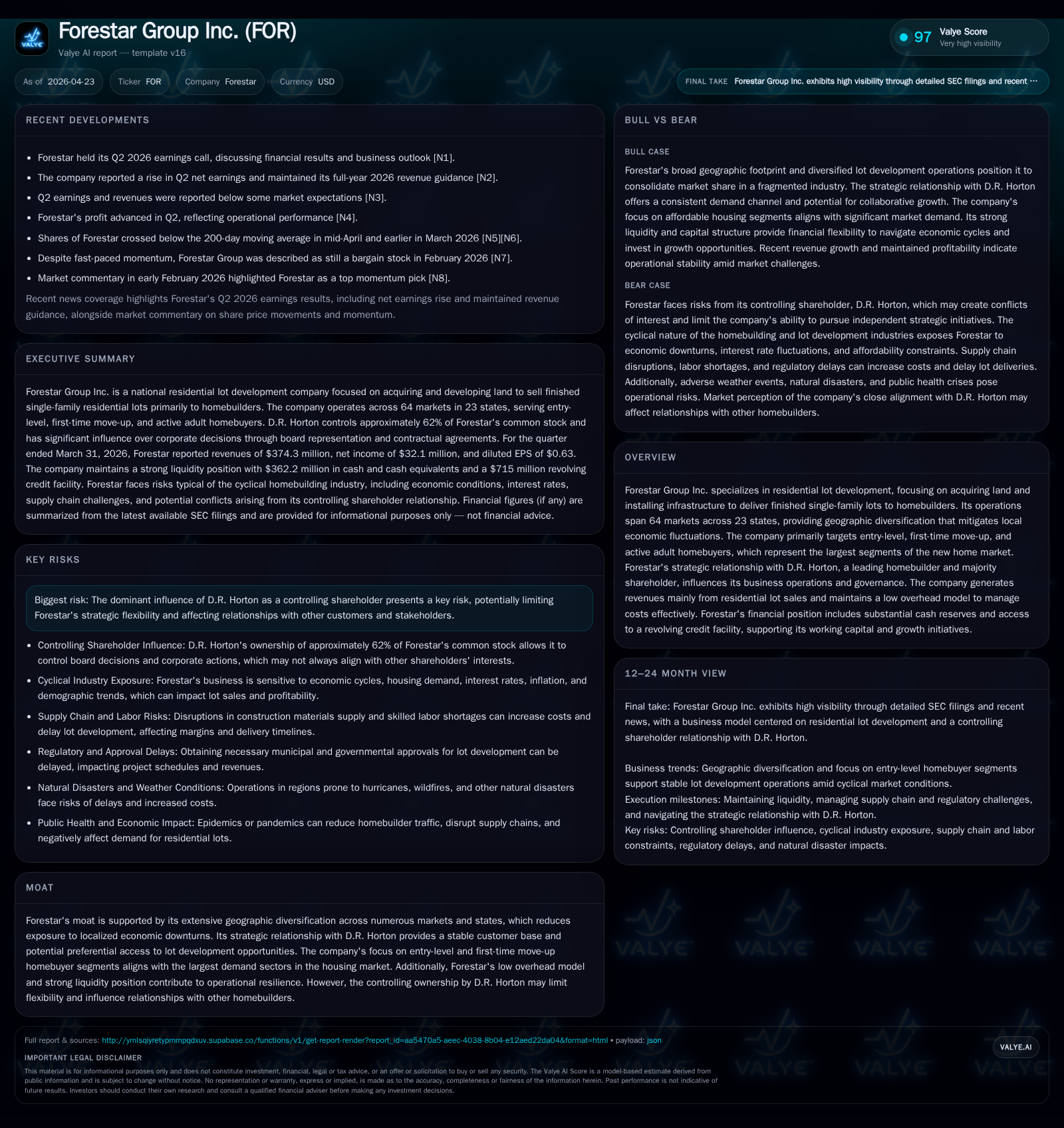
In the second quarter ended March 31, 2026, Forestar Group reported a 15% decline in total residential lots sold, juxtaposed with a 12% increase in average lot prices, resulting in a net 5% drop in lot sales revenue. Consolidated revenues rose 8%, driven by growth in tract sales and other segments. This financial performance underscores evolving market conditions characterized by affordability challenges and cautious consumer sentiment. Forestar’s geographically diversified lot development model, coupled with its strategic alliance with majority shareholder D.R. Horton, provides operational stability and resilience. Despite volume softness, the company maintains solid liquidity and a moderate leverage ratio, positioning it to navigate ongoing cyclical pressures in the U.S. single-family housing market.
Latest Operating Performance: Sales Volume Decline Offset by Pricing Gains
Forestar Group's second quarter ended March 31, 2026 [S2] revealed mixed signals from its core residential lot sales operations. Total residential lots sold fell meaningfully by 15% year-over-year, an indication of continued softness in underlying new single-family home demand amid affordability constraints facing buyers [N1][N2]. However, this was partially mitigated by a robust 12% increase in the average sales price per lot, resulting in only a modest 5% reduction in residential lot sales revenue relative to the prior year period.
Despite the decline in volume-driven revenues from lot sales, Forestar's consolidated revenues rose by 8% to $647.3 million owing principally to improved tract sales and ancillary revenue streams [S2]. This suggests that while lot deliveries softened—reflective of cautious consumer activity—other segments within their broader real estate operations gained traction.
Profitability held up reasonably well: pre-tax income edged up to $64.8 million compared to $62.6 million year-over-year while pre-tax operating margins remained relatively stable at about 10%, down slightly from 10.4%. This stability reflects effective cost control measures despite inflationary development headwinds such as elevated material costs and protracted municipal approval processes still affecting cycle times [S23].
Such pricing power amidst declining volumes signals at least temporary resilience in Forestar's ability to push through price increases to offset demand softness—an important dynamic given the overall challenging macro environment for single-family housing.
Forestar’s Business Model: Residential Lot Development and Strategic Customer Profiles
Forestar generates revenues primarily through the acquisition of land followed by infrastructure installation culminating in the delivery of finished single-family residential lots to homebuilders [S1][S23]. This business-to-business model connects land development directly with local, regional, and national builders who then construct homes targeting key buyer segments.
Critically, Forestar focuses on entry-level buyers (first-time home purchasers), first-time move-up buyers (those upgrading from starter homes), and active adults—segments that represent the majority of new home demand nationally . These buyer groups tend to be highly sensitive to interest rate fluctuations and housing affordability challenges but also provide large addressable markets underpinning steady foundational demand.
Operational efficiency is maintained via a low overhead model minimizing fixed administrative burdens so that gross margins primarily depend on successful lot development economics [S2]. By preparing fully developed lots ready for construction—with required permits and installed infrastructure—Forestar reduces time-to-market risk for builders who face labor constraints themselves.
This approach also supports tight partnerships with customers; reducing switching costs as builders gain confidence in Forestar's ability to deliver consistent quality product within anticipated timelines.
Industry Context: Fragmented Homebuilding Lot Supply Supported by Geographic Diversity
The residential lot development industry remains fragmented across regional markets due to wide variations in land availability, regulatory landscapes, economic conditions, and demographic trends [S1][S27]. Forestar strategically operates across an expansive footprint encompassing approximately 64 diverse markets spread over 23 states [S23].
This geographic dispersion is a critical moat element that shields Forestar from localized recessions or regulatory hurdles affecting individual metro areas or states. For instance, regulatory delays noted in certain municipalities can extend development cycles but are balanced out by smoother operations in other regions.
Fragmentation also impacts pricing power; where supply constraints exist locally, developers can command premium prices while commoditization may pressure prices elsewhere. Forestar’s scale enables it to arbitrate across markets capturing pockets of premium pricing while maintaining volume elsewhere.
Customer dynamics further reinforce Forestar's competitive position: builders often prefer established suppliers who consistently deliver developed lots on schedule—creating switching costs that protect incumbents like Forestar against encroachment.
Strategic Relationship with D.R. Horton: Benefits and Governance Implications
A cornerstone of Forestar's operational stability is its strategic relationship with D.R. Horton (DHI), which holds approximately a 62% ownership stake and thus controls Forestar's governance outcomes [S1]. This majority ownership translates into preferential access for Forestar to sell lots directly into one of the country's largest national homebuilders’ pipelines.
Operationally, this relationship secures predictable demand channels—a valuable advantage during periods of market uncertainty—and aligns product development strategies closely with builder specifications.
However, this tight affiliation poses trade-offs: Forestar’s autonomy is constrained by D.R. Horton’s voting control provisions restricting certain corporate actions without majority shareholder approval [S1]. Moreover, heavy reliance on D.R. Horton may limit Forestar’s attractiveness or negotiating leverage with competing builders wary of working under the shadow of D.R. Horton's controlling interest.
In governance terms, D.R. Horton's authority extends to designating four out of seven board members subject to independent director guidelines but still enabling significant influence over capital allocation decisions including equity issuance or dividend policies.
Growth Prospects: Market Drivers, Pricing Power, and Segmentation Risks
Looking ahead, Forestar’s growth hinges on several interrelated factors:
- Demand drivers: Population growth trends especially among millennials entering prime homebuying years sustain underlying entry-level buyer volumes; however affordability constraints exert significant headwinds dampening near-term willingness or ability to purchase new homes [S23][N1].
- Pricing power: The recent quarter’s price increases demonstrate some passthrough ability reflecting both regional supply limitations and components inflation; sustained pricing gains would be crucial if volumes remain pressured.
- Segmentation risks: Concentration on entry-level/first-time move-up buyers exposes Forestar somewhat cyclically given these segments’ sensitivity to mortgage rates volatility. Active adult segment growth potential mitigates some risk via demographic tailwinds.
- Development cycle efficiency: Continued efforts to reduce permitting delays and control rising infrastructure costs will be vital for margin preservation.
- Geographic mix: Expanding presence selectively into high-growth Sun Belt markets while managing exposure to slower-growth regions will shape long-term scalability.
Thus growth prospects embody a balance between structural opportunities from favorable demographics/geographies versus cyclical risks tied to housing affordability and credit availability developments.
Near-Term Watchpoints: Performance Guidance and Execution Milestones
The immediate future warrants close attention on several fronts:
- Management's upcoming quarterly guidance updates clarifying expectations for lot sale volumes amid prevailing affordability challenges [N2].
- Development project completions timing impacting revenue recognition patterns given elongated municipal permitting noted as current bottlenecks [S23].
- Margin trajectory amid evolving cost environments—monitoring whether operational levers continue offsetting inflationary pressures effectively.
- Order backlog health particularly contribution from D.R. Horton versus other builders signaling diversification or concentration trends.
- Shifts in builder incentives or consumer buying behavior reflecting mortgage interest rate movements potentially impacting demand elasticity further [N1].
Forestar’s execution against these performance vectors will inform whether recent pricing strength counterbalances volume softness sustainably or if further adjustments are necessary.
Financial Health and Capital Structure: Liquidity, Leverage, and Covenants
Historical performance (annual)
| FY | Rev ($mm) | Net ($mm) | CFO ($mm) | Capex ($mm) | Rev YoY | Net YoY |
|---|---|---|---|---|---|---|
| 2025 | 1662 | 168 | -198 | 2 | +10.1% | -17.5% |
| 2024 | 1509 | 203 | -158 | 2 | +5.0% | +21.9% |
| 2023 | 1437 | 167 | 364 | 1 | -5.4% | -6.7% |
| 2022 | 1519 | 179 | 109 | 4 |
Source: SEC companyfacts cache [F1].
Capital returns and efficiency (annual)
| FY | FCF ($mm) | ROE% |
|---|---|---|
| 2025 | -200 | 9.5 |
| 2024 | -161 | 12.8 |
| 2023 | 363 | 12.2 |
| 2022 | 105 | 14.9 |
Source: SEC companyfacts cache [F1].
As of March 31, 2026, Forestar reported $362 million cash & equivalents alongside zero borrowings on its senior unsecured revolving credit facility that has capacity totaling $715 million—with additional accordion rights up to $1 billion subject to bank approvals [S2][S6][F1]. The company had approximately $793.5 million total debt yielding net debt near $431 million (debt less cash).
Leverage ratios reflect moderate capital structure conservatism: debt-to-total-capital stood at about 30%, while net debt-to-total-capital was approximately 19%, comfortably below the company's targeted ceiling near 40% long term [S6]. The firm remains compliant with all revolving credit facility covenants restricting dividends, additional indebtedness, liens creation or significant asset sales without lender consent [S2][S11].
Interest expense related mostly to fixed-rate senior notes maturing between late-2026 through early-2033 provides predictability though floating rate borrowings under revolver expose modest interest rate risk tied primarily to SOFR movements [S14][S18].
Operating cash flows have faced headwinds leading to negative free cash flow through investment cycles typical for land acquisition/development phases; however strong liquidity cushions working capital needs enabling flexibility amid uncertain economic conditions [F1].
Overall financial positioning supports ongoing lot development investments while preserving nimbleness through uncertain housing demand environments and price normalization risks.
Disclaimer: This analysis is based exclusively on publicly available SEC filings up through April 2026 combined with corroborated secondary news sources. It does not constitute investment advice or recommendations regarding buying or selling securities issued by Forestar Group Inc.
Disclaimer: This is research-only, informational analysis and not investment advice. It may include AI-generated interpretation and general industry context. Always verify important details using primary sources.

Comments