
Forestar Navigates Lot Sales Volume Decline with Geographic and Customer Mix Shifts
Forestar Group’s Q3 results reflect moderate sales volume pressures offset by price improvements amid a strong capital and geographic footing.
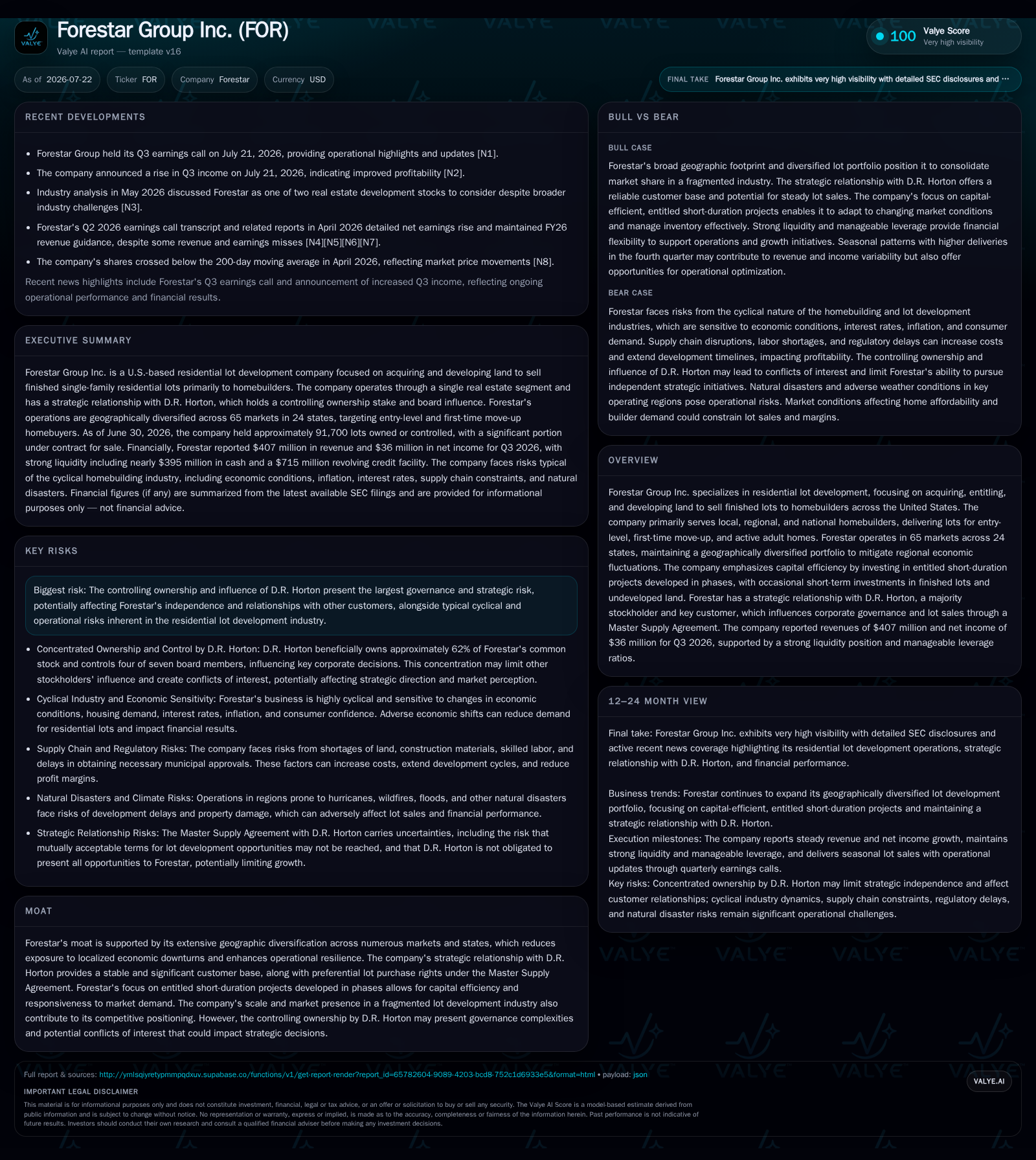
Forestar Group Inc. reported mixed Q3 2026 operating metrics, with a 9% decline in residential lots sold over the nine months ended June 30, 2026, partially offset by an 8% increase in average sale price per lot, resulting in net flat residential lot revenues year-over-year. The company’s geographically diversified portfolio across 65 markets and strategic relationship with majority owner D.R. Horton underpin its operational resilience. Forestar's capital discipline through phased development and short-duration projects is central to its business model, though risks from customer concentration and cyclical housing demand remain relevant. Liquidity is robust with $395 million cash and $670 million undrawn credit at quarter-end, supporting growth and debt management.
Latest Operating Update and What It Means
Importantly, overall consolidated revenues rose by around 6% to $1.05 billion due to higher tract sales and other real estate revenue streams beyond residential lots [S2]. Meanwhile, pre-tax income increased modestly to $113.5 million from $106.2 million last year, maintaining a stable pre-tax operating margin around 10.8%, reflecting controlled costs relative to revenues despite volume pressure [S2]. This snapshot indicates Forestar's ability to partially offset volume softness with pricing and product mix shifts.
Business Model Specifics: From Land Acquisition to Finished Lots
Forestar generates revenue principally by acquiring raw land parcels across diverse U.S. markets, securing entitlements necessary for single-family residential development, installing infrastructure such as roads and utilities, then selling finished buildable lots primarily to homebuilders [S1][S25]. These customers range from local and regional players to national homebuilders like D.R. Horton — which simultaneously maintains a majority ownership stake (~62%) — furnishing Forestar with both strategic partnership advantages and governance complexities.
The company's approach focuses on entitled short-duration projects developed incrementally through phases that align releases of finished lots closely with current homebuilder demand [S25]. This phased development model is integral for capital efficiency: it limits upfront capital exposure and minimizes inventory holding risks typical in long-term land banking.
Occasional short-term investments into finished lots (“lot banking”) or raw land (“land banking”) are used tactically when excess capital is available or when market timing warrants holding inventory briefly before sale [S25]. Control over entitlement cycles – typically a multi-step regulatory process of planning approvals – is critical; delays can lengthen project timelines and tie up capital longer than planned.
Revenue mechanics hinge on three pillars:
- Volume (lots sold), influenced by builder demand and competitive supply,
- Average selling price per lot driven by location quality, regional market conditions, and product segmentation (entry-level versus move-up or active adult),
- And customer concentration effects given the prominence of D.R. Horton under a Master Supply Agreement which secures preferential purchase rights but concentrates demand risk.
Industry Structure and Competitive Positioning
The residential lot development industry is fragmented yet deeply intertwined with the homebuilding sector upstream. Forestar’s extensive geographic reach—spanning about 65 distinct markets across 24 states—confers a significant advantage by diluting localized economic or regulatory disruptions that often characterize real estate cycles [S25]. This diversity reduces earnings volatility tied purely to any single metropolitan area or state policy environment.
Forestar competes against other lot developers ranging from specialized land entitlement firms to vertically integrated homebuilders with internal lot development arms (e.g., Lennar Corporation). Its emphasis on shorter-duration projects developed in phases contrasts with some players who engage heavily in longer-term land banking strategies that carry more capital at risk but potentially greater upside if timed well.
The strategic alliance with D.R. Horton positions Forestar within a unique niche balancing independent developer agility with homebuilder demand visibility. However, this relationship places governance control largely within D.R. Horton's influence (four of seven board seats are company designees), limiting autonomy on corporate actions like acquisitions or equity issuances without D.R.’s approval [S1]. This may complicate broader customer relationship expansions or strategic pivots over time.
Growth Drivers
Key drivers supporting Forestar’s growth trajectory include:
- Demographic Tailwinds: Rising household formations sustain demand for new housing starts focused on entry-level buyers—Forestar’s primary target segment—which underpins lot absorption rates.
- Geographic Expansion: Continuing targeted entry into new markets while deepening presence in existing ones aids scale economies and diversifies earnings sources.
- Master Supply Agreement: Collaboration with D.R. Horton guarantees baseline volume stability which can be leveraged for capital planning.
- Capital Efficiency via Phased Development: Aligning project cash outflows closely with buyer demand enables better working capital management and reduces inventory risk.
- Pricing Power Enhanced by Regional Mix Shifts: The recent uptick in average selling prices per lot — partly driven by focus on higher-value regions—could improve margins if sustained.
- Land Acquisition Opportunities: Favorable purchasing environments or unlocking permits more swiftly than competitors could provide sourcing advantages.
Risks and Constraints
Forestar faces several notable risks:
- Cyclicality of Housing Market: Lot demand directly correlates with broader new home construction activity; rising mortgage rates or economic downturns may depress volumes.
- Customer Concentration: Heavy reliance on D.R. Horton exposes Forestar to revenue volatility if this key partner alters buying patterns or market share.
- Governance Complexity: Majority ownership by D.R. Horton relationship segment.
- Trends in average selling price per lot sustained beyond one quarter signaling pricing power versus cyclical discounting pressures.
- Progression speed through entitlement phases across new developments affecting future lot availability.
- Changes in geographic mix revealing management’s market prioritization shifts relative to regional housing dynamics.
- Corporate governance developments or board changes impacting strategy especially regarding shareholder interests versus majority owner control.
- Debt covenant compliance updates given upcoming smaller senior note maturity windows starting mid-2028 offer refinancing risk insights.
Financial Profile Discussion
At June 30, 2026, Forestar held approximately $395 million in cash and equivalents alongside nearly $794 million of total debt, yielding net debt near $399 million after cash offsets [F1]. The company maintains solid liquidity supported by a $715 million senior unsecured revolving credit facility, with about $670 million undrawn capacity, maturing primarily at the end of 2029 (with a smaller tranche due late October 2026) [F1][S11].
Forestar continues servicing $300 million senior notes due March 2028 (5%) alongside $500 million notes maturing in March 2033 (6.5%), providing a balanced maturity ladder without immediate refinancing pressures [S11][S13]
Operating income trends have maintained stability despite softer volumes thanks to pricing gains and non-lot real estate revenues contributing incremental top-line expansion [S2]
Overall, Forestar’s financial profile exhibits disciplined capital structure management combined with prudent liquidity buffers vital in this cyclical sector where working capital swings with inventory cycles can be significant.
This analysis integrates recent quarterly disclosures with established industry framing to present an informed view into Forestar Group Inc.’s current operating state and strategic positioning within residential lot development while highlighting key growth levers and risk exposures for continued monitoring.
Disclaimer: This is research-only, informational analysis and not investment advice. It may include AI-generated interpretation and general industry context. Always verify important details using primary sources.

Comments