
First Industrial Realty Trust Strengthens Its Portfolio and Financial Flexibility in Q2 2026
Q2 2026 results show robust operational metrics and strategic capital management underpinning First Industrial’s growth amid favorable industrial real estate trends.
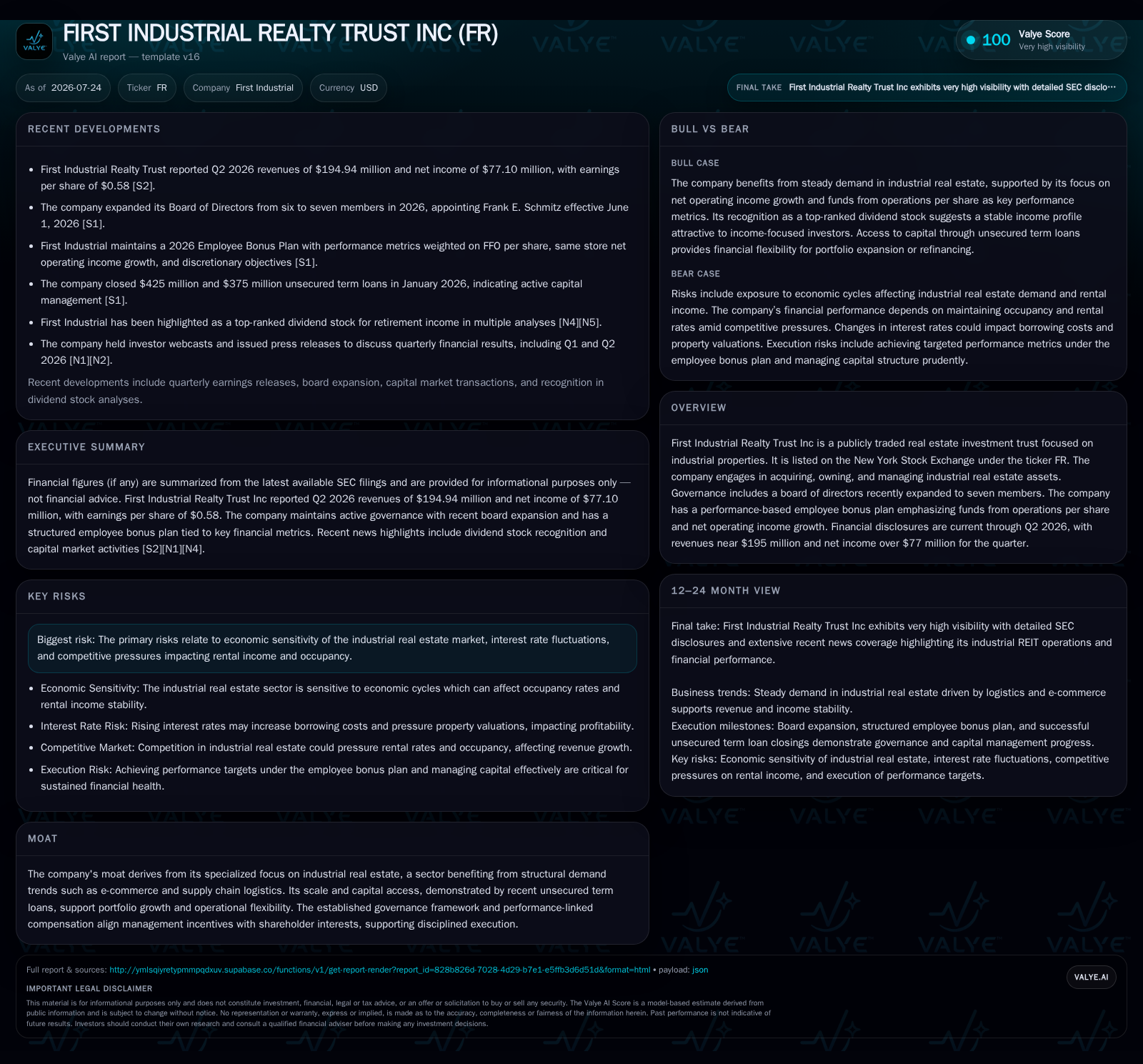
First Industrial Realty Trust reported strong Q2 2026 performance, with revenues approaching $195 million and net income surpassing $77 million, reflecting solid occupancy and rental growth in its industrial property portfolio. The company’s strategic use of unsecured term loans supports disciplined acquisitions and development, enhancing capital flexibility despite a leveraged balance sheet. Structural tailwinds from e-commerce and supply chain logistics continue to drive demand for its warehouse and distribution center assets. Industry risks remain linked to interest rate sensitivity and macroeconomic cycles influencing tenant demand and lease renewals.
Q2 2026 Operational Performance Reinforces Industrial Focus
First Industrial Realty Trust demonstrated solid operating momentum in Q2 2026 with revenues approaching $195 million and net income exceeding $77 million [S2], [S3], [N1]. This outcome reflects effective portfolio management centered on leasing modern industrial warehouses and distribution centers that align closely with ongoing structural demand shifts toward e-commerce fulfillment. The company’s ability to maintain stable occupancy rates through the quarter supports consistent rental income streams, a critical factor given the long-term lease structures typical in industrial REITs. This operational leverage positions First Industrial well for sustainable cash flow generation essential to funding dividends and reinvestment activities.
E-commerce Tailwinds Enable Rental Income Strength
The sustained expansion of e-commerce underpins the sector-wide demand for logistics real estate, a trend that First Industrial strategically leverages through its property mix focused on last-mile delivery hubs and freight distribution centers [S1],. This structural demand not only bolsters occupancy but also enables incremental rental rate increases contributing to same-property net operating income growth. The company's tenant base predominantly comprises logistics, manufacturing, and e-commerce fulfillment operators whose reliance on reliable warehouse space strengthens lease renewal prospects. Consequently, First Industrial benefits from pricing power relative to more general industrial REIT portfolios lacking this direct exposure.
Capital Strategy Balances Growth with Financial Flexibility
Supporting its growth ambitions, First Industrial has proactively structured its capital base with recent amendments to unsecured term loan agreements executed early in 2026 [S5]. These facilities underpin acquisitions and selective developments by providing liquidity while maintaining balance sheet flexibility. As of Q2 end, the company reported approximately $2.58 billion in total debt against $46 million in cash equivalents, resulting in net debt close to $2.53 billion [F1]. This leverage level permits accretive capital deployment but necessitates vigilant interest coverage monitoring amid a higher-rate environment described in the Valye overview. The successful navigation of these financing arrangements is vital for limiting refinancing risk while enabling opportunistic portfolio expansion.
Lease Portfolio Stability Highlights Tenant Quality Metrics
A central pillar of First Industrial’s operational resilience is its stable lease portfolio characterized by a defensible weighted average lease term (WALT) that mitigates vacancy risk as leases mature. Although precise WALT figures are not disclosed here, the company emphasizes disciplined lease renewal efforts supported by performance-linked tenant improvements expenditures designed to retain high-quality tenants [S1]. Such practices reduce downtime between tenants and preserve net operating income quality through efficient turnover management. The tenancy profile anchored in logistics-oriented users further strengthens retention probabilities given their operational dependence on well-located warehouse facilities.
Peer Comparisons Illuminate Competitive Positioning
In the context of peers such as Prologis and Duke Realty, which lead the industrial REIT space by scale and geographic breadth, First Industrial occupies a competitive niche with a diversified national footprint that balances urban-adjacent last-mile facilities against larger regional distribution centers. While its debt-to-equity ratio is moderately elevated compared with some larger counterparts benefiting from broader capital access, First Industrial’s financial strategy successfully aligns growth initiatives with prudent risk management. The consistency in funds from operations (FFO) growth relative to industry benchmarks validates execution discipline even as the company navigates cyclical headwinds impacting leasing markets.
Growth Opportunities Anchored in Logistics Demand Expansion
Looking forward, multiple secular drivers support First Industrial’s growth trajectory: accelerating e-commerce penetration sustains warehouse demand; supply chain reshoring favors domestic logistics infrastructure investments; heightened attention to last-mile delivery augments need for urban-proximate facilities; favorable albeit fluctuating interest rates influence acquisition pacing. These factors collectively promote opportunities for same-property NOI improvement alongside targeted acquisitions fueling external growth. However, management maintains a cautious stance on pipeline deployment absent explicit disclosures, ensuring capital efficiency while seeking portfolio quality enhancement.
Identified Risks: Interest Rates and Market Cyclicality
Despite favorable structural trends, First Industrial faces inherent risks common across industrial real estate REITs. Rising interest rates elevate borrowing costs directly affecting interest coverage ratios given the leveraged balance sheet reported at quarter-end [F1], heightening pressure on dividend sustainability if leasing momentum falters [S2]. Economic cyclical downturns could reduce tenant demand temporarily lowering occupancy or forcing concessions on renewal rents. Tenant credit quality concentration within logistics sectors may pose downside risks if specific operators experience distress amidst macro volatility. Regulatory changes or localized oversupply could also disrupt market balance though current indicators point to stable fundamentals.
Upcoming Catalysts to Monitor for Execution Assessment
Next quarters will be pivotal for assessing how well First Industrial converts pipelines into realized gains. Key metrics include quarterly updates on lease renewal rates reflecting tenant retention efficacy, acquisition volume confirming capital deployment capacity aligned with unsecured loan availability, and any revisions to FFO per share guidance signaling earnings trajectory shifts consistent with market conditions [S3]. Monitoring these operating markers against peers' performance will illuminate whether First Industrial can sustain competitive advantages during economically turbulent intervals.
Financial Profile Discussion: Leverage, Liquidity, Dividend Sustainability
At June 30, 2026, First Industrial reported total debt of approximately $2.58 billion offset by cash reserves of about $46 million resulting in net debt of roughly $2.53 billion [F1]. This level of leverage is typical within mid-sized industrial REITs actively pursuing portfolio expansion but mandates careful liquidity management especially considering rising interest expenses implicit in unsecured term loans renewed earlier this year [S5]. Dividend payout norms rely heavily on funds from operations (FFO), supported by management incentives aligned with FFO per share and NOI growth targets reinforcing financial discipline [S12], [S16],. Market conditions governing credit availability thus remain a key watchpoint for assessing capital structure resilience going forward.
This analysis synthesizes disclosures from First Industrial Realty Trust’s recent filings contextualized within prevailing industry dynamics shaping industrial REIT operations today. It emphasizes operational results validated by key metrics like occupancy stability and NOI growth alongside evolving capital strategies underpinning sustainable expansion amid an active e-commerce-driven logistics real estate cycle. While prospects appear favorable given sector tailwinds, ongoing macroeconomic volatility related to interest rates and tenant demand should be monitored vigilantly as potential headwinds.
Disclaimer: This report is analytical commentary based solely on publicly available information through SEC filings and reputable news sources as of the stated dates without forward-looking predictions or investment research views.
Disclaimer: This is research-only, informational analysis and not investment advice. It may include AI-generated interpretation and general industry context. Always verify important details using primary sources.

Comments