
FRP Holdings Advances Strategic Investments Amid Industrial and Residential Growth
FRP Holdings deploys capital into industrial expansions and multifamily developments while managing revenue shifts and rising costs in its diversified real estate portfolio.
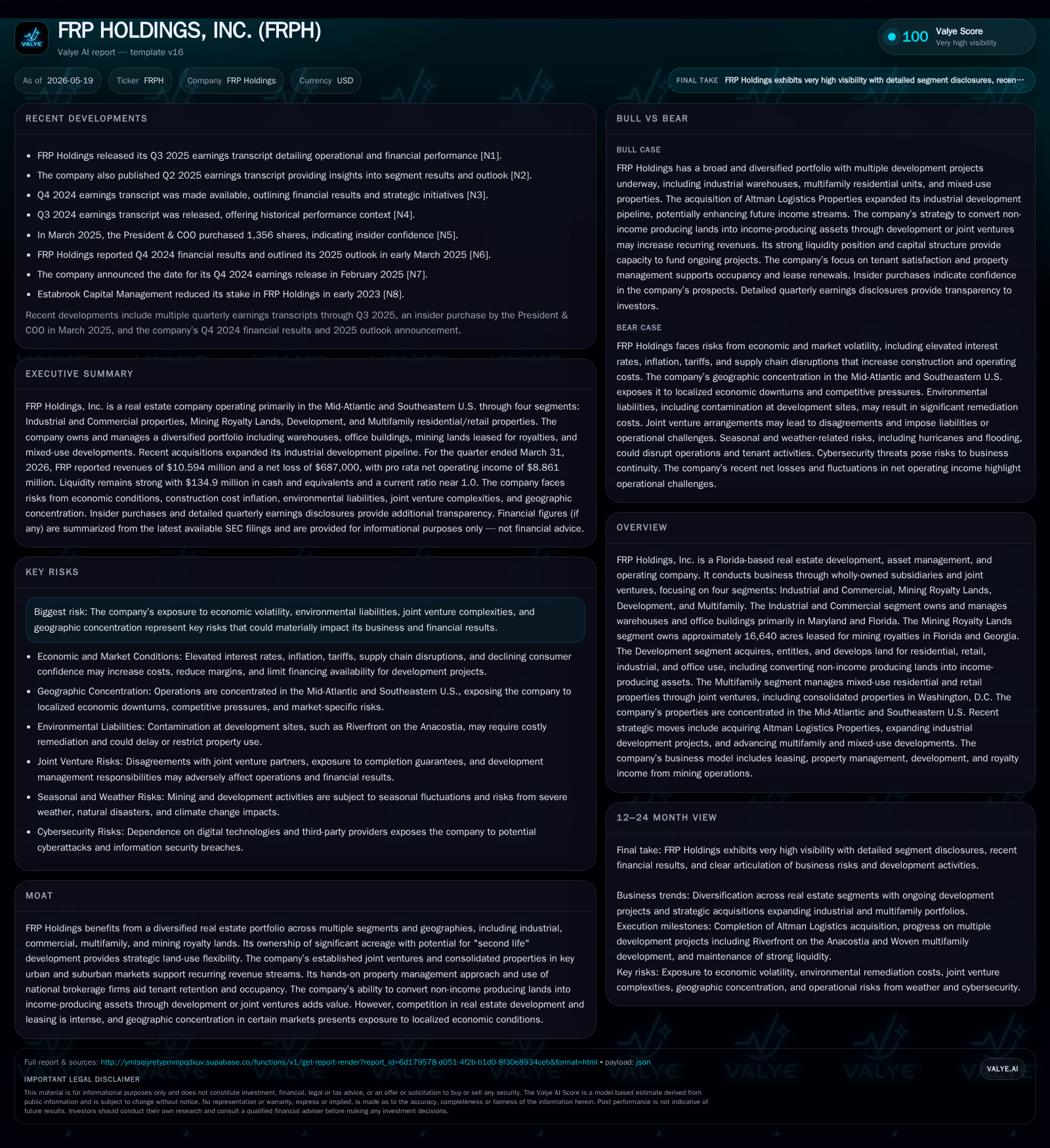
In its latest quarterly filing ending March 31, 2026, FRP Holdings reported mixed revenue trends with a 5.1% decline in lease revenues offset by a nearly 15% increase in mining royalty income, alongside the introduction of joint venture management fees. The company plans substantial capital deployment totaling $69 million in 2026 and an additional $113 million thereafter toward ongoing development projects, supported by strong liquidity and a moderate net debt position. Its diversified platform spanning industrial, multifamily, mining royalties, and development segments provides resilience amid market headwinds including occupancy challenges and inflationary pressures. The recent acquisition of Altman Logistics properties enhances FRP's industrial footprint and joint venture income streams, underpinning its long-term growth ambitions despite operational cost escalation and concentrated regional exposure.
Latest Quarterly Operating Developments and Strategic Capital Commitments
FRP Holdings’ first quarter ended March 31, 2026 delivered a nuanced operational performance during a dynamic real estate market backdrop [S2]. Lease revenues softened by 5.1% year-over-year to $6.7 million as industrial and multifamily segments faced tenant turnover, leading to transient vacancies and non-renewals. Against this softness was a firm uplift in mining royalty income, up nearly 15% to $3.7 million, propelled by a notable increase in royalty tons extracted coupled with improved revenue per ton figures.
A new element in the quarter’s financials is $164,000 generated from joint venture management fees — signifying progress in scaling third-party partnership operations which diversify earnings streams beyond traditional lease revenues.
Cost pressures are evident as operating expenses lifted sharply by around 15%, partly reflecting integration costs connected to the October 2025 acquisition of Altman Logistics Properties LLC [S17], which brought under FRP’s wing a development pipeline of institutional-grade industrial assets concentrated in Florida and New Jersey submarkets.
Capital expenditure plans underscore FRP's strategic intent to accelerate its expansion: $69 million is targeted for investment this calendar year towards existing holdings and joint ventures while a further $113 million is budgeted beyond 2026 to advance projects already underway [S2]. This cash outlay is planned to be funded through an established mix of existing liquidity, cash flows from operations, property dispositions, joint venture distributions, and potential borrowings under credit facilities — maintaining financial flexibility during market uncertainties
Integrated Business Model and Portfolio Composition
FRP operates across four core segments: Industrial & Commercial leasing operations primarily consisting of warehouses and office properties located principally across Maryland and Florida; Mining Royalty Lands that include over 16,600 acres under mineral leases mostly within Florida and Georgia; Development activities encompassing residential, retail, industrial, and office construction projects aimed at transforming held land into income-generating assets; and Multifamily residential/retail joint ventures focused on stabilized asset management within urban centers such as Washington D.C [S1]
Revenue generation involves multiple distinct customer bases: end tenants paying recurring rents on variable length leases (notably short-lived residential leases vs longer duration retail space agreements); miners producing royalties based on extraction volumes under leased lands; joint venture partnerships contributing fee-based income from cooperative development endeavors; alongside proceeds from property sales or ground leasing arrangements.
The company’s approach actively leverages “second life” land redevelopment opportunities—redeeming idle or non-income producing parcels for new constructions or partnerships—which bolsters optionality against cyclical cycles in leasing demand while enhancing intrinsic asset value. Supporting occupancy stability, FRP employs a hands-on property management ethos complemented by collaboration with national brokerage networks — crucial levers for tenant retention amid competitive commercial real estate markets.
Competitive Landscape and Industry Structure
Within the fragmented U.S. real estate ecosystem where specialized ownership dominates submarket control, FRP’s positioning reflects a mid-scale diversified player embedded particularly in southeastern U.S. corridors exhibiting robust population growth but also intense competition for premium industrial land parcels [S1]. Capital cost inflation for construction materials such as steel and lumber—exacerbated by tariffs—and rising labor expenses compress margin levers especially for Development segment projects.
The industrial portfolio contends with heightened leasing competition aggravated by recent tenant evictions which temporarily inflate vacancy rates although early signs point toward improved leasing velocity [S20]. Multifamily property operations face oversupply-driven rent pressure notably within Washington D.C., challenging same-store net operating income recovery despite measured expense control initiatives.
Joint ventures introduce operational complexity yet provide access to institutional-quality assets otherwise challenging to scale independently; however, co-investment dependencies may present timing risks or diluted return profiles if partner objectives diverge [S1]
Growth Catalysts from Development Initiatives and Mining Royalty Assets
Key engines driving future revenue expansion center on active land development schemes converting non-income producing acreage into industrial warehouses or mixed-use residential complexes [S17][S21]. The Altman Logistics acquisition marks a cornerstone enhancing FRP’s footprint across fast-growing submarkets such as Orlando’s Lake County—with warehouse construction underway targeting substantial square footage—and New Jersey logistics hubs slated for completion through early- to mid-2026
The mining royalty lands remain strategically vital for stable cash flow contributions with ongoing increases in royalty volume tonnage shipments allied with favorable pricing adequacy expected to persist [S2]. These lands also hold latent redevelopment potential once leases conclude or minerals are depleted.
Multifamily growth hinges on successfully stabilizing recently leased-up assets through sustained occupancy gains leading to incremental rent escalations while tightly managing operating costs—essential under prevailing soft market conditions [S20]. This segment's retail components benefit from long-term leases indexed with percentage rents tied to tenant sales performance adding incremental upside when economic activity strengthens.
Operational and Market Risks to Monitor
FRP underscores significant exposure to macroeconomic headwinds impacting supply chains (raw material availability), interest rate volatility affecting debt service costs on variable instruments, tariff-related cost inflation particularly for construction inputs like steel/lumber, as well as wage inflation stemming from labor shortages or regulatory changes elevating minimum wage thresholds [S1]
The regional concentration emphasis in southeastern U.S., though benefiting from demographic trends, introduces vulnerability should localized economic disruptions arise.
Environmental liabilities associated with mining lease reclamation may impose contingent costs requiring close oversight given the company’s responsibility scope under applicable law [S1]. The inherent complexities within joint venture structures can delay project completions or impose constraints on capital deployment timing affecting earnings visibility.
Key Upcoming Milestones and Execution Metrics
Investors should track the pace of capital expenditure execution relative to the planned $69 million spend during the remainder of 2026 alongside rollout progress across newly acquired Altman Logistics pipeline properties—the timing of warehouse completions slated chiefly within early next year bears directly on lease-up momentum and cash flow inflows [S2][S17]
Multifamily occupancy rates represent another critical KPI where improvement from current below-historic levels will materially influence segment profitability going forward [S20]. Equally important are renewal rates within commercial leasing portfolios especially given recent tenant churn noted in industrial parks.
Monitoring joint venture fee income growth post-May 2025 sign-up also offers insight into scalability success of these partnership models [S2]. Additionally, mining royalties’ shipment volume trends will remain barometers for sustaining enhanced revenue trajectories.
Current Financial Position and Capital Structure Snapshot
As of March 31, 2026, FRP Holdings maintains substantial liquidity quantified at approximately $108 million in cash and equivalents with only modest revolver usage ($6.5 million drawn against a $50 million facility) [S2]. Total secured notes payable aggregate around $329 million across business segments inclusive of construction loans tied primarily to development initiatives within joint ventures [S2]. Meanwhile net debt stands near $45 million after accounting for available cash resources indicating manageable leverage commensurate with current asset base [S2][F1].
This capital posture provides operational breathing room facilitating continued project funding internally supplemented by JV distributions or financing without over reliance on incremental debt issuance amidst uncertain credit climates. Variable-rate borrowings are hedged somewhat via predominance of fixed-rate instruments but still present sensitivity risks warranting vigilant financial management considering rising interest rates trend documented over last fiscal periods.
This analysis synthesizes available SEC filings dated through May 14-15, 2026 alongside contemporaneous disclosures without offering investment research views or forecasts. It focuses on observable operational dynamics grounded strictly in disclosed data without speculative interpolation.
Disclaimer: This is research-only, informational analysis and not investment advice. It may include AI-generated interpretation and general industry context. Always verify important details using primary sources.

Comments