
First Seacoast Bancorp's Strategic Merger Shifts Regional Banking Dynamics
The company faces near-term operational challenges alongside long-term growth opportunities driven by its merger plan with Cambridge Financial Group.
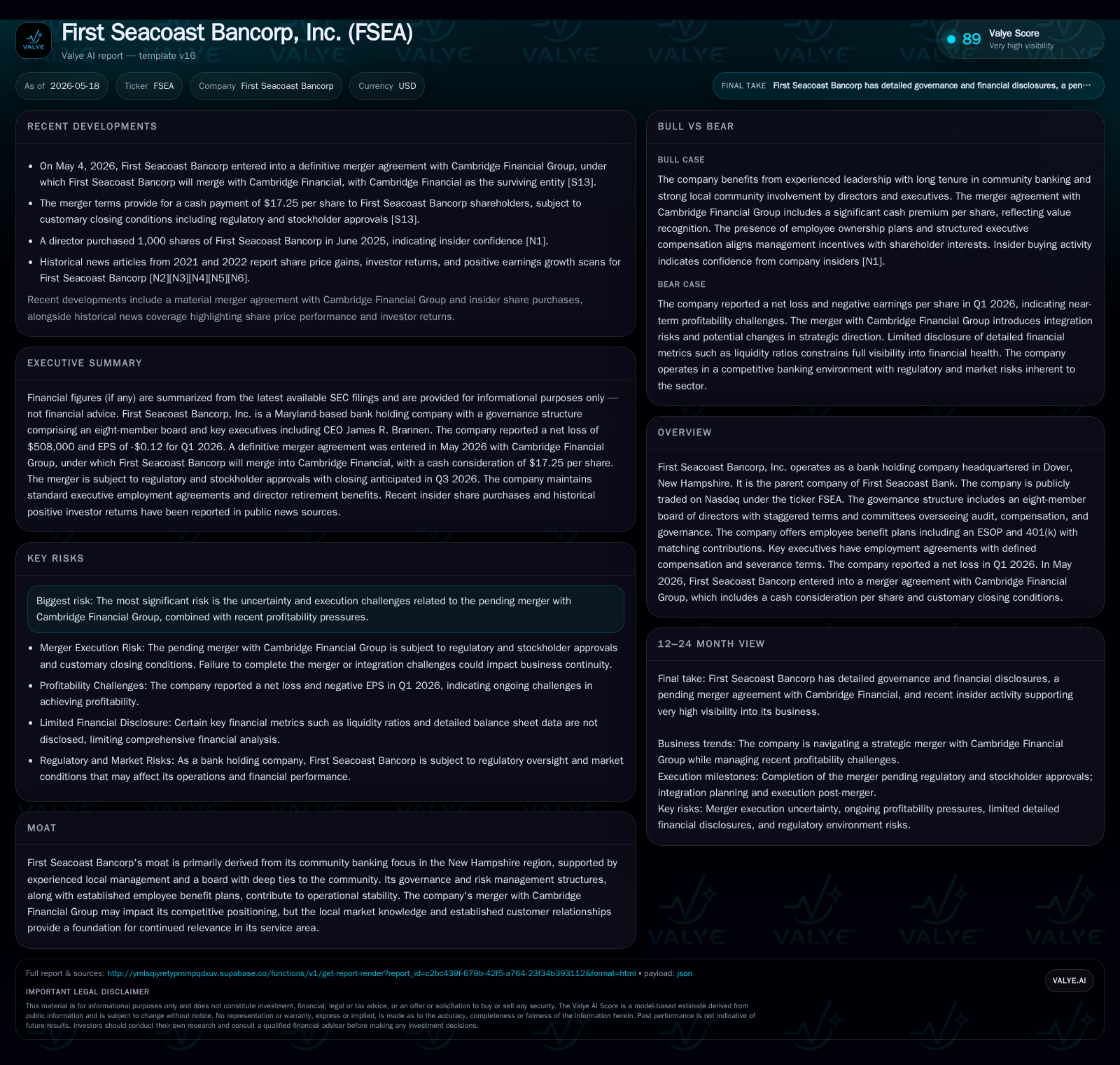
First Seacoast Bancorp reported a net loss in Q1 2026 and announced a definitive merger agreement with Cambridge Financial Group. The merger aims to create a larger regional banking entity with greater scale and market reach, leveraging First Seacoast’s localized community presence. While the combination offers potential synergies and expanded service capabilities, execution risks and integration challenges amid current profitability pressures pose near-term uncertainties. Key upcoming milestones include regulatory approvals and shareholder votes anticipated in Q3 2026.
Q1 2026 Turbulence: Earnings Decline and Merger Announcement
First Seacoast Bancorp opened 2026 with a notable operational setback as it reported a net loss in the first quarter [S2]. This contrasts with prior periods of modest profitability and underscores mounting pressures on margins in its core regional operations. Shortly after this quarterly filing, on May 4, 2026, First Seacoast entered into a material definitive merger agreement with Cambridge Financial Group, itself a mutual holding company affiliated with Cambridge Savings Bank [S3][S4][S13]. The deal contemplates Cambridge Financial surviving the transaction while First Seacoast shareholders receive $17.25 per share in cash consideration. This agreement introduces significant transitional dynamics for First Seacoast as it navigates earnings weakness alongside executing a complex consolidation within New England’s community banking sector.
First Seacoast Bancorp's Business Model: Localized Community Banking with Stability Pillars
Operating as the holding company for First Seacoast Bank based in Dover, New Hampshire, First Seacoast Bancorp primarily drives revenue through traditional community banking activities including deposit products, lending portfolios spanning commercial and residential segments, and fee income from ancillary financial services [S1]. Its business model benefits from longstanding customer relationships embedded within its localized footprint. Complementing this are governance structures featuring an eight-member staggered board overseeing strategic risk management [S1], along with robust employee benefit plans such as ESOPs and 401(k) matches that promote retention and institutional knowledge continuity. These elements collectively contribute not only to operational stability but also reinforce intangible competitive advantages difficult to replicate at scale.
Competitive Framework: Regional Focus Underpinning Moat Amid Consolidation Trends
First Seacoast’s competitive moat is predominantly derived from deep community integration within New Hampshire markets where trust-based relationships underpin client retention [S3]. Unlike large national banks, this regional focus enables strong pricing discipline on deposits and select lending segments owing to less direct competition locally. However, industry-wide consolidation among peers signals structural pressure on smaller banks to achieve scale economies necessary for technology investments and regulatory compliance efficiencies. Against this backdrop, First Seacoast’s merger with Cambridge Financial represents a strategic response to these macro trends by seeking to broaden its geographic footprint while preserving localized service differentiation
Synergies and Challenges in the Cambridge Financial Merger
The merger agreement outlines customary representations and warranties complemented by typical termination rights including a $3.5 million cash termination fee if the deal collapses under certain conditions [S13][S14]. By merging with Cambridge Financial—also operating as a mutual holding company—First Seacoast aims to realize scale synergies through expanded loan and deposit bases as well as cost rationalization opportunities. The combination is expected to offer broader product suites potentially enhancing cross-selling avenues. However, integrating two distinct corporate cultures governed by mutual ownership models presents challenges in aligning operating systems, risk frameworks, and workforce coordination at both bank subsidiaries. Additionally, securing regulatory approval requires navigating scrutiny over market concentration effects prevalent in regional transactions.
Growth Drivers: Scale Expansion vs. Integration Execution Risks
Post-merger growth vectors include leveraging combined balance sheet scale to deepen penetration into credit-worthy borrower segments while optimizing deposit mobilization across an enlarged customer base [S3][S2]. Fee revenue may grow via enriched product offerings enabled by pooled expertise and distribution networks. Cost efficiencies stemming from consolidated back-office functions hold potential margin upside. Nevertheless, these drivers remain contingent on successful integration execution amidst short-term disruption risks evidenced by the latest quarterly loss. Operational setbacks or customer attrition during transition phases could amplify near-term financial headwinds.
Risks and Constraints: Profitability Pressure and Merger Uncertainty
Core risks confronting First Seacoast revolve around the recent earnings decline signaling margin compression possibly exacerbated by integration-related expenses [S2]. Further uncertainty derives from customary closing conditions attached to the merger including stockholder vote approvals—despite board-level voting agreements—and obtaining requisite regulatory clearances anticipated in Q3 2026 [S13]. A failure or delay along any of these milestones could materially impact shareholder value realization timelines or dilute strategic rationale benefits.
Key Developments to Monitor: Regulatory Approval, Stockholder Votes, and Integration Milestones
Investors should track several critical near-term catalysts: regulatory agency review progression including antitrust inquiries; outcomes from scheduled stockholder meetings where voting on the merger agreement will be decisive; post-announcement filings revealing integration planning detail; and second-quarter earnings that may provide incremental clarity on traction or strains stemming from preliminary merger activities [S3][S13]. These markers will signal if projected consolidation benefits can be captured swiftly or if execution complexities prolong transitional instability.
Financial Snapshot: Context on Recent Losses and Capital Structure
From a financial viewpoint, Q1 2026’s net loss highlights immediate performance challenges [S2][F1], though there are no explicit indications of liquidity stress or adverse leverage conditions reported contemporaneously. Balance sheet strength appears sufficient to absorb integration costs without pressing capital constraints. Nonetheless, sustained profitability recovery will be essential to restore confidence given the elevated deal-related uncertainties.
This analysis synthesizes factual disclosures from First Seacoast Bancorp’s recent SEC filings without speculative projections. It aims to clarify current strategic transitions shaping firm trajectory while outlining identifiable operational fundamentals within its regional banking niche.
Disclaimer: This is research-only, informational analysis and not investment advice. It may include AI-generated interpretation and general industry context. Always verify important details using primary sources.

Comments