
Flag Ship Acquisition Corp’s Strategic Challenges Amid SPAC Market Competition and Regulatory Hurdles
FSHP faces mounting Nasdaq compliance risks and liquidity constraints while pursuing a critical business combination amid intense SPAC market competition.
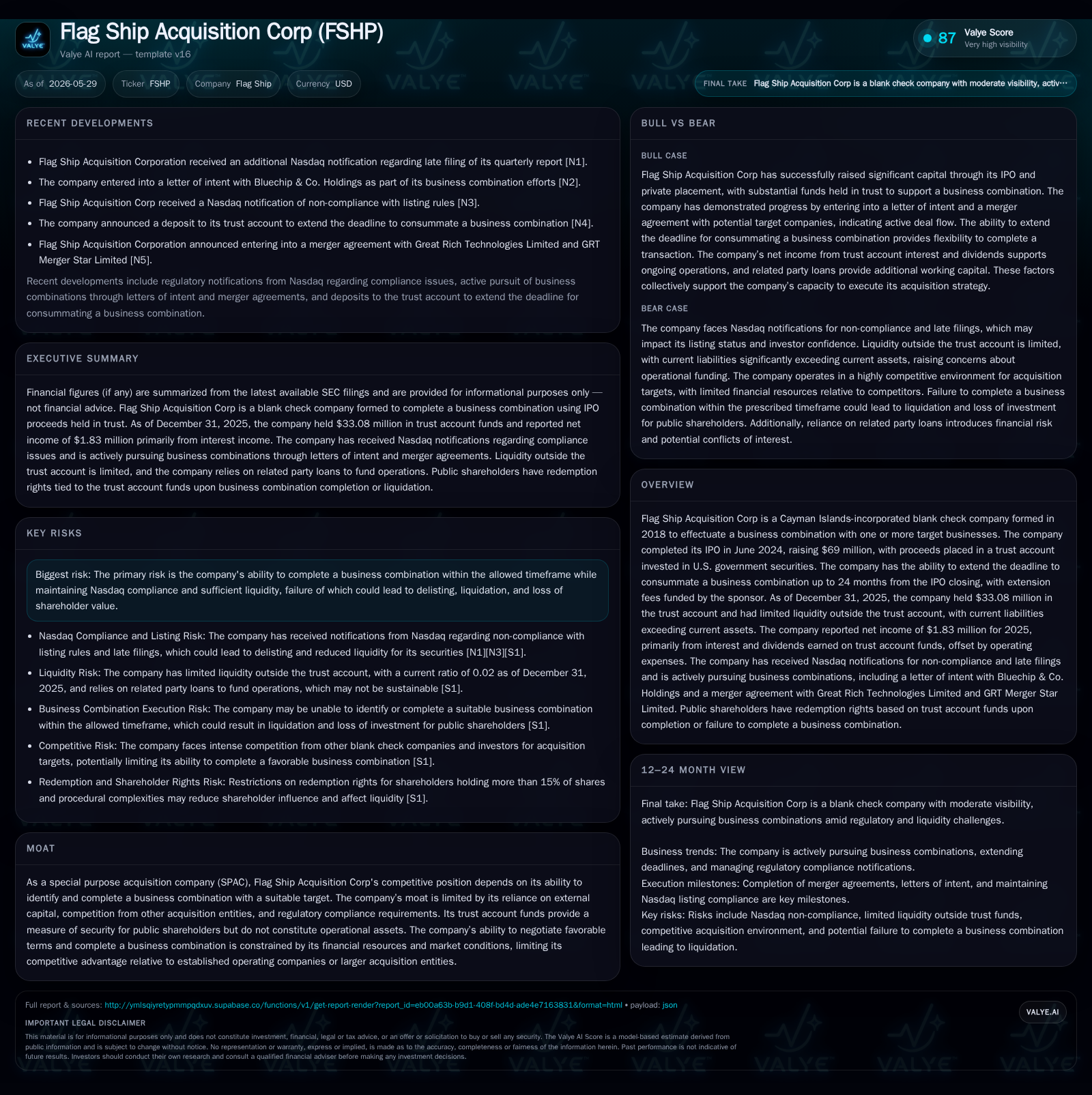
Flag Ship Acquisition Corp (FSHP) recently received additional deficiency notices from Nasdaq due to late filings of key financial reports, heightening risk of delisting if unresolved. As a Cayman Islands-incorporated blank check company, FSHP relies on limited trust account funds chiefly invested in U.S. Treasuries to complete a merger with target businesses, with little operational revenue. The SPAC operates in a highly competitive deal sourcing environment compounded by regulatory complexities affecting prospects for transactions, especially involving China-based entities. Liquidity pressures are evidenced by the company’s very low current ratio driven by liabilities far exceeding non-trust current assets. Key near-term milestones include Nasdaq compliance filings and culmination of the ongoing letter of intent negotiations with Bluechip & Co. Holdings.
Recent Nasdaq Compliance Challenges and Operating Update
Flag Ship Acquisition Corp (FSHP) disclosed on May 21, 2026, receipt of an additional deficiency notice from Nasdaq's Listing Qualifications Department attributing the delay in timely filing its Form 10-Q for the quarter ended March 31, 2026 [S3][N1]. This follows an earlier April 2026 notice regarding late filing of its FY2025 Form 10-K [S3][N3]. Under Nasdaq rules, FSHP must submit a remediation plan within 60 days of the first notice to avoid delisting risks. If the plan is accepted, Nasdaq may grant an exception allowing up to October 12, 2026, for filing completion. These notices do not immediately impact listing but introduce material uncertainty regarding continued compliance and shareholder confidence.
It completed its initial public offering (IPO) in June 2024, raising $69 million net of underwriting fees placed into a trust account invested primarily in U.S. government treasury bills or money market funds [S1]. The trust account funds are reserved for use exclusively upon consummation of a business combination or liquidation event.
The company's operations generate no substantive revenues outside nominal interest and dividends earned on trust account balances [S11]. Operating expenses include administrative costs and fees payable to sponsors who provide extension loans enabling time flexibility to finalize deals [S1][S7]. Public investors have redemption rights at the time of business combination approval or tender offer initiation.
FSHP can extend its deadline to consummate an initial business combination up to 24 months after IPO closing via sponsor-funded monthly extension fees structured as loans repayable only if a combination closes [S1][S22]. This reveals dependency on external capital infusions for sustainment prior to deal closure.
Competitive Environment: SPAC Market Dynamics and Peer Context
In today’s saturated SPAC landscape, Flag Ship Acquisition faces stiff competition from well-established private equity groups, rival blank-check companies domiciled domestically and abroad, as well as emerging private investor partnerships [S1]. Each pursues scarce attractive targets across industries leveraging varied sector expertise.
The company’s Cayman incorporation subjects it to unique regulatory considerations compared with U.S.-based peers. Moreover, recent heightened scrutiny and evolving restrictions around acquisitions involving China-based entities complicate cross-border deal-making strategies [S5]. Regulatory uncertainties arising from cybersecurity reviews and foreign ownership limitations constrain access to otherwise promising Chinese targets or increase transactional risks post-merger.
While FSHP’s trust account balances offer security for public shareholders relative to competitors with weaker reserves, it lacks operational assets or diversified capital sources outside sponsor funding — placing it at a strategic disadvantage versus larger or more liquid peers.
Growth Drivers: Merger Targets, Timing Flexibility, and Capital Deployment
Critical growth hinges on consummating an initial business combination that unlocks valuation uplifts beyond the trust account principal [S1][S6]. On May 8, 2026, FSHP entered into an exclusive Letter of Intent (LOI) with Bluechip & Co. Holdings reflecting progress in negotiations toward a definitive agreement [S6][N2]. This LOI includes exclusivity provisions extending at least ninety days for due diligence completion and contract finalization.
Temporal flexibility afforded by sponsor-funded extension loans mitigates immediate pressure yet imposes cumulative cost considerations reflecting non-operational expense leverage [S22]. Post-merger pathways typically involve capital structure expansions including potential issuance of debt or equity securities enhancing financial optionality for scaling operations or incremental acquisitions.
Deal flow quality remains critical; termination of previous agreements such as those with Great Future Technology Inc. further illustrates deal risk volatility within this sector [S15]. Success depends on sourcing targets aligned both operationally and strategically while satisfying escalating SEC reporting requirements under newly adopted SPAC guidance [S24].
Risks and Constraints: Filing Delays, Liquidity Concerns, and Regulatory Hurdles
The twin specters of ongoing regulatory non-compliance manifested through repeated late filings threaten FSHP’s listing status on Nasdaq—a critical platform for share liquidity and capital access [S3][N3]. Failure to remedy compliance shortcomings could result in delisting actions detrimental to shareholder value.
Liquidity fragility is starkly apparent: excluding trust account holdings earmarked strictly for mergers or liquidation distributions, current assets measured $25 thousand against current liabilities exceeding $1.46 million as of December 31, 2025—yielding an extremely low current ratio near 0.02 indicative of acute working capital stress outside the trust structure [F1]
Operational costs related to legal, accounting, audit compliance coupled with transaction pursuit expenses compound cash burn risk without offsetting operating revenue streams [S7][S11]. Furthermore, mutual termination agreements impose transactional exit costs potentially limiting negotiation leverage moving forward [S15].
Regulatory complexities especially concerning cross-border transactions involving China-based parties heighten execution risk given ongoing governmental policy shifts restricting foreign investment structures like Variable Interest Entities (VIEs) often utilized in offshore listings associated with SPAC mergers [S5].
Milestones to Monitor: Filings, Business Combination Execution, and Nasdaq Review
Key upcoming events provide critical checkpoints: Nasdaq stipulates October 12, 2026 as the deadline for compliance plan acceptance tied to FSHP’s remediated filings status following deficiency notices received earlier this year [S3]. Failure here elevates delisting risk sharply.
Negotiations pursuant to the Bluechip LOI are expected to yield either definitive merger documentation or alternative decisions impacting timelines [S6]. Subsequent shareholder meetings will be required for voting approval which influences redemption dynamics thereby affecting shareholder composition ahead of deal closing.
Closely watching incremental extension loan funding rounds advised by sponsors will reveal management’s assessment on deal viability timelines alongside tangible progress toward strategic milestones involves readjustment if setbacks arise.
Financial Summary: Trust Account Stability, Liquidity Status, and Market Implications
As of December 31, 2025 data demonstrates $33.08 million residing safely within the Trust Account from IPO proceeds awaiting deployment toward business combinations [F1][S11], preserving foundational capital backing public shareholders’ investments.
This analysis incorporates publicly available SEC filings supplemented by authoritative news disclosures without forward-looking investment opinions or research views. Individual investor objectives vary greatly; thorough personal due diligence is advised before engagement with securities connected to SPAC entities such as Flag Ship Acquisition Corp.
Disclaimer: This is research-only, informational analysis and not investment advice. It may include AI-generated interpretation and general industry context. Always verify important details using primary sources.

Comments