
Forefront Tech Holdings Acquisition Corp: SPAC Structure, Interest Income, and the Countdown to a Business Combination
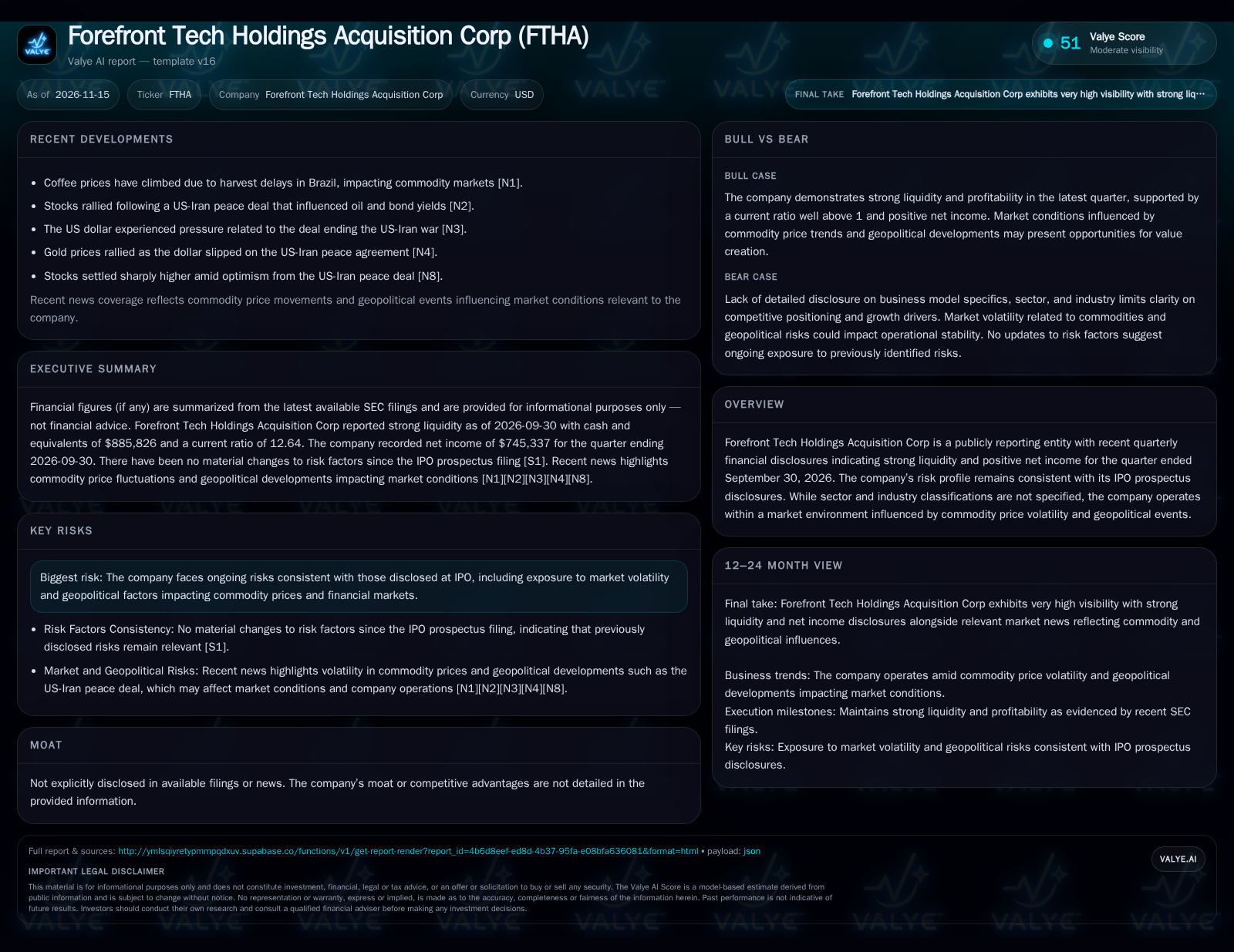
Forefront Tech Holdings Acquisition Corp is an early-stage SPAC with reported liquidity position and positive net income, generated solely from interest on IPO proceeds. With no operations or acquisition target as of September 2026, the company’s future hinges on executing a successful business combination amid shifting market and geopolitical dynamics.
Forefront Tech Holdings Acquisition Corp is a recently IPO’d special purpose acquisition company (SPAC) with $100M+ in IPO and private placement proceeds held in trust. As of September 2026, it has not identified a merger target and reports positive net income entirely from interest on trust account assets. The investment thesis now centers on the SPAC’s ability to find and close a value-accretive business combination before the trust deadline, with macro volatility and sector ambiguity as key uncertainties. [S1]
Forefront Tech Holdings Acquisition Corp sits at the classic crossroads of a newly formed SPAC: flush with IPO proceeds and private placement funds, yet still searching for a business combination target. Its financials as of September 2026 are a snapshot of the SPAC lifecycle—substantial cash held in trust, negligible liabilities, and positive net income derived exclusively from interest on those idle funds. With no operations and sector focus only loosely referenced as ‘technology,’ the real question for investors is whether management can identify and close a compelling acquisition within the required timeframe, particularly as broader market volatility and geopolitical developments inject additional layers of uncertainty. [S1]
Where Forefront Stands: Capital Raised, No Target, and Interest-Only Income
Forefront Tech Holdings Acquisition Corp completed its IPO in May 2026, raising $100 million from public investors plus $3.7 million from a private placement, with $100.3 million placed in a trust account. As of September 30, 2026, the company had not commenced operations, generated any revenue, or selected a business combination target. Its reported net income of $745,337 for Q3 2026 was entirely attributable to interest income on trust assets, offset by modest administrative expenses. The current ratio of 12.64 reflects a typical SPAC balance sheet prior to a transaction, with minimal liabilities and high liquidity. There have been no changes to risk factors since the IPO, underscoring the unchanged nature of the SPAC’s structural and market risks. [S1]
SPAC Economics: Trust Interest, Expenses, and the Clock to De-SPAC
Forefront’s current financial model is emblematic of the SPAC structure: the company generates interest income on IPO proceeds held in a trust account, while incurring expenses related to public company compliance and the search for an acquisition. There is no revenue from operations or business activity until a merger is consummated. The economics are binary: if a business combination is completed, the economics shift dramatically to reflect the acquired company’s operations, capital structure, and deal terms. Until then, value creation for public shareholders is largely a function of the trust value (including accumulated interest) minus expenses, and the ability to secure a transaction that delivers post-merger upside. Capital needs are minimal pre-acquisition, but execution costs and potential redemptions at the time of business combination can materially affect the post-merger cash position.
The interplay between trust account interest income and SPAC expenses is crucial to understanding the pre-merger economics. While interest income accrues passively, administrative costs—such as legal, accounting, and regulatory compliance—are ongoing and non-trivial. If interest rates were to decline materially, the net income generated from the trust could diminish, tightening the financial cushion available to support the search process. Conversely, rising interest rates could enhance trust income, potentially extending the runway or enabling more robust due diligence. This dynamic introduces a sensitivity to macroeconomic factors that investors must consider when assessing the SPAC’s financial resilience prior to a business combination.
Another dimension to the SPAC’s economics is the potential impact of shareholder redemptions on the trust account. Redemptions reduce the cash available at closing, which can constrain the size and potential financial flexibility of the post-merger entity. High redemption levels may force the SPAC to seek additional capital through PIPE financing or sponsor contributions, diluting existing shareholders and complicating deal economics. Therefore, the SPAC’s ability to select an attractive target that minimizes redemption risk is not only a matter of strategic fit but also a critical financial consideration influencing the ultimate value delivered to public investors.
SPACs in 2026: Crowded Field, Unclear Differentiation, and the Hunt for Quality Targets
In late 2026, the SPAC market remains crowded, with many blank check companies seeking targets across sectors, especially technology. Forefront is structurally undifferentiated: it has not disclosed a specific industry focus beyond a broad intention to consider technology targets, nor has it revealed any proprietary sourcing edge, anchor investor, or sponsor track record that would set it apart. The competitive landscape includes other SPACs targeting similar sectors, as well as private equity, strategic acquirers, and direct listings—all vying for attractive acquisition candidates. A significant counterforce is the rising scrutiny of SPAC deal quality, redemption risk, and the market’s skepticism toward speculative or overvalued targets. Without a disclosed target or unique sponsor advantage, Forefront’s ability to secure and close a superior deal is uncertain.
A Compelling Tech Acquisition Could Unlock Value Beyond the Trust
If Forefront identifies and completes a merger with a high-quality technology company—preferably one with strong growth prospects, scalable economics, and public-market readiness—the combined entity could command a valuation above the trust value, generating upside for shareholders. Key confirming evidence would include the announcement of a definitive merger agreement with a credible, well-regarded target, positive market reaction, and low redemption rates at the time of the shareholder vote. Additional signs of success would be the sponsor’s ability to secure PIPE (private investment in public equity) financing at favorable terms, and post-close trading above the redemption price. Falsification would come from failure to announce a target, market skepticism toward the selected company, or high redemptions eroding the post-merger cash position.
Trust Preservation and the Default SPAC Lifecycle—Return of Capital Absent a Deal
The most plausible outcome, given current facts, is that Forefront continues to search for a target while incurring modest administrative and due diligence expenses. If no deal is announced or closed within the SPAC’s permitted timeframe (typically 18-24 months post-IPO), the trust account—including accrued interest, minus expenses—would be returned to shareholders. Confirmation of this scenario would be continued absence of a target announcement, persistently high trust value, and no significant sponsor or investor moves to extend the SPAC’s life. Falsification would occur if a credible acquisition candidate is announced, or if the sponsor seeks and receives shareholder approval for an extension.
Erosion of Trust Value and Sponsor Dilution Risk If the Clock Runs Out or Deal Quality Falters
The principal downside risk is twofold: first, that Forefront fails to identify or close a business combination within the SPAC’s operating window, resulting in the return of trust proceeds to shareholders but with sponsor capital and effort lost. Second, if a transaction is rushed or pursued with a subpar target, high shareholder redemptions could drain trust funds, reduce public float, and leave the merged company undercapitalized or facing market skepticism. Confirmation would involve rising administrative costs, delays or extensions, and weak or controversial target selection. Falsification would be a timely, well-received deal with minimal redemptions and robust post-merger performance.
Thesis-Testing Developments for Forefront: From Target Search to Trust Value
Announcement of a letter of intent or definitive agreement with a credible business combination target—preferably in technology.
Shareholder redemption rates at the time of any merger vote, as high redemptions can significantly impact the post-close cash position.
PIPE financing commitments or strategic investor participation in connection with a business combination, if disclosed.
Administrative and due diligence expenses relative to interest income, as excessive costs could erode trust value.
Extension requests or amendments to the SPAC timeline, which may signal difficulties in securing a deal.
Any disclosed sponsor or management actions that suggest a differentiated sourcing capability or sector focus.
Broader market and sector-specific volatility that could affect deal terms, investor appetite, and target quality.
Disclaimer: This is research-only, informational analysis and not investment advice. It may include AI-generated interpretation and general industry context. Always verify important details using primary sources.

Comments