
Veea’s Edge AI Platform: Scaling Ambition Confronts Commercial Realities
Veea Inc. is striving to carve out a leadership position in hybrid edge-cloud computing with its patented VeeaONE platform, broad product suite, and focus on underserved markets. Despite industry accolades and deep partnerships, the company faces fundamental questions about commercial traction, financial sustainability, and its ability to compete against much larger incumbents.
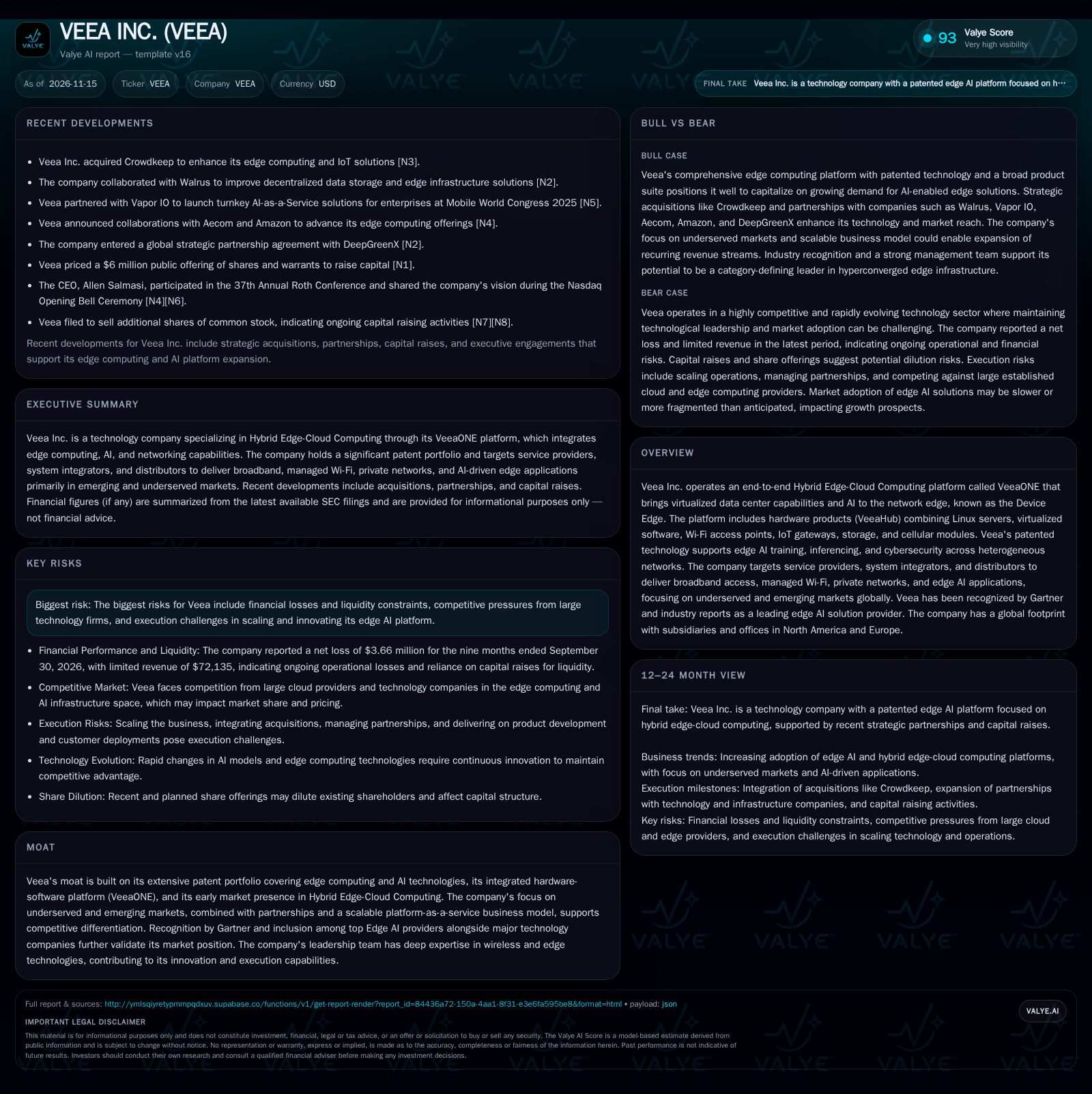
Veea Inc. offers a patented hybrid edge-cloud platform targeting global service providers and system integrators, emphasizing AI at the device edge. Recent acquisitions and partnerships have broadened its technology stack and market reach, but commercial scale remains limited; nine-month revenue through September 2026 was just $72,135, with a net loss of $3.66 million. [S2] [N1] [N3] [N5] [N7] [N8]
Veea Inc. stands at the intersection of edge computing and AI, aiming to deliver data center-grade capabilities at the device edge through its VeeaONE platform. The company has built a robust patent portfolio and forged alliances to enhance its technology and market access, particularly in underserved global regions. Yet despite industry recognition and a management team with deep wireless expertise, Veea’s commercial impact so far is nascent: revenue remains minimal, net losses persist, and repeated capital raises underscore the challenge of scaling a complex platform business in a competitive landscape dominated by tech giants. The critical question is whether Veea can translate technical promise and strategic partnerships into sustainable, profitable growth.
Recent Partnerships, Patent Strength, and Financial Realities Define the Current Stage
Veea Inc. has made several strategic moves in the past 18 months—acquiring Crowdkeep to strengthen its IoT and edge computing stack, partnering with Walrus for decentralized data storage, and collaborating with Vapor IO, Amazon, and Aecom to expand its AI-as-a-Service and edge infrastructure offerings. These developments underscore a push to broaden both technology capabilities and market reach. [N2] [N3] [N4] [N5]
The company’s patent arsenal is notable, with 123 granted patents and 32 pending applications across 26 families, positioning Veea as a technology innovator in edge AI. [S1]
Despite these strengths, commercial progress remains early-stage: for the nine months ended September 30, 2026, revenue was only $72,135, with a net loss of $3.66 million. The balance sheet as of December 31, 2024, showed $1.685 million in cash and equivalents, a current ratio of 1.19, and a cash ratio of 0.12. [S2]
Ongoing capital needs are evident, with a $6 million public offering of shares and warrants and multiple additional share sale filings in the past year. [N1] [N7] [N8]
How Veea’s Platform Could Generate Value—And Where the Economics Are Unproven
Veea’s value proposition hinges on delivering an integrated edge-cloud platform (VeeaONE) that combines hardware (VeeaHub), virtualized software, AI capabilities, and networking into a modular, scalable system. The commercial logic is to offer service providers, system integrators, and distributors a turnkey solution for broadband access, managed Wi-Fi, private networks, and edge AI applications—especially in regions where traditional cloud reach is limited or cost-prohibitive. [S1]
If Veea succeeds in embedding its hardware/software stack at the edge, recurring revenue could emerge from managed services, platform-as-a-service fees, and software subscriptions layered atop initial hardware deployments. However, the current evidence does not establish the prevalence or structure of recurring contracts, nor the mix of hardware versus service/software revenue.
Cost structure in such models typically exhibits high upfront R&D and hardware costs, with the potential for operating leverage if deployments scale and software/services adoption rises. The company’s modest current revenues and continued net losses suggest fixed costs are not yet supported by commercial volume. Capital requirements remain high, as evidenced by ongoing equity raises, which may continue until the business achieves commercial scale.
Defining the Moat: Patent Coverage, Product Breadth, and Market Focus Versus Industry Giants
Veea’s competitive claims rest on a combination of technology differentiation (patent coverage, integrated hardware/software, edge AI support), industry validation (Gartner recognition, inclusion among top Edge AI solution providers), and strategic focus on underserved and emerging markets. [S1]
The company’s approach contrasts with hyperscale cloud providers and large networking incumbents, which typically focus on centralized data centers or standardized edge appliances with global reach. Veea’s modular, device-edge products and open-source AI compatibility could appeal to customers seeking customizable, privacy-centric, or latency-sensitive solutions.
However, the edge computing market is intensely competitive, with well-capitalized firms able to bundle edge infrastructure with cloud, AI, and managed services. Barriers to switching may be moderate if integration and interoperability remain industry norms. Veea’s differentiation will be tested by its ability to secure anchor deployments, demonstrate service reliability, and achieve cost/performance advantages at scale.
If Edge AI Adoption Accelerates in Underserved Markets, Veea’s Platform Could Gain Flywheel Momentum
The most favorable outcome for Veea would be rapid adoption of edge AI and hybrid cloud solutions by service providers, system integrators, and enterprises in markets where centralized cloud is impractical. If Veea’s integrated platform enables faster, simpler, and more secure deployments—backed by its IP portfolio and validated by major reference customers—recurring software and service revenues could begin to outpace hardware sales.
Evidence that would confirm this scenario includes: multi-year contracts with large service providers, a pronounced shift in the revenue mix toward software/services, and a substantial increase in reported backlog or deferred revenue (if disclosed). Announcements of major deployments in smart buildings, construction, or public infrastructure—particularly in emerging markets—would also support the bull case.
A falsification would be continued stagnation in revenue, lack of contract wins, or failure to convert partnerships into material commercial traction.
Slow Traction and Ongoing Capital Needs Characterize the Most Likely Path
Given the current revenue base, persistent net losses, and repeated capital raises, the most plausible scenario is one of gradual commercial progress. Veea may secure pilot projects or small deployments with service providers in targeted regions, incrementally building reference accounts and case studies.
The business may remain reliant on equity financing for the foreseeable future, as operating cash flows are unlikely to cover fixed costs in the near term. Progress would be evidenced by sequential revenue growth, narrowing net losses, and announcements of recurring revenue contracts—even if at modest scale.
Failure to demonstrate meaningful commercial expansion, continued heavy reliance on equity issuance, or an inability to convert partnerships into paying customers would suggest the company is stuck in an extended proof-of-concept phase.
Persistent Commercial Gaps and Capital Constraints Could Force Retrenchment or Strategic Alternatives
The adverse scenario centers on Veea’s inability to achieve commercial scale before capital runs thin. If revenue growth remains negligible despite partnerships and investments, further dilution from capital raises could erode shareholder value and strain management’s ability to maintain momentum.
Competitive pressure from larger incumbents may intensify, making it harder for Veea to win or retain customers. If cash burn accelerates and outside capital becomes scarce or costly, the company could be forced to curtail R&D, delay deployments, or seek a strategic buyer.
Evidence for this scenario would include shrinking cash balances, rising short-term liabilities, missed partnership milestones, or layoffs and cost-cutting measures. A lack of new contract announcements or customer wins, combined with continued net losses, would further confirm downside risk.
Milestones That Will Determine Whether Veea Converts Technical Promise into a Scalable Business
Sequential growth in reported revenue, particularly from software subscriptions and managed services, if disclosed.
Announcements of multi-year or recurring contracts with major service providers, system integrators, or reference customers.
Evidence of successful integration and commercial synergies from the Crowdkeep acquisition (e.g., bundled IoT/edge deployments, cross-selling wins).
Progress in expanding deployments within key verticals such as smart buildings, construction, or public infrastructure, especially in emerging markets.
Updates on backlog or deferred revenue (if disclosed), which would indicate forward visibility and traction with enterprise buyers.
Sustained improvement in operating margin or narrowing of net losses, signaling movement toward breakeven.
Capital raise activity and dilution—frequency, terms, and whether subsequent financings are required to fund operations.
Competitive responses or new entrants in edge AI and hybrid edge-cloud markets, and whether Veea is cited as a credible peer in industry reports or RFPs.
Disclaimer: This is research-only, informational analysis and not investment advice. It may include AI-generated interpretation and general industry context. Always verify important details using primary sources.

Comments